Clear Sky Science · en
The Q10 of in situ microbial soil respiration varies with mean annual temperature, precipitation, pH, and plant cover: a meta-analysis and spatial prediction of Q10
Why soil breath matters for climate
Every handful of soil is alive with microbes that "breathe" out carbon dioxide as they break down dead plants. Because soils store more carbon than the atmosphere, small shifts in this underground breathing can nudge climate change in different directions. This study asks a simple question with huge consequences: how strongly does soil breathing speed up when the world warms, and does that response differ from place to place?
How scientists measure soil’s response to heat
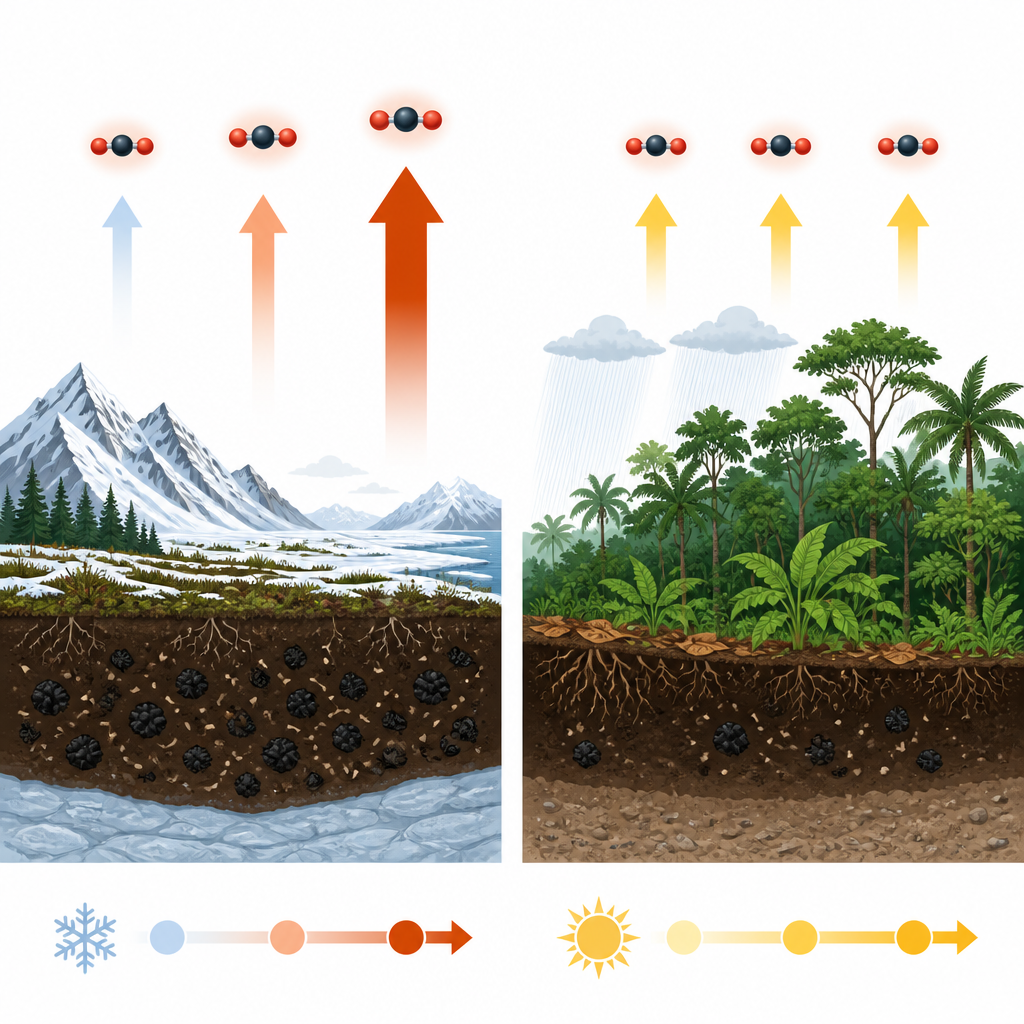
To compare soils from around the world, researchers often use a number called Q10. It tells you how much faster microbes release carbon dioxide when the temperature rises by ten degrees Celsius. Climate models usually assume Q10 is the same almost everywhere, and often give it a fixed value of about two. The authors of this paper suspected that real soils behave less neatly. They gathered measurements of microbial breathing and soil temperature from 104 sites described in 77 field studies, focusing on natural ecosystems rather than farmed fields. For each site they calculated Q10 from how strongly respiration rose with temperature in the field.
Climate and plant cover shape soil breathing
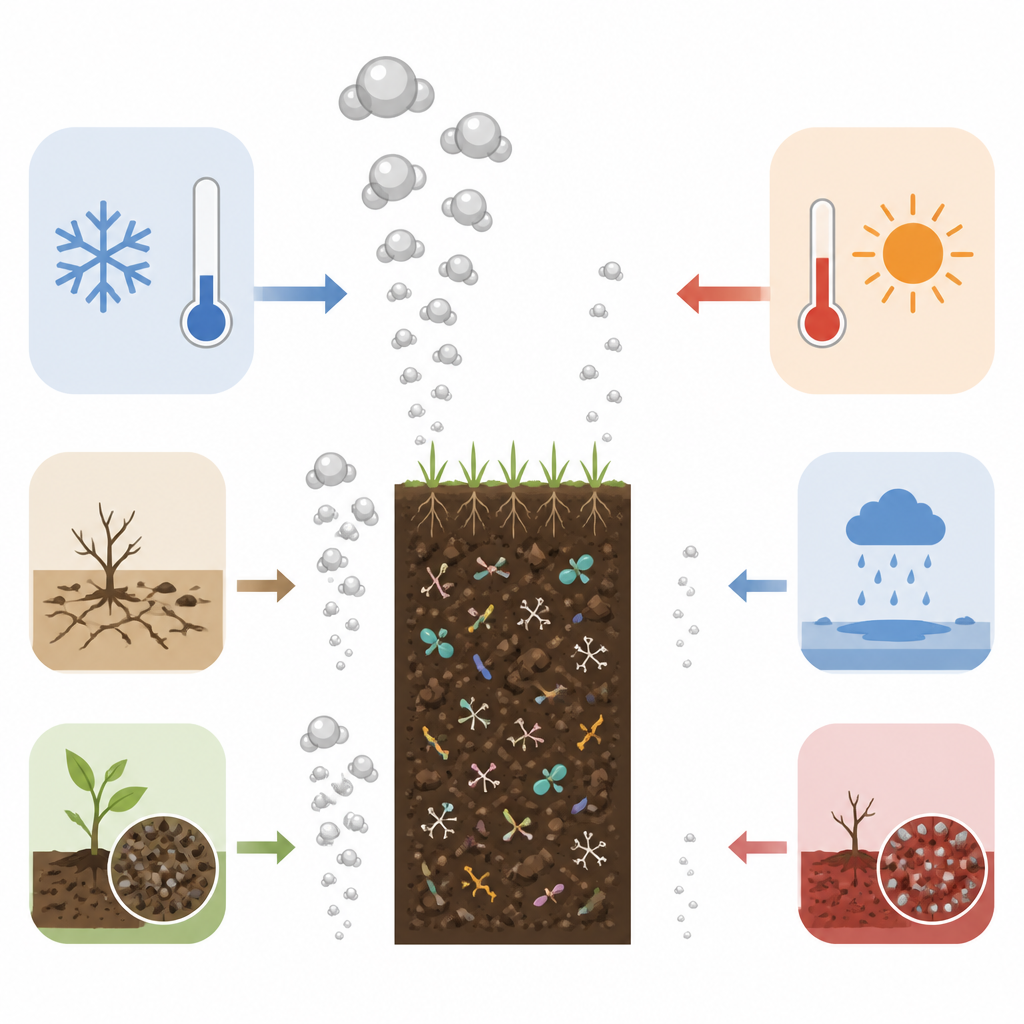
The team then asked how Q10 changed with broad environmental conditions. They found that soils in colder places had higher temperature sensitivity: Q10 was lower where mean annual temperature was high, and higher in cooler climates and at higher latitudes. Likewise, soils in wetter regions tended to have lower Q10 than those in drier ones. Soil acidity also mattered. Sites with higher pH, meaning less acidic soils, showed stronger temperature responses, especially in temperate grasslands. In contrast, the balance of carbon and nitrogen in soil did not show a clear link to Q10 in this global dataset.
Different ecosystems, different risks
Not all plant communities sat on equal footing. When the authors grouped sites by plant cover, they found that mountain grasslands had the highest Q10 values, while tropical moist forests had the lowest. Mountain grasslands are often cool and relatively dry, and their soils contain large stores of carbon that microbes can tap once temperatures rise. Tropical forests, by contrast, are warm and often very wet, so microbes there may already be close to their preferred working temperature, or starved of oxygen by waterlogged conditions. Using the most important climate and soil factors in a statistical model, the researchers built a global map of predicted Q10. It showed especially high temperature sensitivity in high latitude and high altitude regions, including vast permafrost zones where frozen carbon is at risk of thawing.
A closer look at how enzymes respond to heat
The study also tested whether the standard Q10 approach is the best way to describe how soil microbes react to rising temperatures. Many biological reactions do not increase smoothly with heat: instead, they speed up, reach a peak, then slow down as enzymes become less efficient. To capture this, the authors fitted their pooled global data to a more detailed framework called macromolecular rate theory, which accounts for changes in the heat-handling properties of enzymes. When they compared how well this theory and the simpler Q10 model matched the measurements, the enzyme-based approach gave a clearly better fit, even after penalizing it for having more adjustable parameters.
What this means for future warming
Taken together, the results suggest that soil carbon responses to climate change are not uniform across the globe. Soils in already warm, often wet regions may release less extra carbon dioxide under further warming than simple models predict. In colder and drier regions, especially in northern permafrost and mountain landscapes, microbial breathing is much more sensitive to rising temperatures, raising the risk of stronger carbon losses there. The authors argue that climate models should let Q10 vary with local climate, soil conditions, and plant cover, and should consider using enzyme-based temperature responses. Doing so could sharpen forecasts of whether soils act more as carbon sources or carbon sinks in a warming world.
Citation: Hacopian, M.T., Choreño-Parra, E.M., De Araujo, L.H.A. et al. The Q10 of in situ microbial soil respiration varies with mean annual temperature, precipitation, pH, and plant cover: a meta-analysis and spatial prediction of Q10. Sci Rep 16, 15691 (2026). https://doi.org/10.1038/s41598-026-45615-w
Keywords: soil respiration, microbial activity, temperature sensitivity, permafrost carbon, climate feedback