Clear Sky Science · en
Emotion-driven front-end design of NEVs using an improved LSTM with LDA-based emotion mining
Why car faces and feelings matter
When you first see a new car on the road, its front “face” often decides whether you like it or not. This is especially true for new energy vehicles, which compete not just on batteries and range but on personality and style. The study behind this article asks a simple question with a complex answer: how can car makers design the front of an electric SUV so that it reliably feels fashionable, powerful, high tech, or sporty to everyday drivers, rather than just to designers and engineers?
Turning online chatter into clear feeling words
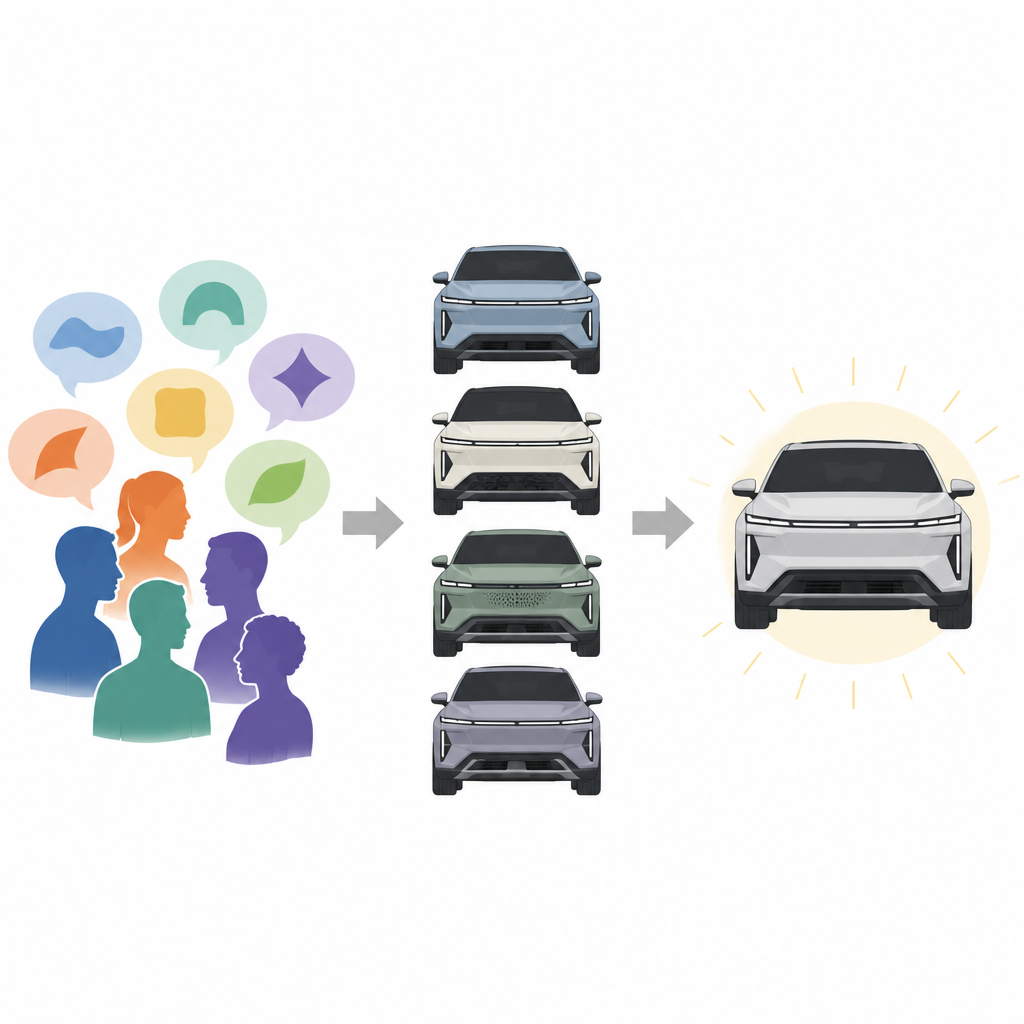
Instead of starting with expert opinions, the researchers went straight to real drivers. They collected more than 27,000 online comments about the looks of pure electric SUVs from major Chinese car forums. After cleaning the text and keeping only words that described appearance, they used a statistical method to uncover the main themes hidden in the comments. Four clear emotional directions emerged: a sense of fashion, a sense of power, a sense of technology, and a sense of sportiness. These four feelings became the basic emotional “map” that the rest of the study is built on.
Breaking car fronts into simple building blocks
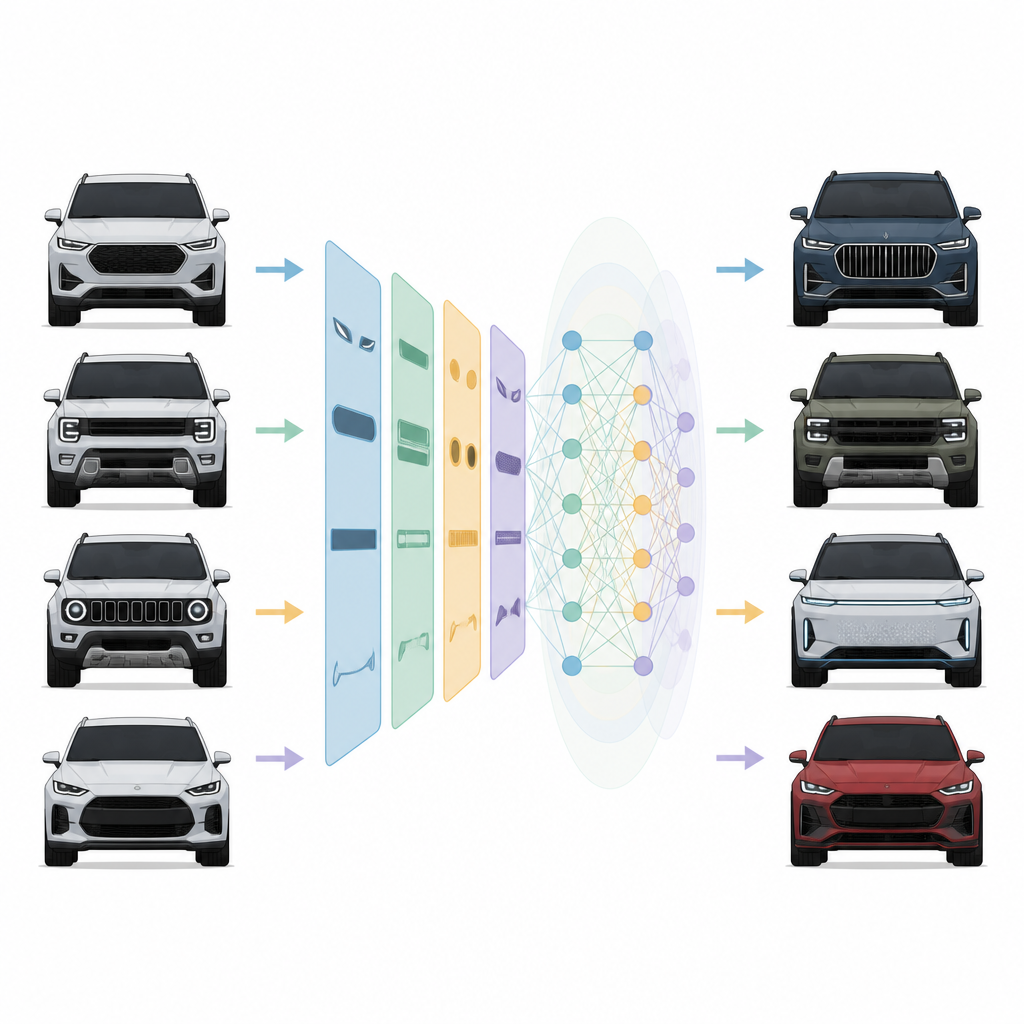
Of course, feelings alone do not tell designers how to move a headlamp or reshape a grille. To connect emotion to shape, the team assembled 90 front-view images of recent electric SUVs and asked design experts to describe their structure in detail. They split each front end into eight main features, such as the flow of the lines, headlamp layout, grille area, air intakes, mirrors, hood lines, and logo position, which together produced 49 specific types. Then, 60 potential buyers rated how strongly each image expressed the four feelings. Using a mathematical screening method, the researchers found that only four of the eight features carried most of the emotional weight: the overall line direction, the headlamp configuration, the lower air intake, and the hood lines.
Teaching a model to feel what people feel
With key shapes and feelings in hand, the team trained a deep learning model to predict emotional reactions from the four core design features. They used a special type of neural network that can learn complex interactions and added an “attention” layer that highlights which feature combinations matter most for each feeling. Because such models can be finicky, a genetic algorithm searched automatically for good settings, like how many internal units to use and how fast to learn. Even though there were only 90 car fronts, the final models matched people’s ratings very closely for all four feelings, with only tiny average errors on the seven point scale used in the surveys.
From feelings to concrete design recipes
Once trained, the system could be run in reverse as a kind of emotional design calculator. The researchers generated more than a thousand possible combinations of the four main features and asked the model to score how fashionable, powerful, high tech, or sporty each one would likely feel. For each feeling, the model pointed to a specific mix of line flow, headlamp style, lower intake shape, and hood pattern as the best match. Designers then sketched and rendered four concept SUV fronts that followed these recipes, one for each target feeling, and presented them to 127 potential buyers for fresh evaluation.
Do the model’s designs actually work?
The final test was simple: would people agree that the “fashion” design really felt fashionable, and so on? When participants rated the four concept fronts, each design scored highest on its intended feeling and clearly above a neutral midpoint. This suggests that the framework can reliably turn vague emotional goals like “more sporty” into concrete front end design choices that many viewers interpret in the same way. For car makers, that means a more direct route from what customers say online to what appears in the showroom, with data guiding the shape of headlights, air intakes, and hood lines so that the vehicle’s face better matches the moods buyers are seeking.
Citation: Yu, C., Qian, Y. & Li, Y. Emotion-driven front-end design of NEVs using an improved LSTM with LDA-based emotion mining. Sci Rep 16, 15786 (2026). https://doi.org/10.1038/s41598-026-45602-1
Keywords: new energy vehicles, car design, user emotions, deep learning, SUV styling