Clear Sky Science · en
Honeybee adaptability to square comb foundation
Bees as tiny master builders
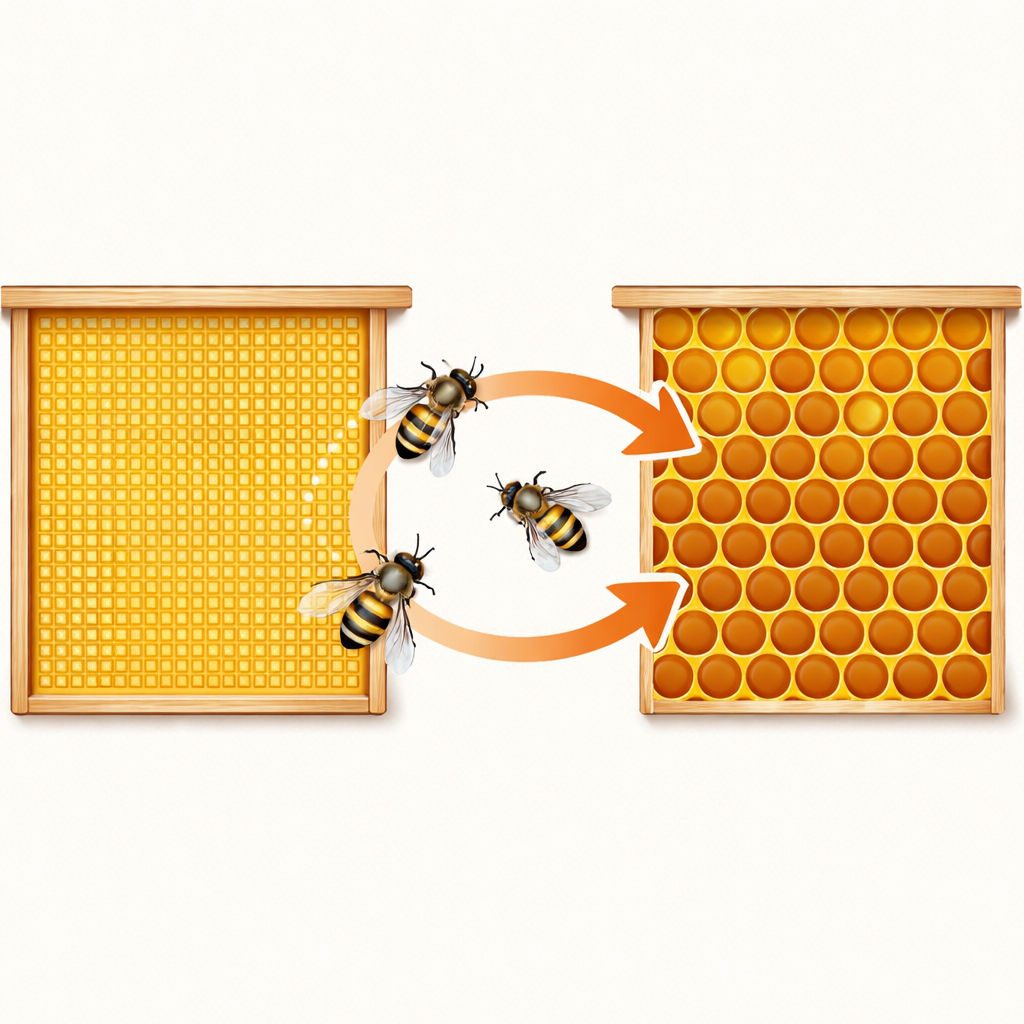
Most of us picture a beehive as a wall of perfect hexagons, each cell neatly packed with honey or brood. This study asks a surprisingly simple question with far-reaching implications: what happens if we give honeybees the “wrong” building plan? By replacing the usual hexagon-patterned wax sheets used in beekeeping with ones carved into squares, the researchers could watch how bees cope with a badly mismatched blueprint—and in doing so, uncover the hidden rules behind their remarkable construction skills.
When the floor plan fights instinct
Modern beekeeping normally starts bees off with thin wax sheets stamped with tiny hexagonal ridges. These pre-made patterns nudge the insects to quickly extend the walls into the familiar honeycomb. In nature, however, bees build from scratch, guided only by simple local cues and their own bodies. To test how strongly those cues matter, the team created custom wax foundations covered not in hexagons, but in tiny square depressions of different sizes and layouts. Some squares were small, others large; some were arranged like offset bricks, others in a perfectly aligned grid. These experimental frames were then placed at the center of active hives on a city rooftop in Sapporo, Japan, where thousands of bees set to work.
Breaking the rules when space is too tight
For the smallest square patterns—2.4 and 4.0 millimeters on a side—the bees treated the foundation almost as if it were a mistake. Over days and weeks, photographs revealed that workers began by scraping away the square ridges, flattening the surface, and seemingly recycling the wax. In their place, they raised new cells that matched their usual preferred size, slightly larger than a bee’s head and hexagonal in outline. The end result looked like a standard comb, with clean hexagon-based symmetry, bearing almost no trace of the original square template underneath. In these cramped square grids, the gaps between opposite sides were simply too narrow for bees to work comfortably inside, so the insects chose to demolish the provided structure and rebuild one that fit their own body-based measurements.
Following the lines when the fit is just right
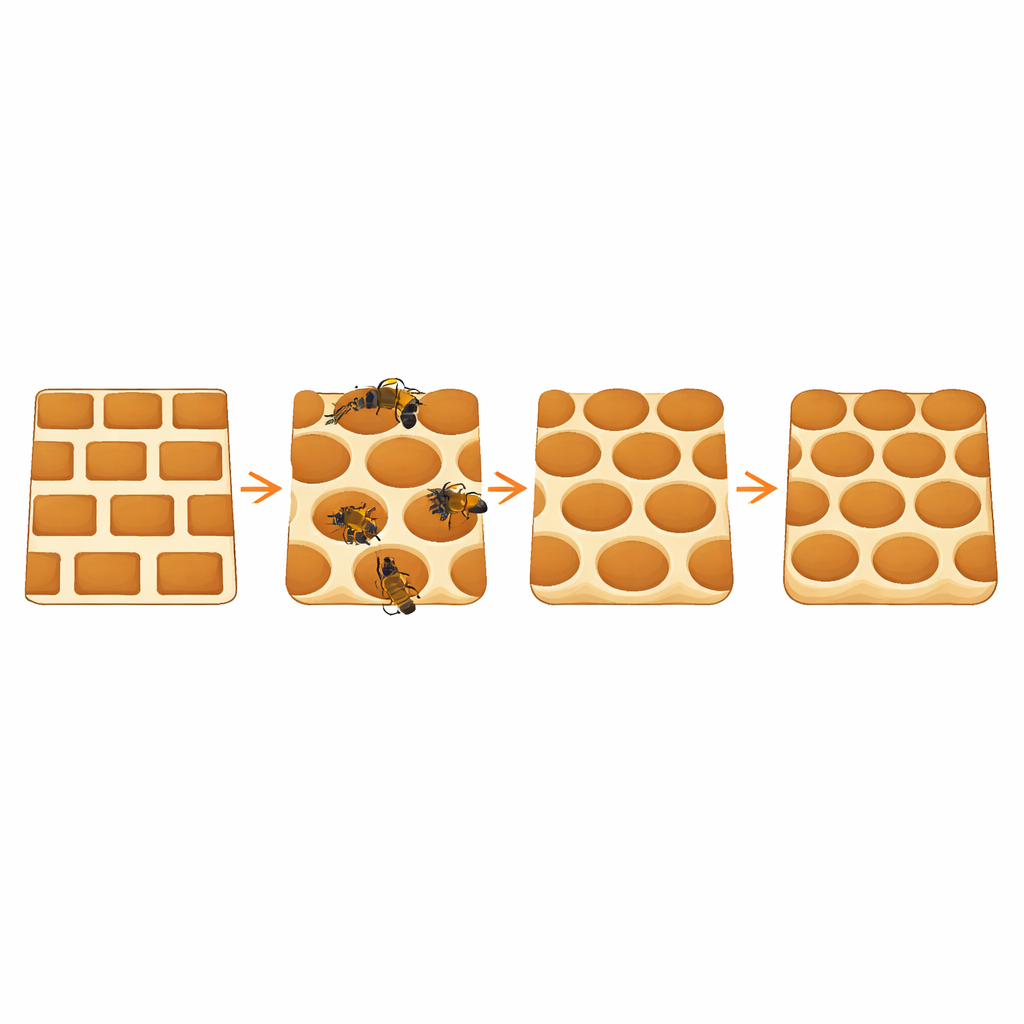
When the researchers increased the square size to 6.0 millimeters, the bees’ strategy flipped. Now the distance between opposite sides of each square came close to the natural spacing bees seem to prefer between cell walls. Instead of tearing the pattern down, the insects piled fresh wax onto the existing square ridges and gradually bent the walls inward. Over time, these curved walls pulled the available space inside each square toward the “comfort distance” bees like to maintain. On foundations where squares were offset like bricks, this process produced rounded cells arranged with an overall hexagon-like symmetry—but with unusually thick walls and small unusable gaps between neighboring cells, reminiscent of densely packed soap bubbles. On foundations where squares met in a perfect grid, the finished cells formed a strikingly different pattern, with rounded chambers lined up in a square-based lattice and tiny bowl-shaped wax structures at the grid corners.
Simple size rules with big consequences
From these observations, the study concludes that bees’ building decisions hinge on a straightforward geometric rule: what matters most is the spacing between opposite walls, not the exact shape stamped into the wax. If that spacing is too small, bees ignore the given pattern, scrape it away, and impose their own preferred hexagon-based layout. If it is close enough to their favored distance, they accept the supplied ridges and adapt them, curving and thickening the walls until the inner space suits their needs. Because this work used just one colony and a limited set of square sizes, questions remain—for example, exactly where the size threshold lies, how it might vary between species or colonies, and which parts of the bee’s body serve as the built-in ruler. Still, the results show that honeybee comb building is not a rigid instinct but a flexible, body-guided craft, able to twist even an awkward square blueprint into a workable home.
Why this matters beyond the hive
To a lay observer, these experiments reveal bees as creative problem solvers, not mindless builders. By deliberately disturbing the usual hexagonal template, the researchers exposed a simple yet powerful rule: bees prioritize comfortable working distances over perfect geometry. This insight strengthens the view that the famous honeycomb pattern emerges from countless local decisions by individual bees, each following low-level guidelines rather than a master plan. Such knowledge can refine computer models of swarm construction, inspire new bioinspired designs for lightweight structures, and help beekeepers understand how colonies respond when commercial foundation sizes are altered. In short, watching bees wrestle with square cells offers a window into how flexible rules and bodily constraints can give rise to the elegant architecture of the hive.
Citation: Shima, H., Hayashi, M.M., Kunieda, T. et al. Honeybee adaptability to square comb foundation. Sci Rep 16, 10816 (2026). https://doi.org/10.1038/s41598-026-45592-0
Keywords: honeybee comb building, hexagonal honeycomb, bee behavior, self-organized structures, bioinspired architecture