Clear Sky Science · en
Comprehensive transcriptomic characterization of two melanoma cell lines with acquired dual resistance to BRAF and MEK inhibitors
Why cancer cells outsmart drugs
Targeted drugs have transformed treatment for many people with advanced skin melanoma, especially those whose tumors carry a faulty BRAF gene. Yet even when two drugs are given together to block this cancer-driving signal, tumors almost always find ways to adapt and start growing again. This study takes a close look inside melanoma cells that have learned to live with such combination therapy, revealing how their inner wiring changes and why different tumors may resist the same treatment in distinct ways.
Looking at cancer messages, not just behavior
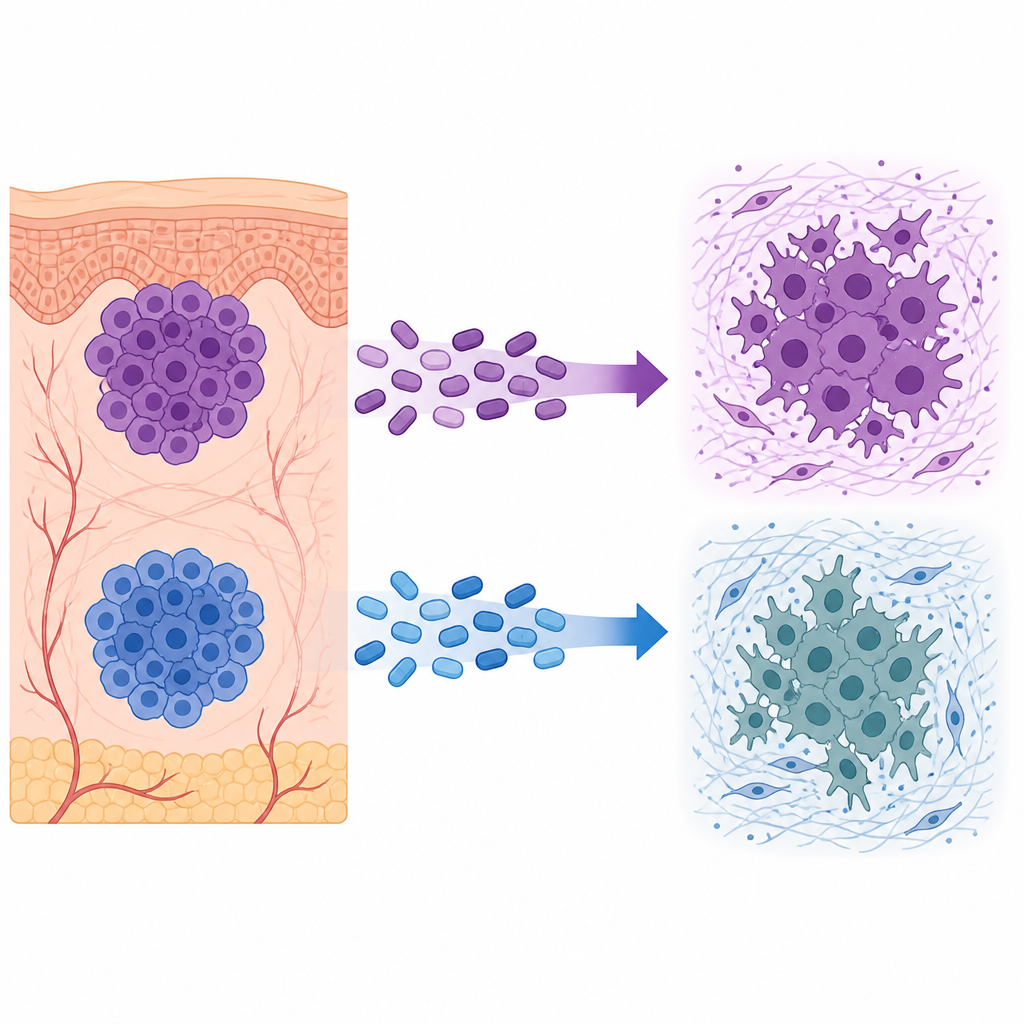
The researchers focused on two human melanoma cell lines, called Hs294T and WM9, both carrying the common BRAFV600E mutation. They gradually exposed these cells in the lab to a pair of targeted drugs that block BRAF and a partner protein called MEK, mimicking how patients receive combination therapy. Once the cells became stably resistant, the team compared them with untreated counterparts by reading out their RNA, the instruction messages that tell cells which genes to turn on or off. This approach, known as transcriptomic profiling, captures early and broad changes in how cells are regulated, beyond what can be seen from proteins or cell shape alone.
One treatment, two different escape routes
When the team examined global patterns of gene activity, resistant cells clearly separated from their drug-sensitive parents, and the two resistant lines also diverged from each other. Both resistant models lost markers of their original pigment-producing identity and ramped up genes involved in building and remodeling the material surrounding cells, such as collagen and other scaffolding components. They also increased markers linked to a more mobile, invasive state, in which cells loosen their attachments and gain the ability to move through tissue. Despite these shared features, many of the genes that changed were unique to one cell line or the other, indicating distinct escape strategies under the same drug pressure.
Inflamed survivor versus shape-shifting builder
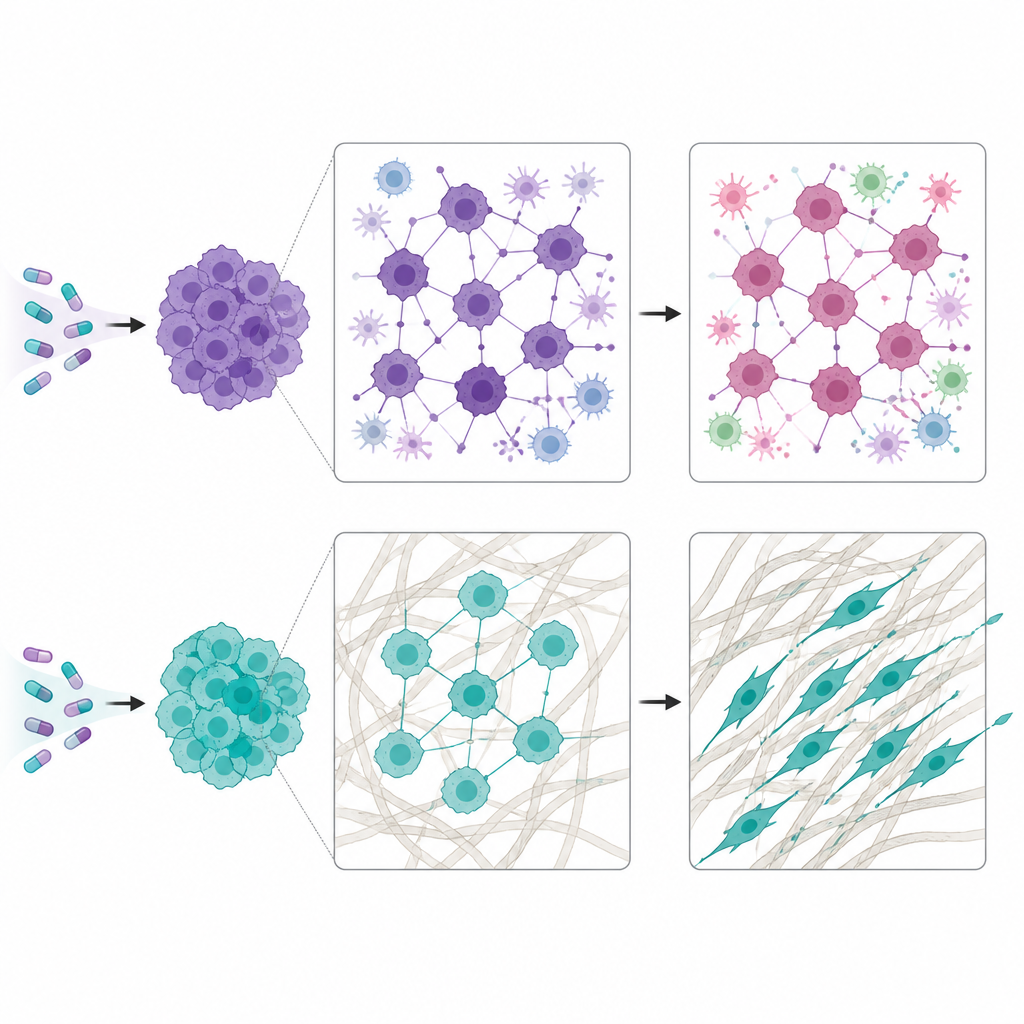
The WM9 resistant cells showed the broader overhaul. Their gene activity pointed to a highly inflamed, stress-hardened state: many immune and inflammatory pathways were switched on, including signals usually driven by molecules like tumor necrosis factor and interferons. Key regulators associated with stress responses and cell protection, such as p53 and NF kappa B, appeared more active, while drivers of rapid cell division were dampened. This pattern suggests that WM9 cells survive by slowing their growth and entering a tough, slow-cycling state that weathers drug attack. In contrast, Hs294T resistant cells changed in a more focused way. Their gene activity concentrated on reworking the internal skeleton and the surrounding matrix, boosting contractile and structural proteins and signaling linked to cell movement and secretion. These cells also showed signs of leaning more strongly on a survival pathway involving the protein AKT.
Hidden coordinators behind resistance
To understand which control switches sit behind these changes, the team used computational tools to infer the activity of transcription factors and enzymes that relay signals inside cells. They found that each resistant cell line relied on a different mix of these regulators. For example, WM9 cells showed activation of p53 and several inflammation-related factors, while both lines showed reduced activity of regulators that normally support immune recognition of cells. The analysis also highlighted shifts in kinase signaling, including differences in proteins such as SRC, ABL2 and AKT2 that are often targeted by existing drugs. Together, these results show that resistance is not governed by a single gene, but by coordinated networks that can vary from tumor to tumor.
What this means for future melanoma care
By mapping how gene activity and signaling networks change in two models of melanoma that withstand combined BRAF and MEK inhibition, the study offers a detailed catalogue of resistance states. For patients, the key message is that tumors can share common themes, like becoming more invasive and less recognizable to the immune system, while still following their own unique paths to survival. This work suggests that reading a tumor’s RNA profile could help doctors spot emerging resistance early and choose drug combinations tailored to the specific escape route that each tumor is taking.
Citation: Kujawa, T., Simiczyjew, A., Kot, M. et al. Comprehensive transcriptomic characterization of two melanoma cell lines with acquired dual resistance to BRAF and MEK inhibitors. Sci Rep 16, 14775 (2026). https://doi.org/10.1038/s41598-026-45586-y
Keywords: melanoma resistance, BRAF MEK inhibitors, RNA sequencing, tumor adaptation, cancer signaling