Clear Sky Science · en
A novel approach for disease and pests detection in potato production system based on deep learning
Why potato health matters to everyone
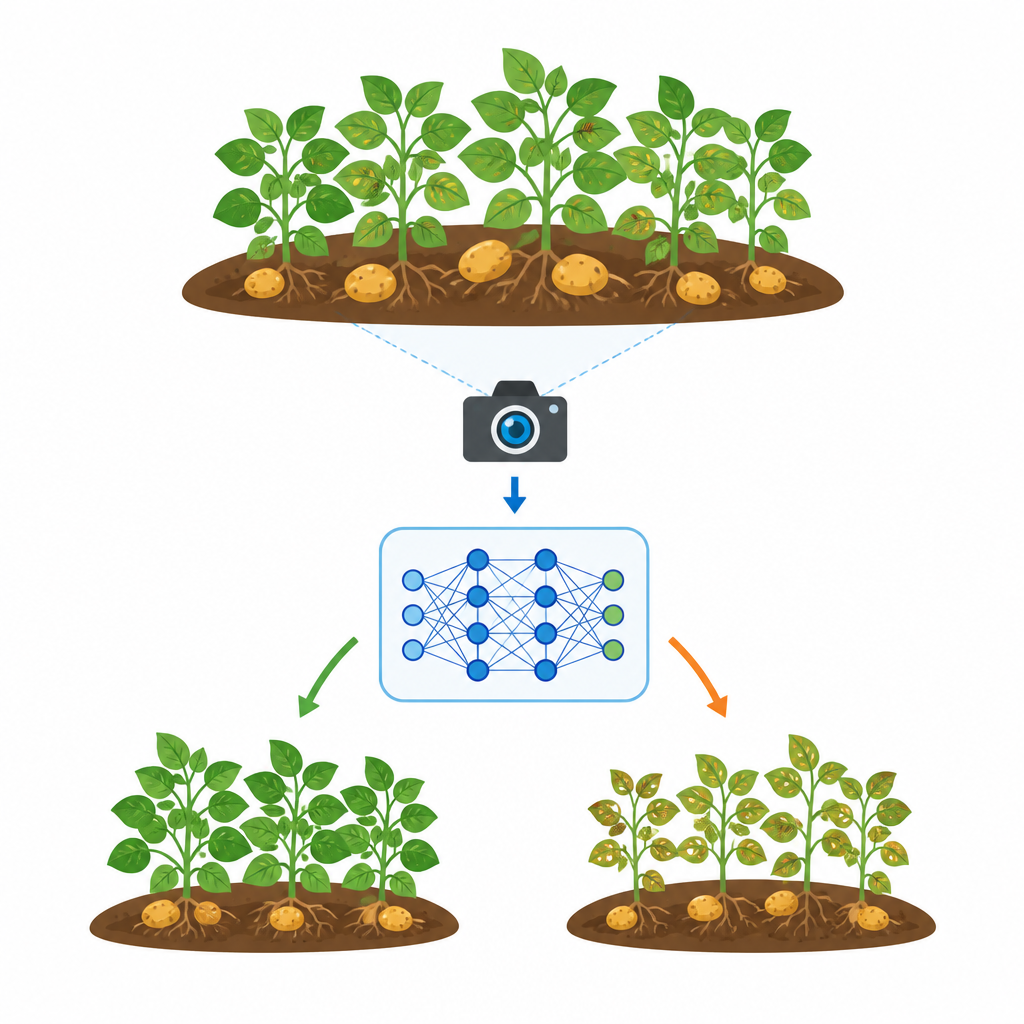
Potatoes are one of the world’s staple foods, rich in energy and nutrients and central to both small farms and large food chains. Yet their leaves are easily damaged by diseases and hungry insects, which can quietly shrink harvests long before problems are spotted by eye. This study explores how smart cameras guided by artificial intelligence can watch potato fields in real time, flag sick plants early, and help farmers protect yields with fewer wasted sprays.
Seeing trouble on leaves in the real world
Out in real fields, spotting what is wrong with a potato plant is harder than it sounds. Different diseases can look similar at first, and tiny insects often hide under overlapping leaves or in deep shade. Farmers usually need expert advice, which costs time and money, and even trained eyes can miss early signs. The researchers set out to build an automatic system that looks at ordinary color photos of potato plants and pinpoints both diseased spots and insect pests as they appear in the field, rather than in neat lab photos of single leaves.
Building a rich picture of field conditions
To make this work, the team first needed a realistic picture of how potato problems look under farm conditions. They collected 2,688 images from two research farms in Pakistan during both winter and summer growing seasons. The camera sat just above the plants so that each image showed leaves along with soil, neighboring plants, and clutter such as straw or pipes. After discarding symptom free images, they kept 2,403 pictures showing four main threats: blight disease, leaf spot disease, leafroll virus symptoms, and the Colorado potato beetle in both larval and adult form. Plant experts carefully drew boxes around each diseased area and beetle so that the computer could learn from these examples.
Teaching computers to find spots and beetles
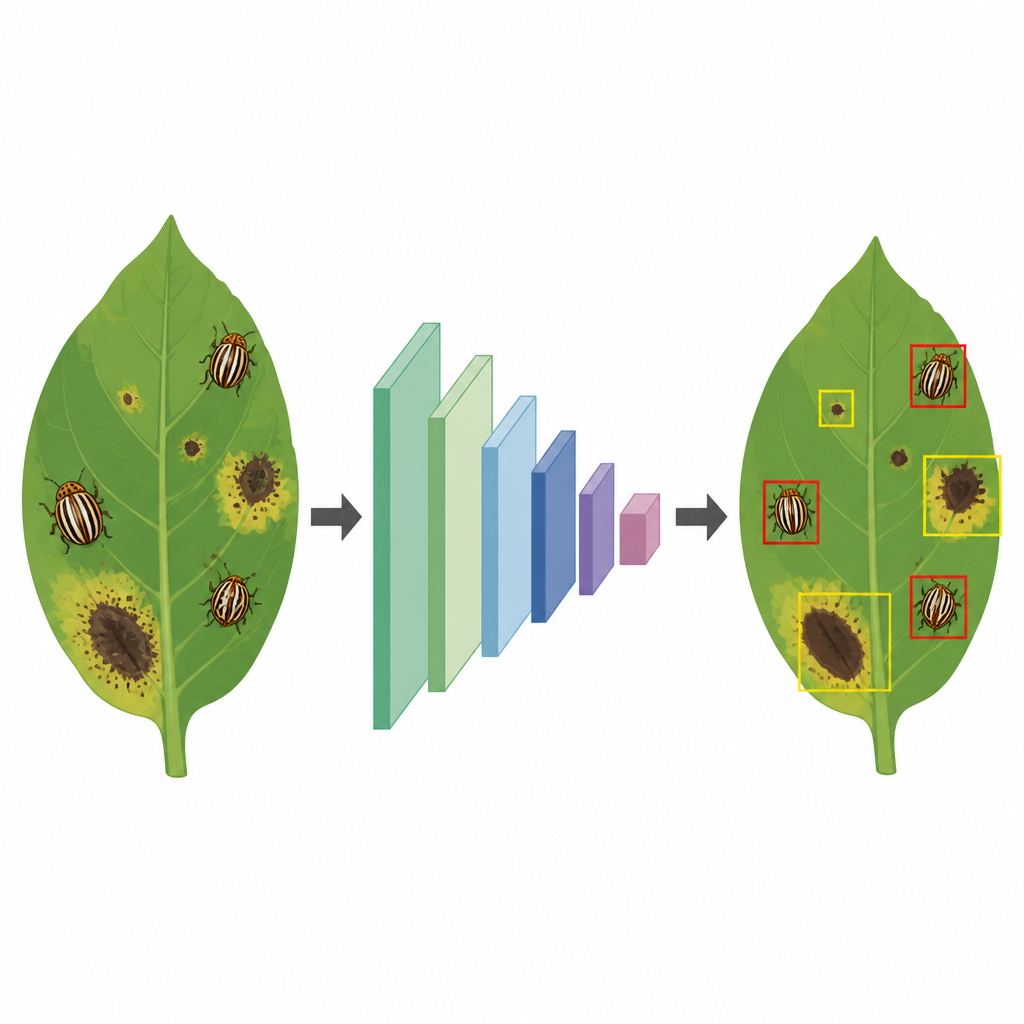
The team trained several modern object detection programs to recognize these problems. These programs, known as YOLO and Faster R-CNN, do not just answer “sick or healthy” but also draw boxes around each patch of disease or each insect. Before training, the images were cleaned, resized, and randomly flipped, rotated, and brightened to mimic different viewing angles and lighting. The key model, a version called YOLOv8-medium, scans each 640 by 640 pixel image in one pass and, using its layered structure, learns patterns of color and texture that distinguish healthy leaf tissue from diseased spots and beetle bodies, even when they are small or partly hidden.
How well the digital scout performs
Across thousands of test images kept separate from training, YOLOv8-medium correctly detected disease patches and beetles with a mean average precision of about 98 percent. It also showed stable behavior when the data were reshuffled in a five fold cross check, suggesting that results are not a fluke of one lucky split. Other versions of YOLO and the older Faster R-CNN model were less accurate or slower. The medium version struck the best balance between speed and correctness, processing an image in only a few milliseconds on a modern graphics card. The system worked especially well for common diseases such as blight and leaf spot, while very small or heavily shaded beetles remained the hardest to catch.
What this can mean for farmers
For non specialists, the core message is simple: a camera linked to a trained computer program can now act as a tireless field scout, watching potato leaves for the main diseases and a key pest with high reliability. The study shows that such a system can run fast enough for real time use, for example on a tractor, drone, or handheld device, and can give precise locations of trouble spots. The authors caution that they tested only two farms in one region and did not include non disease stresses such as drought, so more work is needed before the tool can be trusted everywhere. Still, their results suggest that smart vision systems could one day help farmers apply treatments only where and when they are needed, protecting both harvests and the environment.
Citation: Abbas, A., Rehman, S.U., Mahmood, K. et al. A novel approach for disease and pests detection in potato production system based on deep learning. Sci Rep 16, 15672 (2026). https://doi.org/10.1038/s41598-026-45575-1
Keywords: potato disease, crop pests, deep learning, object detection, precision agriculture