Clear Sky Science · en
PSO-optimized electronic load controller with intelligent energy recovery for self-excited induction generator based micro-hydro systems
Power from Small Streams, Without the Waste
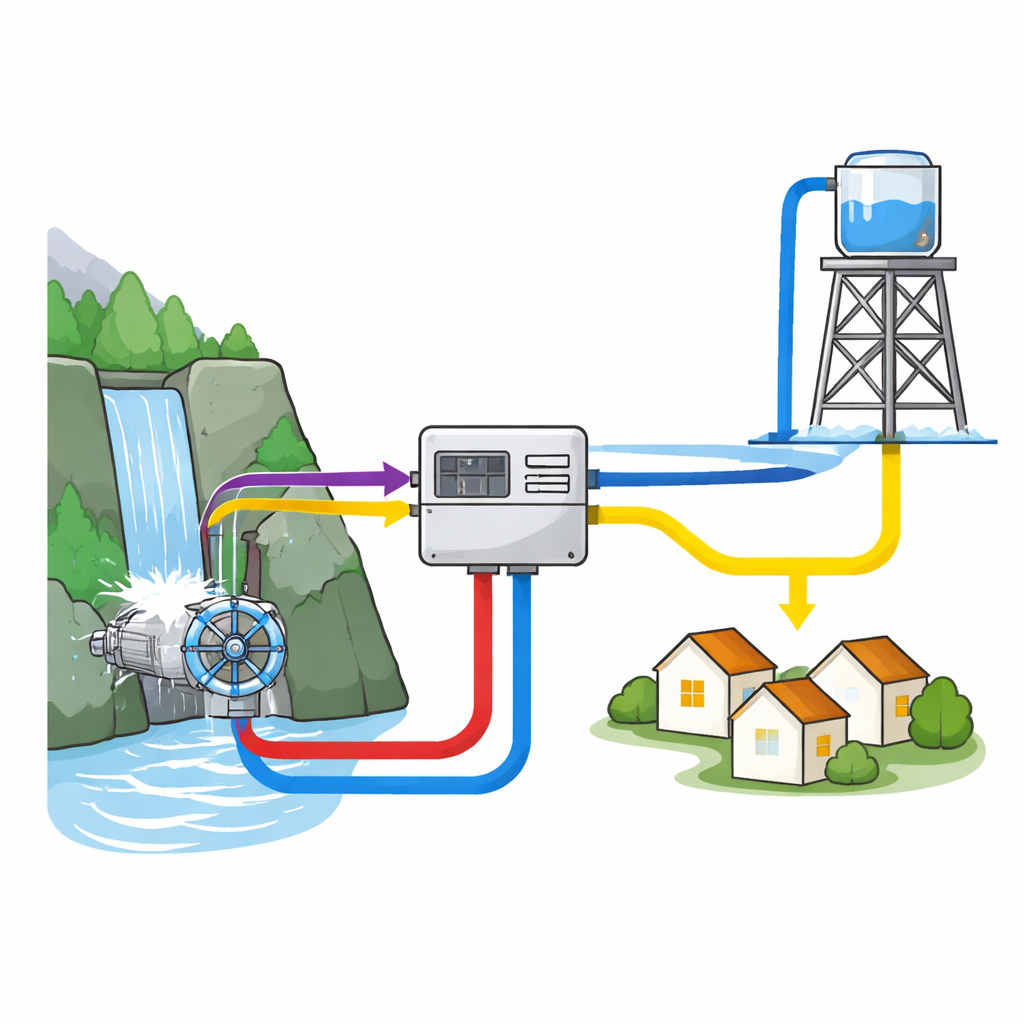
In many remote valleys, small rivers could light homes and pump water, but connecting these places to a national grid is too costly. Micro-hydro systems—compact power plants driven by local streams—offer a way forward, yet they often throw away surplus electricity as heat just to keep voltage and frequency steady. This paper shows how an intelligent controller can both stabilize a tiny power grid and turn that “wasted” energy into useful water pumping, making clean power and clean water arrive together.
Turning Wild Water into Steady Power
The heart of many micro-hydro units is a self-excited induction generator, a rugged machine well suited to harsh sites. Its weakness is that its output voltage and frequency wander whenever people switch lights and appliances on or off, or when river flow changes. Traditional electronic load controllers keep the generator happy by dumping any surplus electricity into big resistors, which simply get hot. That approach wastes as much as 40% of the energy the stream could provide and still leaves voltage, frequency and waveform quality short of modern standards for sensitive equipment.
A Smarter “Traffic Cop” for Electricity
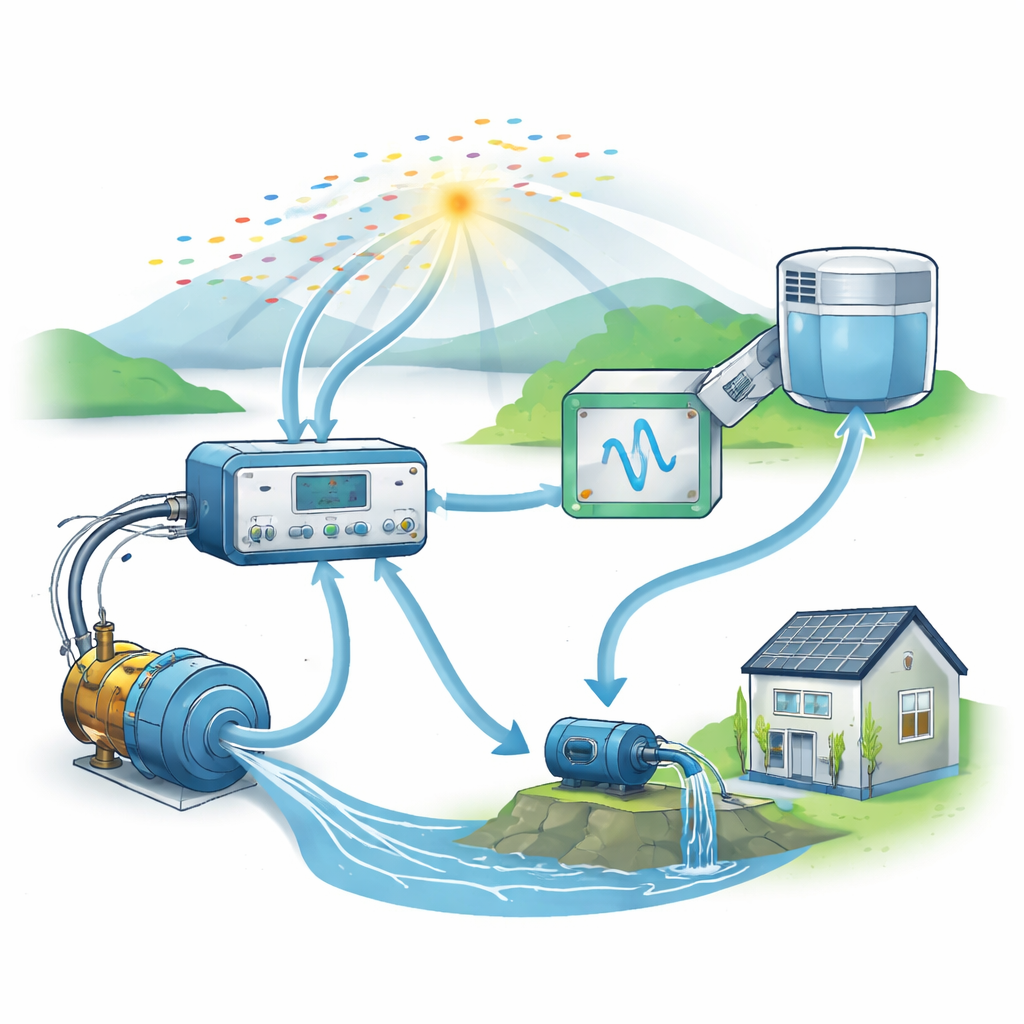
The researchers built a new electronic load controller that behaves more like an intelligent traffic cop than a fixed rulebook. At its core is Particle Swarm Optimization (PSO), a method inspired by how birds flock: many candidate solutions “fly” through a landscape of possibilities, nudged toward better-performing spots. In real time, this swarm tunes key control knobs—such as gains in the voltage and frequency regulators, switching patterns in the power electronics and how much power to send to a water pump. A combined score weighs four goals at once: tight voltage, steady frequency, low electrical distortion and high recovery of surplus energy.
Storing Extra Energy as Elevated Water
Instead of burning off extra power, the system channels it into a motor-driven pump that lifts water into an upper storage tank. When homes draw little electricity but the stream is strong, more power flows to pumping; when demand rises, the controller automatically cuts pump power so homes remain properly supplied. The team carefully modeled the generator, power converters and pump hydraulics to ensure this juggling act stays stable. In laboratory tests with a 2.2 kW setup mimicking a village micro-hydro plant, the controller held voltage within about ±1.8% and frequency within ±0.9%, far better than conventional schemes, while keeping waveform distortion low enough to meet widely used power quality standards.
Faster, More Reliable Decisions from Digital Swarms
Because any advanced controller must run on modest hardware in remote locations, the authors compared PSO with several other popular search methods, including genetic algorithms and grey wolf optimization. Under identical conditions, PSO reached good solutions in roughly half the iterations and within about one millisecond of computing time per update, fitting easily inside the ten-millisecond control window used to generate clean switching signals. Extensive sensitivity and stability studies—both mathematical and experimental—showed that the system stays well behaved when component values, temperatures or operating conditions drift, and that it continues to meet power quality limits in nearly all tested scenarios.
Clean Energy, Clean Water and Real-World Payback
By recovering about 92% of the surplus power through water pumping, the proposed controller almost eliminates the waste inherent in conventional designs. In the test case, this translated to roughly 3.2 million liters of water lifted each year, along with estimated annual savings of more than a thousand dollars and a payback period a little over two years, plus a notable reduction in carbon emissions. Put simply, the work shows that with a dash of digital intelligence, a small mountain stream can reliably power a community and fill its storage tanks at the same time—turning what used to be discarded heat into a valuable source of water security.
Citation: Sinha, S., Rajak, M.K. & Pudur, R. PSO-optimized electronic load controller with intelligent energy recovery for self-excited induction generator based micro-hydro systems. Sci Rep 16, 10862 (2026). https://doi.org/10.1038/s41598-026-45570-6
Keywords: micro-hydro, electronic load controller, particle swarm optimization, energy recovery, water pumping