Clear Sky Science · en
Study on corrosion behavior and mechanical performance degradation prediction of bolts in high mineralized corrosion environment
Why bolts deep underground can quietly fail
Deep underground, steel bolts hold up the roofs and walls of coal mines, keeping tunnels from collapsing on the people working inside. In some mines the surrounding water is packed with dissolved salts, creating a harsh chemical bath that slowly eats away at these hidden supports. This study asks a simple but vital question for mine safety: how fast do these bolts weaken in such conditions, and can a better type of bolt last longer?
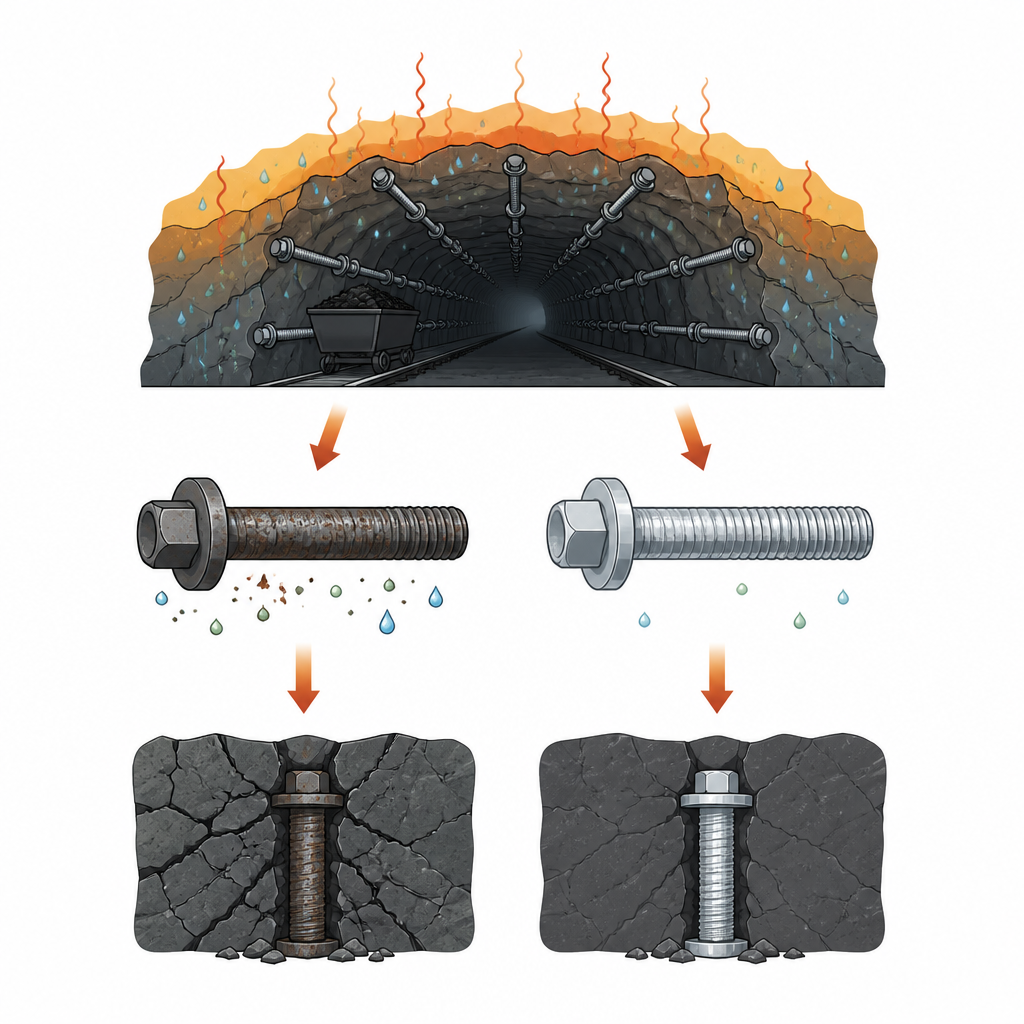
Hidden danger in salty rock tunnels
The researchers focus on “highly mineralized” mine environments, where warm, very humid air and salt rich water combine to attack metal. In these tunnels, steel bolts sit in a thin film of salty moisture rather than staying dry, which greatly speeds up corrosion. The team notes that as mines go deeper, temperatures rise and groundwater slows down, often raising the levels of chloride and sulfate salts. These conditions make bolts more likely to suffer local damage in small spots instead of evenly rusting, so a bolt can look mostly sound yet suddenly snap at a weakened point, risking roof falls and rock bursts in the roadway.
Testing standard and zinc protected bolts
To measure how bad the problem can get, the authors carried out year long soaking tests on two kinds of 20 millimeter steel bolts: ordinary bolts and bolts treated with a zinc rich diffusion coating. They immersed samples in solutions with different amounts of chloride and sulfate ions, alone and in combination, all at a warm temperature. After 365 days they cleaned off the rust, measured weight loss to estimate how deeply the metal had been eaten away, examined the rust with X ray diffraction, and pulled the bolts in a tensile machine to see how much strength they had lost.
How salty water attacks steel and how zinc changes the story
The surface of ordinary steel bolts developed many small, deep pits rather than a smooth rust layer. Chloride proved the most aggressive ion, creating more and larger pits than sulfate at the same concentration. When both ions were present, they competed for spots on the metal surface, so raising chloride made pitting worse, while raising sulfate could slightly shift damage toward more uniform attack. The rust on ordinary bolts was loose and non protective, allowing ions and moisture to keep penetrating. In contrast, zinc treated bolts formed corrosion products rich in zinc compounds that packed tightly, acting like a shield. The pits on these bolts were fewer and shallower, and their strength dropped far less over the same exposure time.
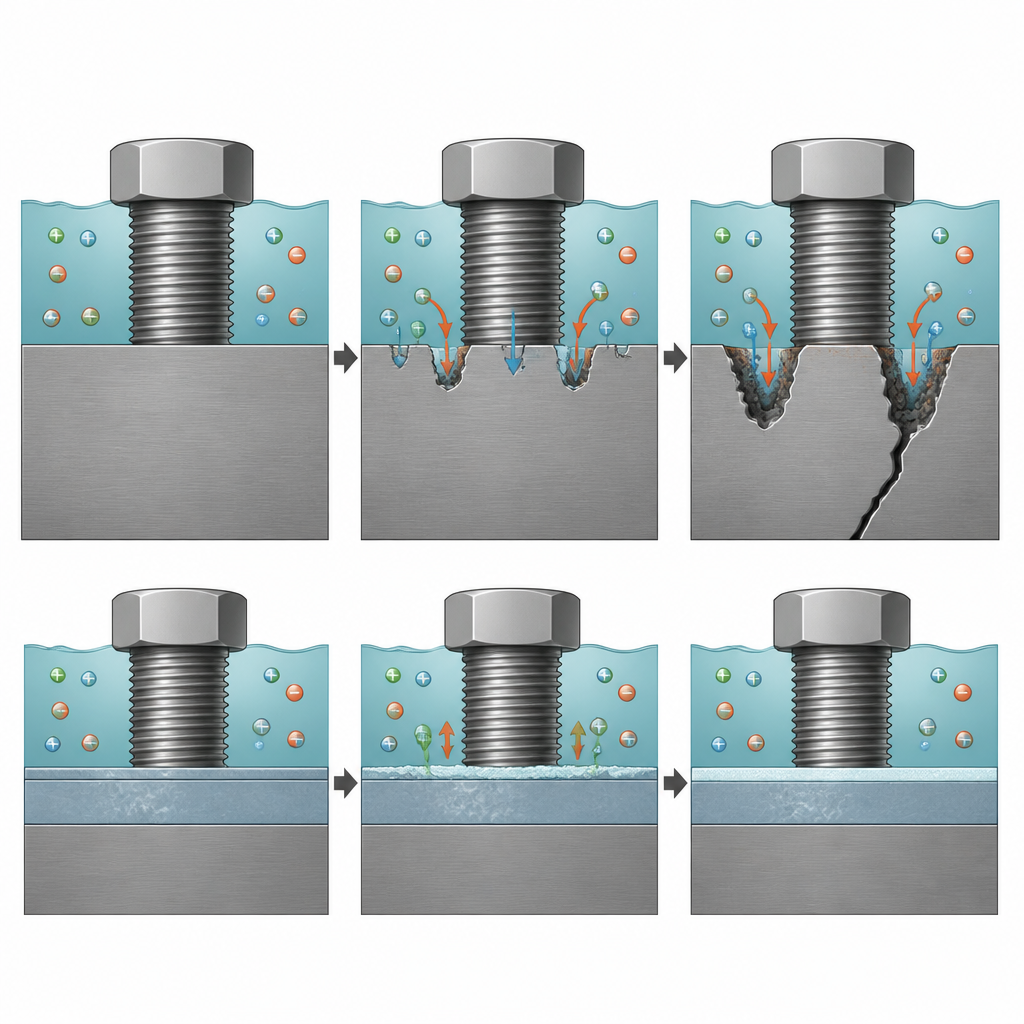
From pits on steel to a clock for strength loss
Because pits act as tiny notches that concentrate stress, the team linked pit depth directly to loss of yield and tensile strength. For the range of damage they observed, strength loss increased almost linearly with average corrosion depth. To turn this into a prediction tool, they built a mathematical model of how pits first appear and then grow over time in chloride rich water, including the influence of temperature. The model treats pit sizes statistically, using a probability distribution that represents many medium sized pits with fewer very small or very large ones. By combining this pit model with their lab data, they derived formulas that express bolt strength loss as a function of chloride level, temperature, and time in service.
What the model says about bolt lifetime
Using their time based model, the authors show that both higher chloride concentration and higher temperature shorten bolt life in a steep, exponential way. For example, doubling the chloride level in the typical range of some Chinese coal mines can cut the expected service life of ordinary bolts by more than half. Warmer rock has a similar but slightly smaller effect. When they compared model predictions with an actual roadway where bolts had been in service for about a year in very salty conditions, the calculated corrosion depth and strength loss closely matched both lab tests and field measurements. This agreement suggests the model can help engineers estimate when bolts are likely to become dangerously weak.
Safer supports for harsh mine environments
To reduce the risk of sudden bolt failures in highly mineralized mines, the study recommends replacing ordinary bolts with zinc treated ones, and using zinc coated plates, mesh, and other hardware so the whole support system corrodes more slowly and evenly. Grouting around the bolts with dense, alkaline materials and adding outer sleeves can further block salt rich water from reaching the steel. Together with better control of mine temperature and ongoing health monitoring of supports, these steps can extend bolt service life and improve the safety of underground tunnels.
Citation: Zhang, J., Li, S., Du, Z. et al. Study on corrosion behavior and mechanical performance degradation prediction of bolts in high mineralized corrosion environment. Sci Rep 16, 14885 (2026). https://doi.org/10.1038/s41598-026-45566-2
Keywords: bolt corrosion, deep coal mining, zinc coated bolts, pitting corrosion, service life prediction