Clear Sky Science · en
Fungal-mediated green synthesis of ZnO–MnO nanocomposites with antimicrobial and anticancer properties
Why Tiny Particles from Fungi Matter
Antibiotic-resistant infections and cancer are two of the most pressing medical problems of our time. Many bacteria no longer respond to common drugs, and cancer treatments can damage healthy tissue. This study explores a surprising helper from nature: a common soil fungus that can build tiny mixed-metal particles. These particles, made of zinc and manganese oxides, were created in a clean, low-waste process and then tested for their ability to stop dangerous bacteria and to harm cancer cells while sparing healthy ones.
Turning a Helpful Fungus into a Nano-Factory
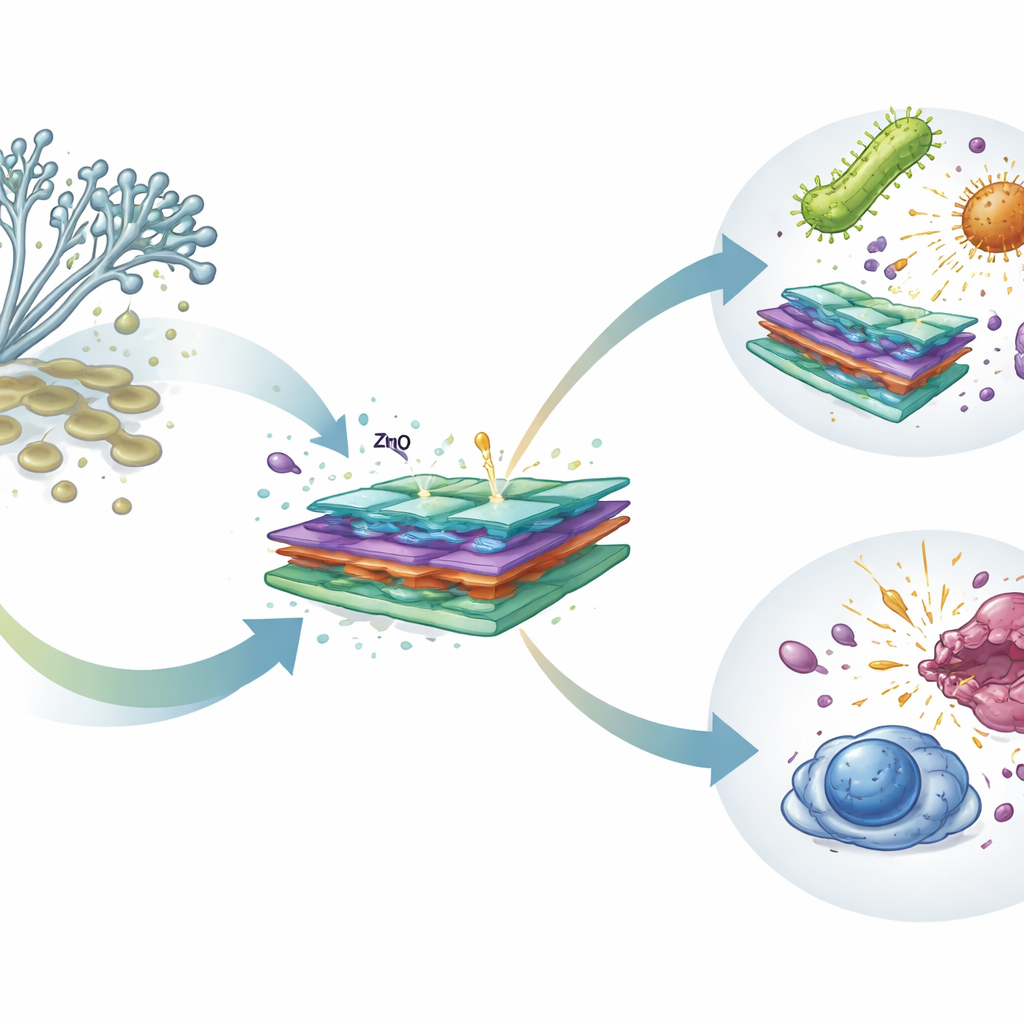
The researchers used the fungus Aspergillus terreus as a living workshop. Instead of relying on harsh chemicals or high temperatures, they grew the fungus in a nutrient broth and then used the liquid surrounding the fungal cells as a reaction medium. When zinc and manganese salts were added to this fungal filtrate, natural fungal molecules acted as both builders and stabilizers, guiding the formation of zinc oxide–manganese oxide nanocomposites. Changes in color and light absorption confirmed that tiny particles had formed. More detailed imaging showed thin, sheet-like layers around 75–100 nanometers across—about a thousand times smaller than the width of a human hair.
Peeking Inside the New Nano-Material
To understand what they had made, the team used several standard tools of materials science. X-ray measurements showed that the final product contained well-ordered crystals of both zinc oxide and manganese oxide, tightly integrated into a single structure. Electron microscopes revealed overlapping plate-like sheets rather than isolated spheres, suggesting a high surface area where chemical reactions can occur. Other tests confirmed that elements from the fungus remained on the surface of the particles. These leftover biological molecules may act like a natural coating, helping the nanocomposites interact strongly with living cells while being produced without toxic by-products.
Fighting Tough Bacteria in the Lab
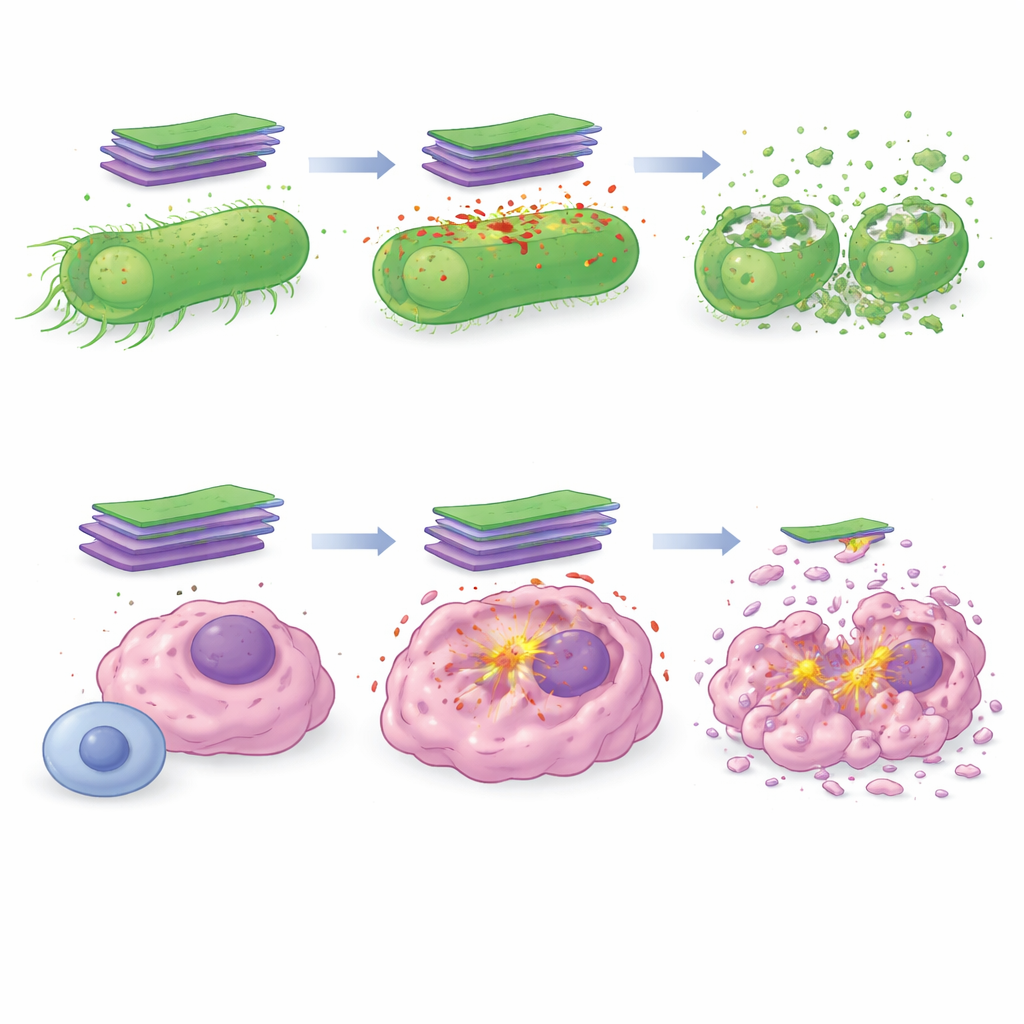
The new nanocomposites were then challenged with several disease-causing bacteria, including Staphylococcus aureus, Escherichia coli, Bacillus subtilis, and Klebsiella pneumoniae. In simple plate tests, the particles created clear, bacteria-free zones, especially around B. subtilis and E. coli. More precise measurements in liquid culture showed that relatively low doses could stop bacterial growth, and somewhat higher doses could actually kill the cells rather than just slow them down. Over 24 hours, the number of live bacteria dropped sharply when exposed to the nanocomposites, particularly at higher concentrations. The authors suggest that the sheet-like particles cling to bacterial surfaces, generate reactive oxygen species, damage membranes and DNA, and disrupt key proteins—multiple attacks that make it harder for microbes to develop resistance.
Targeting Cancer While Sparing Healthy Cells
Because zinc and manganese-based particles have been linked to tumor-killing effects, the team also tested their material on human cell lines. They compared its impact on a normal lung cell line (WI-38) and a breast cancer cell line (MCF-7). The nanocomposites were much more harmful to the cancer cells than to the normal ones: cancer cell growth dropped strongly at doses that normal cells could mostly tolerate. From these data, the researchers calculated a selectivity index of about 3.4, meaning the material was roughly three times more toxic to cancer cells than to healthy cells. This selective action hints that such nanocomposites might one day be tailored into treatments that hit tumors harder than surrounding tissue.
What This Could Mean for Future Treatments
In simple terms, this work shows that a common fungus can be harnessed to build tiny, mixed-metal particles that do double duty: they can strongly inhibit or kill several important bacteria and also slow the growth of breast cancer cells while leaving normal cells comparatively unharmed. All of this is achieved through a process that avoids harsh chemicals and high energy use. While these tests were done in dishes, not in animals or people, they point toward a greener way to design new antimicrobial and anticancer tools. With further testing for safety in the body and stability in blood, such bio-made nanocomposites could become part of a new generation of therapies that are both effective and environmentally friendly.
Citation: Selim, S., Alhujaily, A., Saied, E. et al. Fungal-mediated green synthesis of ZnO–MnO nanocomposites with antimicrobial and anticancer properties. Sci Rep 16, 10842 (2026). https://doi.org/10.1038/s41598-026-45546-6
Keywords: green nanotechnology, antimicrobial resistance, fungal biosynthesis, zinc manganese nanocomposites, anticancer nanoparticles