Clear Sky Science · en
Differential miRNA expression during replicative senescence of dental pulp stem cells with potential for forensic age assessment
Reading Age Clues Hidden in Teeth
How old was this person when they died? Forensic scientists face this question whenever they work with unidentified remains. Teeth often survive fires, accidents, and long periods underground, making them a valuable source of information. This study explores whether tiny molecules found in the soft tissue inside teeth can reveal how “old” cells are, potentially adding a new tool to help estimate age when other methods fall short.
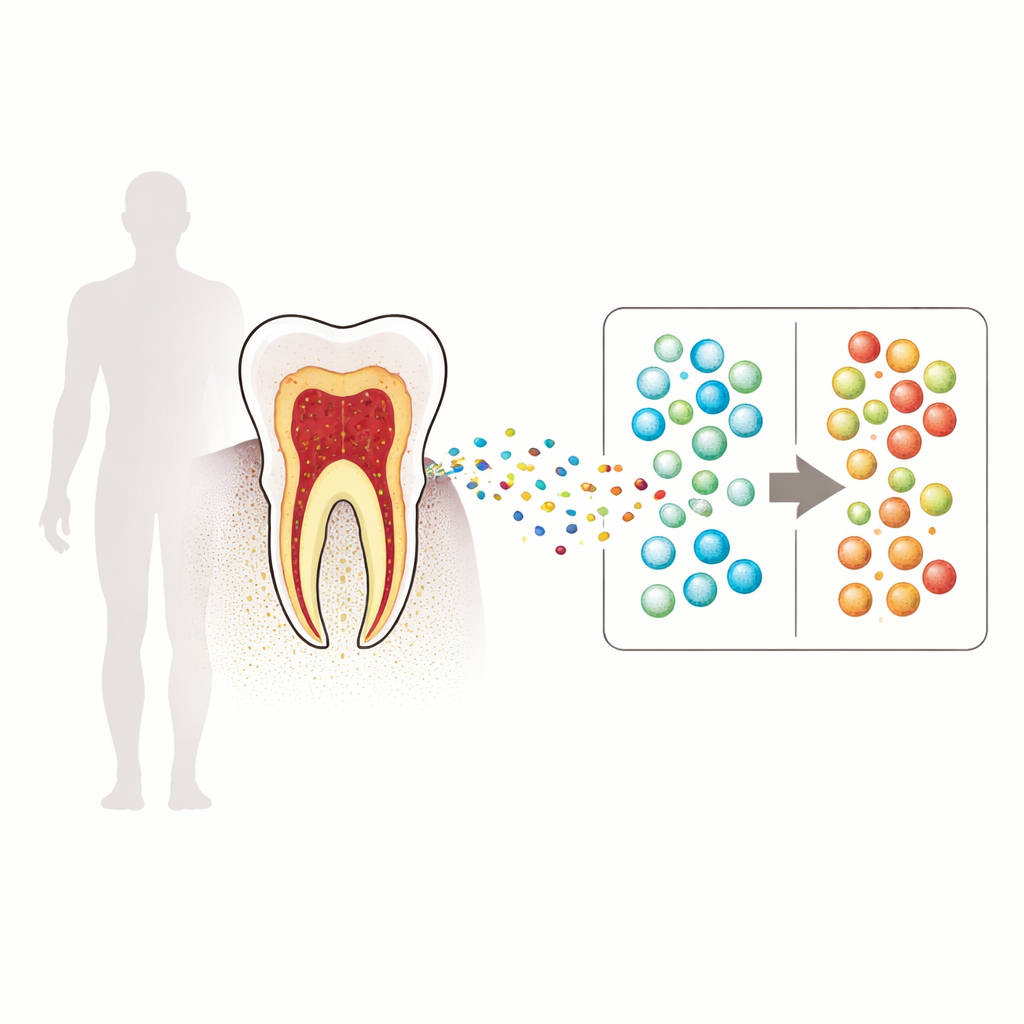
Why Teeth Matter in Forensic Work
Estimating age in adults is notoriously difficult. Classic methods rely on bone and tooth shape, wear, or degeneration, but these traits vary widely from one person to another and are easily distorted by disease or harsh environments. The authors focus on the tooth as more than a hard structure: deep inside lies the dental pulp, a protected pocket of soft tissue rich in living cells. Because this tissue is shielded by enamel and dentin, it can preserve molecular traces long after other organs have decomposed, making it particularly attractive for forensic investigations.
A Cellular Clock Inside Dental Pulp
Instead of targeting the calendar age of a person directly, the researchers look at cellular aging, also known as senescence. Senescent cells are ones that have permanently stopped dividing after accumulating damage or repeated replication. They grow larger, flatten out, change their internal chemistry, and begin to secrete different signals to their surroundings. In this study, the team used dental pulp stem cells—versatile cells taken from the teeth of four young donors—as a controlled model. They pushed these cells toward senescence in three ways: by making them divide repeatedly, by exposing them to ultraviolet light, and by bathing them in hydrogen peroxide, a chemical that generates damaging reactive oxygen species.
Tiny RNA Signals as Age Reporters
The central actors in this work are microRNAs, very short strands of RNA that fine-tune which genes turn on or off. Because they are small and relatively sturdy, microRNAs can often be detected even in degraded samples. The authors tracked eight candidate microRNAs previously linked to aging in dental pulp. As the stem cells grew more senescent, they confirmed the change through classic hallmarks: cells became larger and flatter, and two well-known senescence markers, SA-β-gal activity and the protein p16, rose sharply. Against this phenotypic backdrop, seven of the microRNAs showed clear, repeated shifts: four consistently increased, while three consistently decreased across all three senescence models, forming a recognizable molecular signature of the aged state.
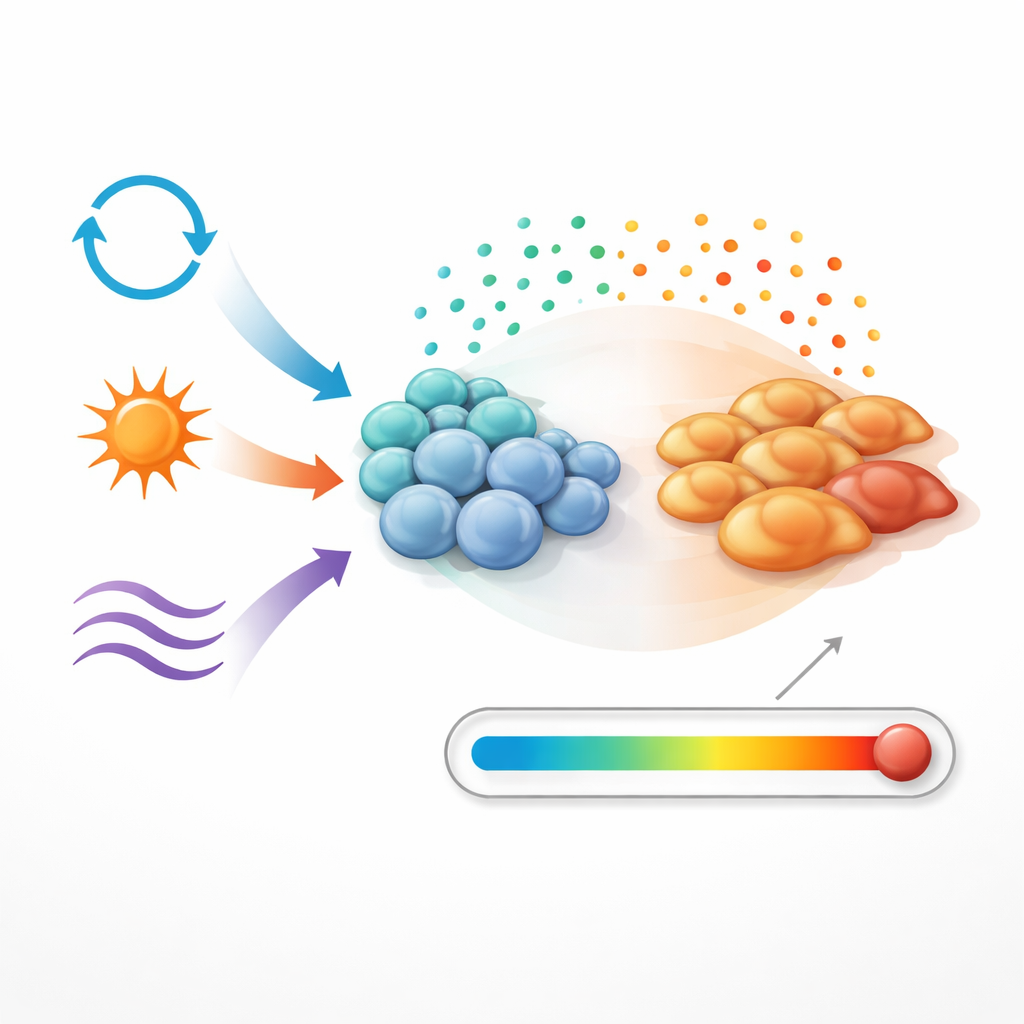
Combining Signals Into a Senescence Score
On their own, each microRNA was only a modest indicator of whether cells were senescent or not. The key advance came from combining them into multivariate panels. Using statistical models common in medical diagnostics, the researchers built “senescence scores” that integrated several microRNAs at once. One four-microRNA panel captured a strong overall signal of senescence, while a simpler two-microRNA panel balanced accuracy with robustness and simplicity. Importantly, when the team examined intermediate conditions—cells partway along the path to senescence—the scores placed them between clearly young and clearly old cells, suggesting that the panels reflect a gradual biological progression rather than a crude on–off switch.
What This Means for Future Forensic Tools
This work does not yet provide a direct formula to turn tooth pulp measurements into a person’s exact age. Instead, it delivers a proof of concept: specific patterns of microRNAs in dental pulp stem cells reliably distinguish youthful cells from senescent ones across different kinds of stress. For forensic science, this points to the possibility of building future tests that use preserved tooth tissue to read out the biological “wear and tear” of cells and complement existing age markers such as DNA methylation. Before such tools can be used in real cases, researchers will need to validate these microRNA panels in whole dental pulp from many people of different ages and under realistic postmortem conditions. Still, the study outlines a clear path toward turning teeth into molecular witnesses of a person’s life history.
Citation: Rojas-Torres, J., Martínez-Durán, L., Isla-Medina, C. et al. Differential miRNA expression during replicative senescence of dental pulp stem cells with potential for forensic age assessment. Sci Rep 16, 10937 (2026). https://doi.org/10.1038/s41598-026-45537-7
Keywords: forensic age estimation, dental pulp stem cells, cellular senescence, microRNA biomarkers, teeth in forensics