Clear Sky Science · en
Leaky recombinant expression reveals design constraints of bicistronic synthetic operons in Escherichia coli
Why tiny leaks in gene switches matter
Biotechnology relies heavily on bacteria as microscopic factories to make medicines, enzymes and research tools. Engineers often wire several genes together so they switch on at the same time. This study shows that such multi-gene designs can behave in surprising ways: even when the switch is supposedly off, some genes refuse to stay quiet. Understanding where these unwanted “leaks” come from is crucial for safer and more reliable bio-based production.
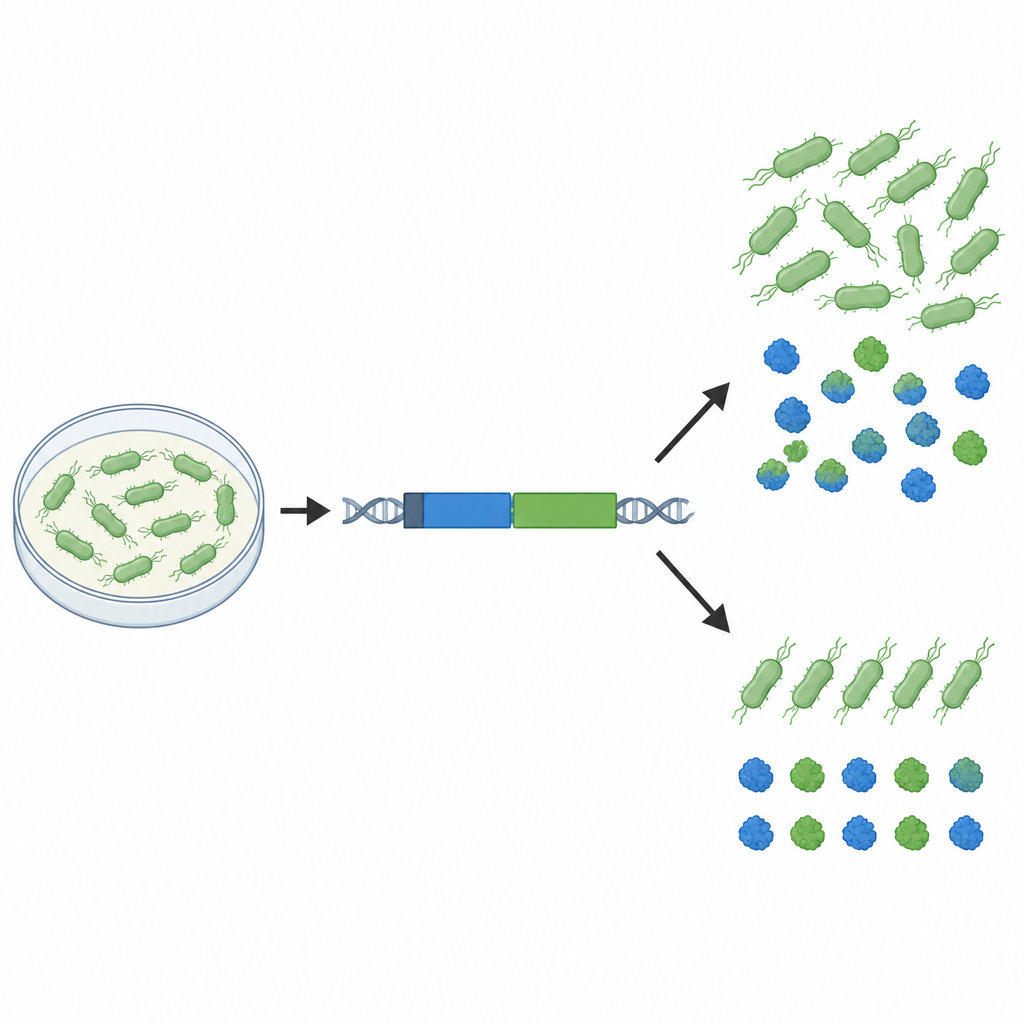
Building a two gene safety lock
The researchers worked with the bacterium Escherichia coli, a standard workhorse in laboratories and industry. They built a “bicistronic” cassette, meaning two genes are placed one after the other and controlled by a single on-off signal. The first gene produced a bright green marker protein, while the second made an enzyme that protects the cells from the antibiotic chloramphenicol. The idea was simple: cells should only survive in the presence of the antibiotic when the green protein is deliberately switched on with a chemical trigger. In theory, this couples cell survival directly to productive protein making.
When off is not really off
Things did not go as planned. Even without the trigger, cells carrying the two gene cassette could still grow in antibiotic, suggesting the resistance gene was active when it should have been silent. To check whether this was caused by the usual powerful viral enzyme used in this expression system, the team repeated the experiments in a strain that completely lacks this enzyme. Surprisingly, the same leak appeared. They then replaced the resistance gene with a red fluorescent protein and measured green and red signals in single cells. Across several cassette layouts, the downstream gene was consistently more active than the upstream one, revealing a hidden source of expression that did not depend on the main external switch.
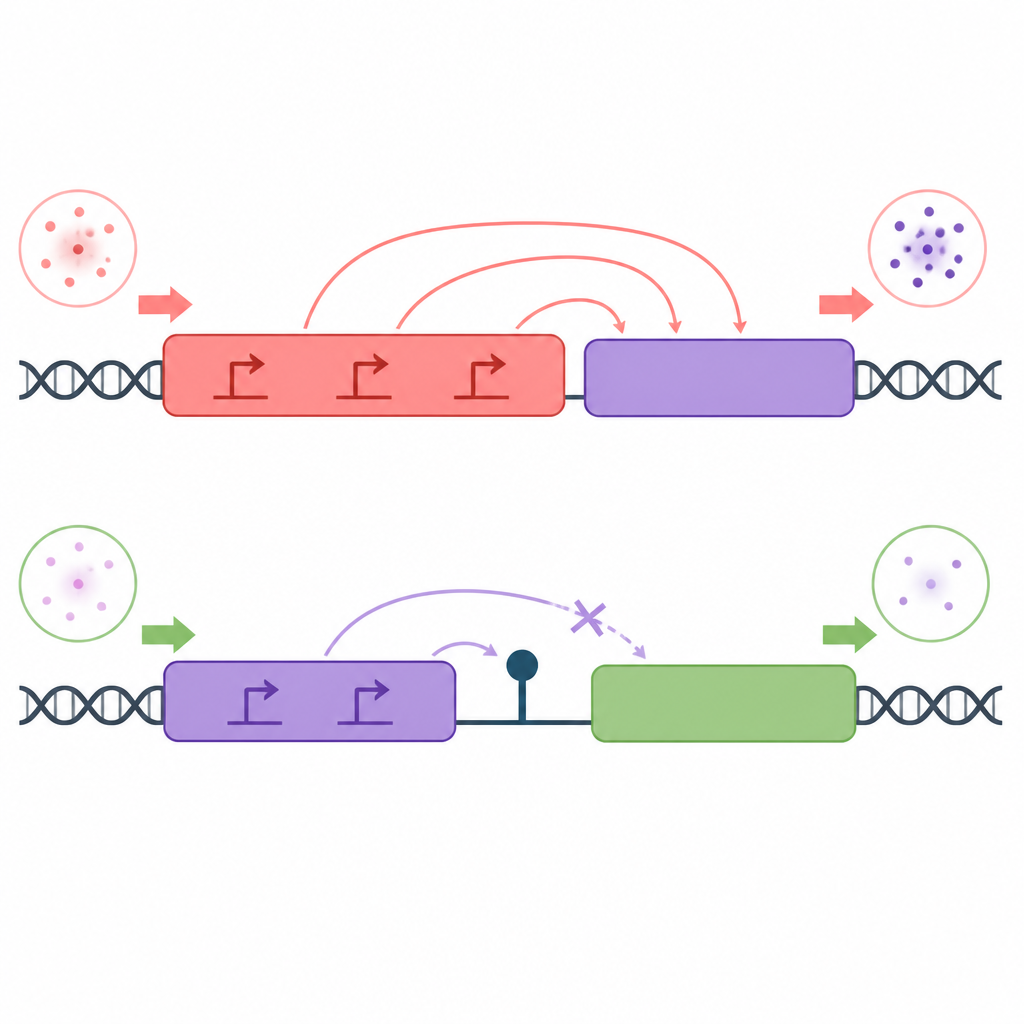
Hidden starts buried inside the DNA
To track down the cause, the authors searched the gene sequences with design software that predicts natural binding sites for the bacterium’s own transcription machinery. They found several “internal” start regions buried within the upstream green fluorescent protein gene. These extra start sites can launch their own RNA copies that contain only the downstream gene, bypassing the intended control region entirely. In other words, the structure of the two gene cassette itself creates an unexpected shortcut that turns the second gene on at a low but meaningful level. This explains why cells showed antibiotic resistance even when the main switch should have been off.
Rewiring the cassette to tame the leak
The team then tested ways to plug these leaks while keeping the system useful. In one strategy, they weakened the translation signal in front of the resistance gene, which had only a modest effect. In another, they inserted a transcription “stop” signal between the two genes to cut off internally started RNA before it reached the resistance gene; this substantially delayed growth in antibiotic. Finally, they flipped the order of the two genes so that the resistance gene sat upstream, in a region with fewer internal start sites, and gave it a weak translation signal. In this layout, uninduced cells could no longer grow in antibiotic at all, both when the cassette was carried on a plasmid and when it was integrated as a single copy into the bacterial chromosome.
Trade offs between control and output
When the researchers compared protein production under full induction, they found that single copy, genome integrated systems made less green protein than multi copy plasmids, and that any two gene cassette produced less of the reporter than a single gene cassette. Some of this drop came from the additional burden of making a second protein, and some from the more complex layout of the genetic construct. These trade offs show that designers must balance tight control, resistance to leaks and overall productivity when wiring multiple genes together in bacteria.
What this means for future genetic tools
This work highlights that multi gene designs can hide internal start sites that quietly switch genes on, even when all known control elements appear to be in the off position. For applications that require strict safety or precise timing, such as toxic proteins or strong selection systems, ignoring these hidden promoters can undermine the entire design. By systematically testing layouts and adding elements like internal stops or reordered genes, the authors show how to turn a leaky two gene cassette into a reliable “addiction” system in which cell growth truly depends on the intended product. Their findings encourage genetic engineers to treat internal transcription as a central design constraint rather than an afterthought.
Citation: Gutmann, S., Tauer, C., Wagenknecht, M. et al. Leaky recombinant expression reveals design constraints of bicistronic synthetic operons in Escherichia coli. Sci Rep 16, 15850 (2026). https://doi.org/10.1038/s41598-026-45533-x
Keywords: E. coli protein expression, bicistronic operon, leaky gene expression, synthetic biology design, recombinant protein production