Clear Sky Science · en
Predictive modeling and experimental validation of mechanical–microstructural relationships in 3D-printed Onyx–fibre composites
Stronger parts from homegrown 3D printers
Many people now own or use desktop 3D printers, but turning these machines into tools for real aircraft, drones, or robots requires plastics that are far stronger than the usual hobby materials. This study explores how to combine a tough nylon-based plastic called Onyx with hair-thin carbon and glass fibers, then uses experiments and computer models to show how printer settings can be tuned to get the best mix of strength, stiffness, and flexibility from these advanced 3D-printed parts.
Building with plastic and threads of strength
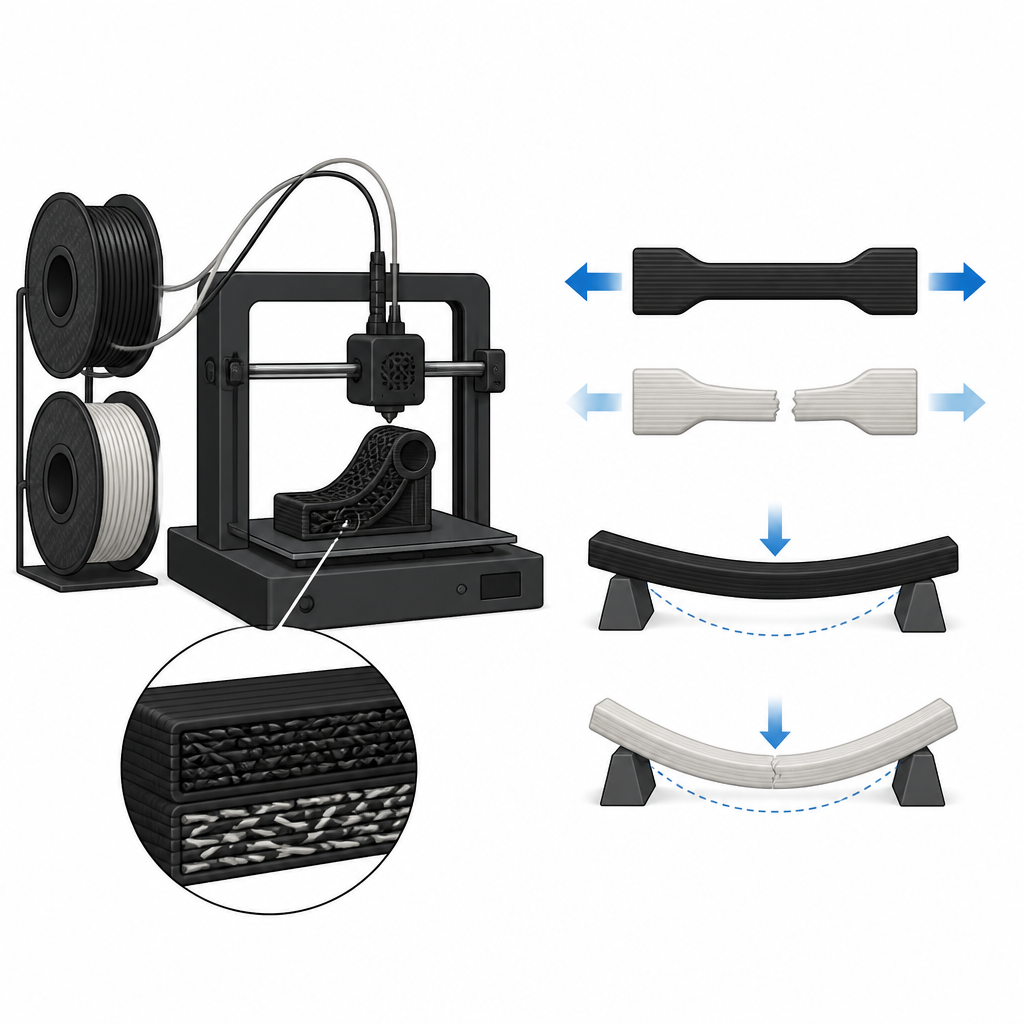
The researchers worked with a commercial printer that lays down two materials at once: the Onyx plastic and continuous strands of carbon or glass fiber. These fibers act like the steel bars in reinforced concrete, carrying most of the load while the plastic holds everything together. They varied how full the part was on the inside, how many layers of fiber were included, how much of the cross-section the fibers occupied, and the direction in which the fibers ran. Test pieces were then pulled and bent according to international standards to measure how strong and stiff the printed composites really were.
How print patterns and fiber choices change strength
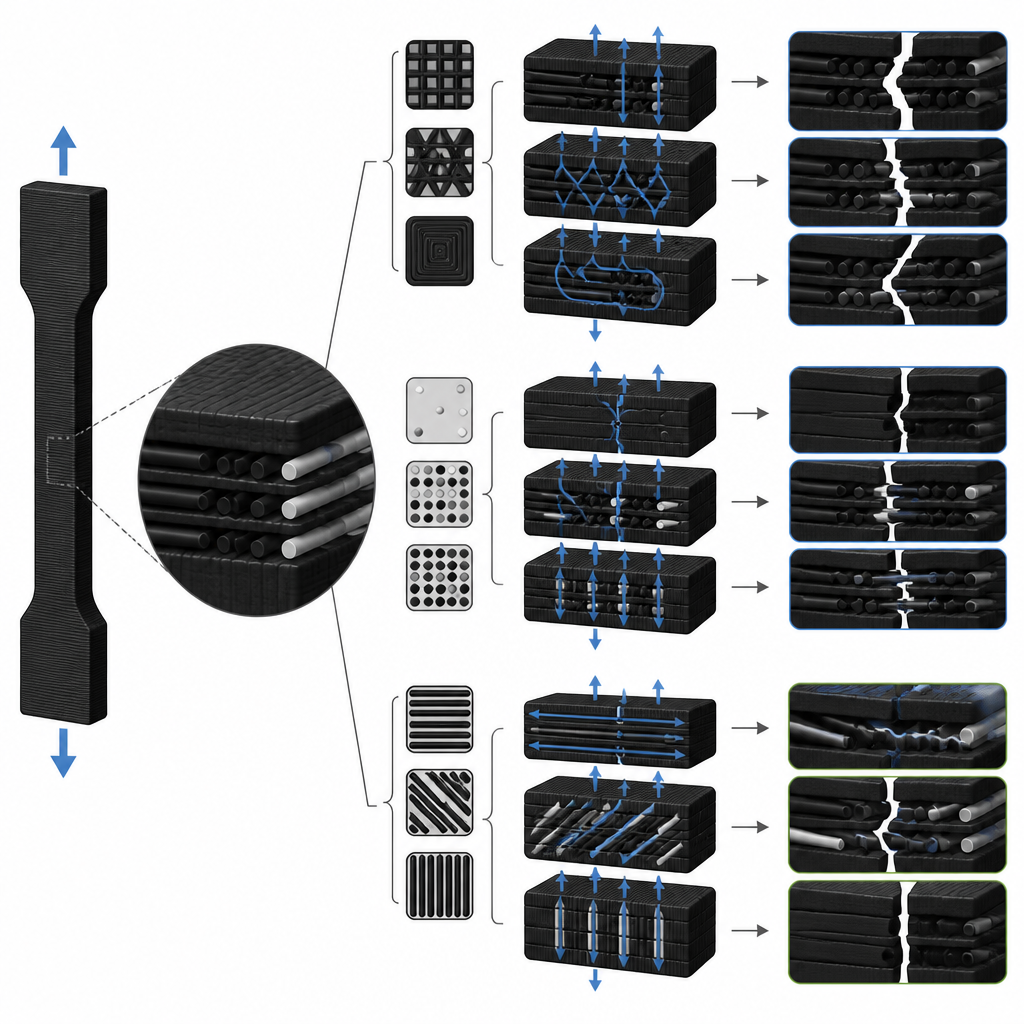
The team found that parts reinforced with carbon fibers were much stronger and stiffer than those with glass fibers, but they also broke in a more brittle way. The best carbon-fiber design reached a tensile strength of about four times that of plain Onyx, while also withstanding heavy bending loads. In contrast, glass-fiber parts carried smaller loads but stretched more before breaking, which can be useful when some flexibility is desired. The internal pattern used to fill the parts played a key role: a flowing, three-dimensional “gyroid” pattern spread stresses smoothly and gave the highest strengths, while a simple rectangular grid created weak spots where cracks could begin.
Teaching computers to predict 3D-printed performance
Because testing every possible combination of settings would be costly and slow, the authors used a structured plan of 27 carefully chosen print recipes to cover the design space efficiently. They then trained machine learning models to learn the links between printer settings and measured properties. A linear model captured how printing choices affected bending strength with excellent accuracy, while a more flexible random forest model predicted both strength and stretch in tension. These tools were able to explain nearly all of the variation in the data, meaning that once trained, they can forecast the behavior of new print recipes without further physical testing.
Looking at broken surfaces for hidden clues
To understand why some parts failed suddenly and others failed gradually, the team examined broken test pieces under a scanning electron microscope. Carbon-fiber composites showed sharp cracks and short fiber pull-out, signs of a stiff but brittle structure. Glass-fiber pieces revealed more extensive fiber pull-out, gaps between fibers and plastic, and larger regions of damaged matrix, all features associated with absorbing more energy before failure. These microscopic observations matched the strength and ductility trends from the mechanical tests and from the computer models, tying together the visible breakage patterns with the underlying structure.
What this means for future printed parts
For non-specialists, the main message is that strong, lightweight parts from desktop-scale printers are not just about choosing a fancy filament but about how that material is laid down in three dimensions. By carefully choosing fiber type, fiber direction, and interior pattern, and by using data-driven models to guide those choices, engineers can design 3D-printed components that either prioritize maximum strength or trade some strength for greater toughness and flexibility. This combined experimental and machine learning approach offers a roadmap for turning everyday 3D printers into reliable tools for demanding structural applications.
Citation: Dhage, B.H., Khedkar, N.K., Naidu, M.J. et al. Predictive modeling and experimental validation of mechanical–microstructural relationships in 3D-printed Onyx–fibre composites. Sci Rep 16, 14715 (2026). https://doi.org/10.1038/s41598-026-45529-7
Keywords: 3D printing composites, Onyx carbon fiber, glass fiber reinforcement, mechanical properties, machine learning models