Clear Sky Science · en
Multiple introgression events from ghost Rüppell’s fox mitochondrial lineages into red fox
Desert fox genes hiding in familiar faces
Most of us think of red foxes as adaptable survivors that thrive from city streets to snowy forests. Far less familiar is their shy desert cousin, Rüppell’s fox, which is built for scorching, dry landscapes. This study reveals that, hidden inside some red foxes, are genetic traces of these desert specialists—ancient “ghost” lineages that no longer exist in pure form, but still travel the world inside red fox mitochondria, the tiny power plants in their cells. 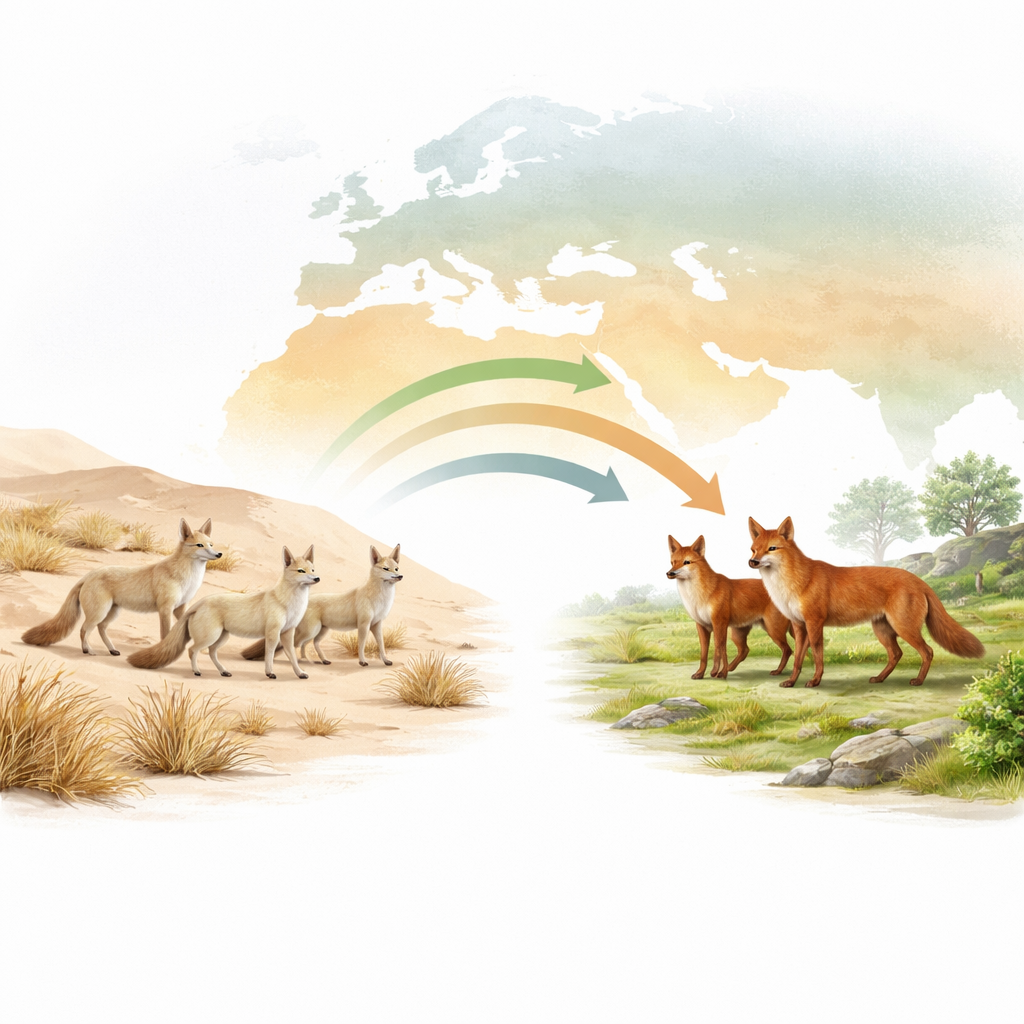
Two kinds of foxes, two very different worlds
Red foxes are classic generalists. They roam across the entire Northern Hemisphere, coping with everything from Arctic cold to suburban gardens. Rüppell’s foxes, in contrast, are desert experts that live in North Africa and the Middle East, with bodies and physiology tuned to conserve water and handle heat. Although their main ranges differ, the two species meet in semi-arid regions stretching from the Sahara and Nile Valley through the Arabian Peninsula toward Iran and Pakistan. Where their territories overlap and mating barriers are incomplete, gene exchange becomes possible, especially in the simple, maternally inherited DNA found in mitochondria.
Following the trail of desert DNA
The researchers assembled an unusually rich genetic dataset: 85 complete mitochondrial genomes and 320 shorter mitochondrial sequences from both fox species. They added new samples from Türkiye and the United Arab Emirates to fill crucial geographic gaps, particularly around the Anatolian Peninsula, a crossroads between Europe, Asia, and the Middle East. When they built evolutionary trees from these data, they found that some red foxes carried mitochondrial types that grouped tightly with Rüppell’s fox, rather than with other red foxes. These special red fox mitochondrial lineages, widespread but rare, were especially common along the southern edge of the red fox’s range, including North Africa, the Middle East, and parts of Asia.
Ghost lineages and one-way traffic
The structure of the genetic trees and the amount of difference between lineages point strongly to one-way mitochondrial transfer from Rüppell’s fox into red fox, not the other way around. Within the Rüppell’s-like mitochondrial group, the team uncovered two clearly separate lineages found inside red foxes. One stretches from Türkiye and Iran into Tunisia; the other is currently known only from Iran. Neither sits neatly inside any living Rüppell’s fox branch, implying that the original desert fox lineages that donated these mitochondria have since vanished—a case of “ghost introgression,” where genes outlive the lineages that first carried them. Timing estimates place the split between these ghost lineages and modern Rüppell’s fox mitochondria around 230,000 years ago, older than the diversification seen in living Rüppell’s fox lineages themselves. 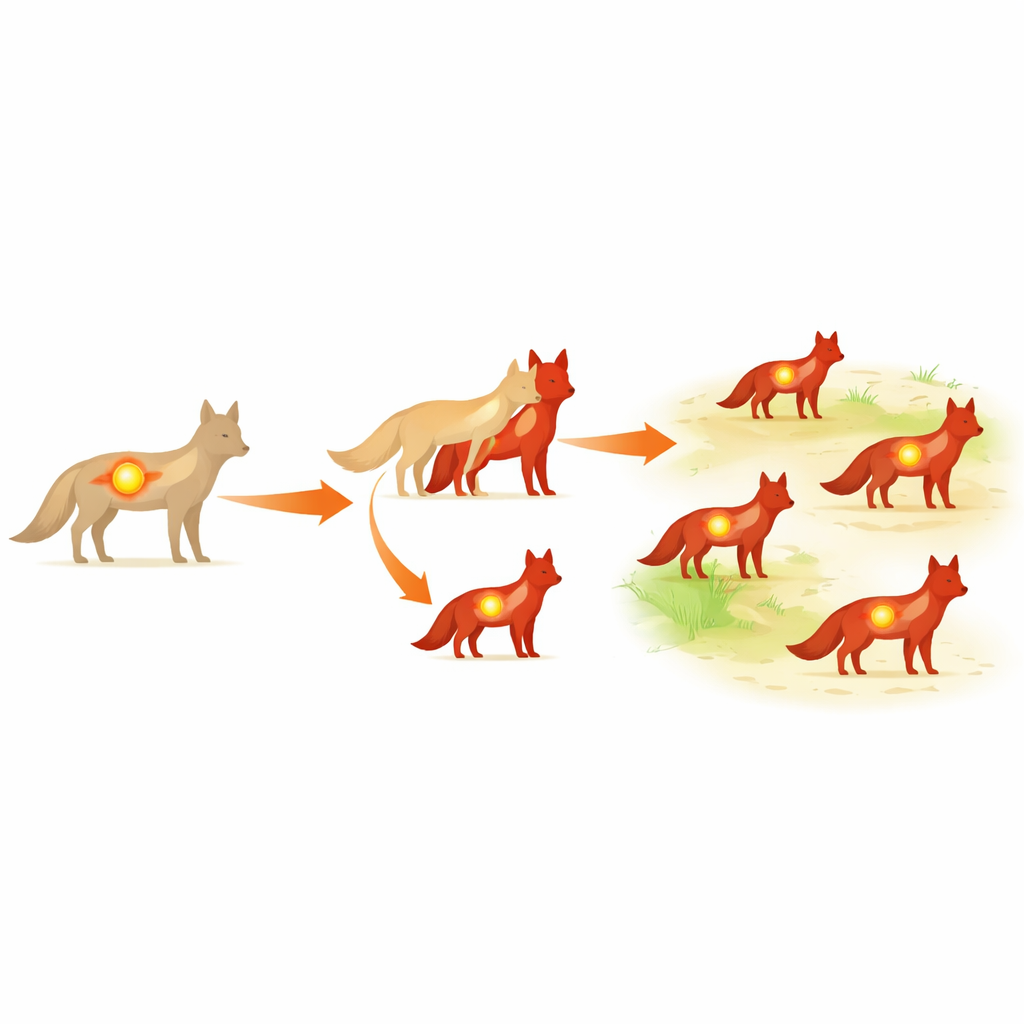
Climate shifts, fox behavior, and chance meetings
Why would desert mitochondria end up in red foxes? The authors link their findings to past swings between wetter and drier periods in North Africa and the Middle East. During wetter intervals, red foxes likely pushed into more arid zones occupied by Rüppell’s fox, creating repeated contact zones. Theory and earlier work suggest that, in such situations, genes often flow from the local species into the expanding one. That fits a scenario where resident desert fox females occasionally mated with incoming red fox males, passing their mitochondria into hybrid offspring that looked and behaved more like red foxes. Because red foxes are larger and typically more abundant than Rüppell’s foxes, mating may have been biased in this direction, helping desert mitochondria infiltrate red fox populations while the original desert lineages faded from view.
Ancient traces in today’s foxes
To a non-specialist, the key message is that today’s red foxes quietly carry the mitochondrial fingerprints of long-lost desert relatives. These ghost lineages testify to multiple, ancient episodes of hybridization driven by shifting climates and unequal population sizes. Although the introgressed mitochondrial types remain rare, they have spread far from the original contact zones through the red fox’s movements and internal gene flow. The study shows how careful sampling and whole-mitochondrion sequencing can reveal hidden chapters in the evolutionary history of familiar animals, reminding us that species boundaries are more porous—and their pasts more intertwined—than they may appear.
Citation: Rocha, R.G., Hassan, A.A., Demirtaş, S. et al. Multiple introgression events from ghost Rüppell’s fox mitochondrial lineages into red fox. Sci Rep 16, 10772 (2026). https://doi.org/10.1038/s41598-026-45528-8
Keywords: red fox evolution, desert fox hybridization, mitochondrial introgression, ghost lineages, canid genetics