Clear Sky Science · en
Identification, comparison of genetic diversity, heat tolerance, and growth performance among Micropterus salmoides salmoides, Micropterus salmoides floridanus, and their reciprocal hybrids
Why hotter ponds matter for dinner plates
Largemouth bass have become one of China’s most important farmed fish, filling supermarket tanks and restaurant menus across the country. But as summers grow hotter and heat waves last longer, pond temperatures now often reach levels that stress these fish, slowing their growth and making them more vulnerable to disease. This study asks a simple, practical question with big consequences for food supply and farmers’ income: can careful crossbreeding create a largemouth bass that can handle higher temperatures without sacrificing too much growth?
Two kinds of bass with different strengths
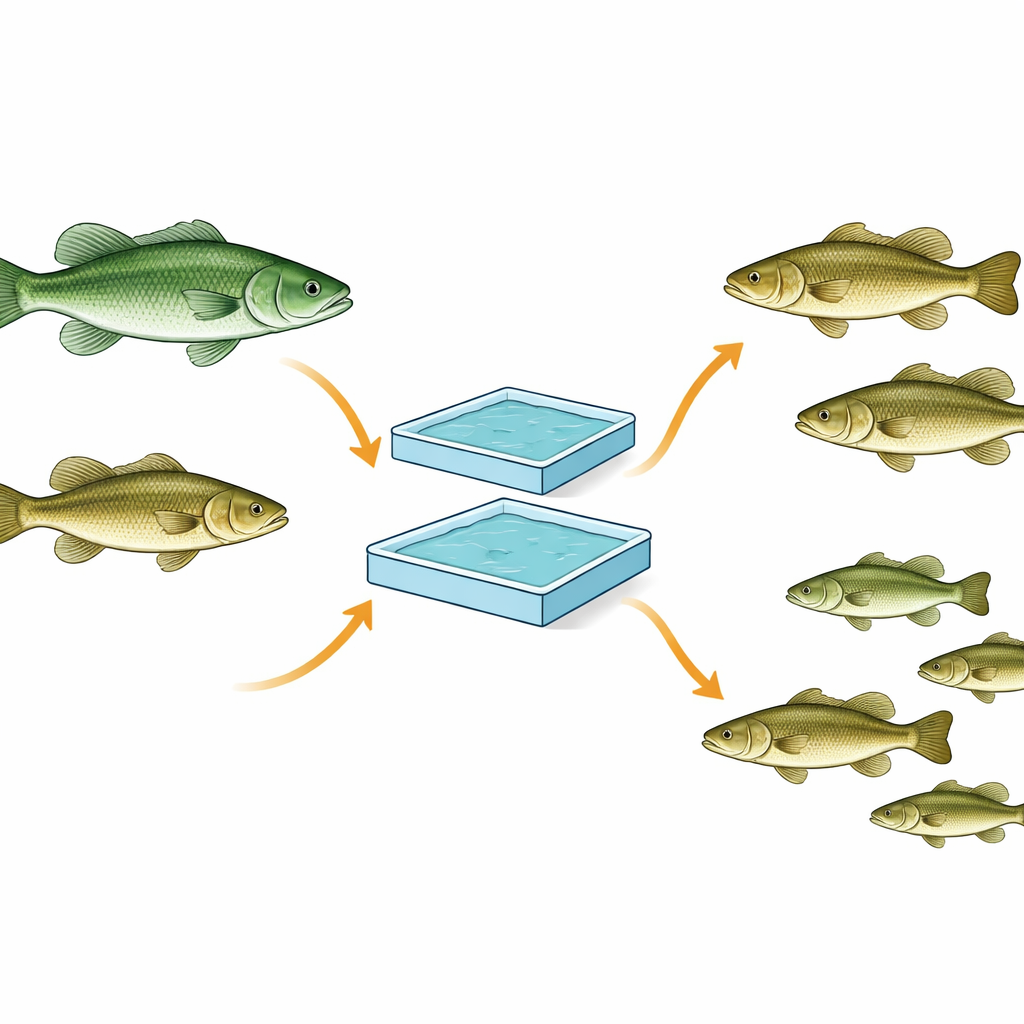
In nature, largemouth bass come in two main forms. The northern type, widely used in Chinese fish farms and represented here by the selectively bred "Youlu No.3" line (NB), grows quickly and does well in cooler water. The Florida type (FB), originally from the southern United States, tolerates heat better but grows more slowly and adapts less readily to commercial feed. The researchers crossed these two types in both directions to produce two kinds of hybrids: one with northern mothers and Florida fathers (NF), and the other with Florida mothers and northern fathers (FN). Because these hybrids look very similar, the team also developed a new DNA-based method that reliably tells the two cross directions apart by reading small, inherited differences in mitochondrial genetic sequences passed down from the mother.
Measuring family trees in the genes
To see how mixing the two bass types reshaped their gene pool, the team used short, highly variable stretches of DNA known as microsatellites. These markers act like bar codes for genetic diversity. Compared with the fast-growing NB line alone, both kinds of hybrids carried more versions of these DNA markers and showed higher levels of genetic variation, which breeders often seek because it provides more raw material for future improvement. When the researchers built a simple genetic “family tree,” the hybrids clustered closer to the northern bass than to the Florida bass, reflecting the long history of selective breeding that NB has already undergone in China.
Putting fish through a heat test
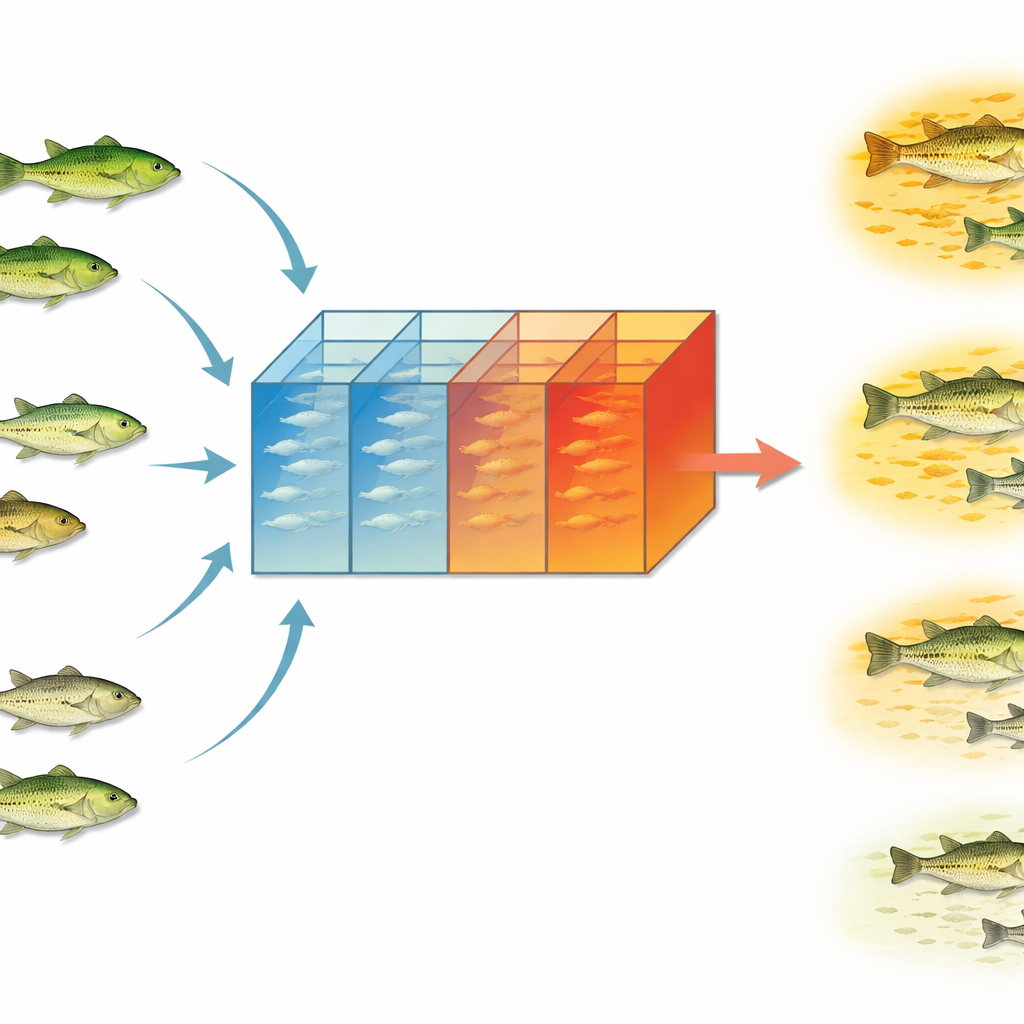
Next, the scientists asked how well each group of fish held up as water temperatures climbed. In short, sharp heat tests, they quickly raised water from normal conditions up into the upper 30s degrees Celsius and recorded survival at each step. The Florida bass and especially the FN hybrids endured the highest temperatures before half the fish died, while the northern line showed the lowest heat limit. In a second experiment that better mimics real farming conditions, all groups were kept for weeks in warm tanks. Here too, the hybrids outperformed the pure northern line: both NF and FN survived better and grew faster at 34 °C, with FN standing out as the strongest performer. Remarkably, FN fish kept at 34 °C not only survived more often but also grew faster than the northern bass maintained at a cooler, safer 32.3 °C.
Growth in real ponds, not just test tanks
Because fish farmers ultimately earn money from fish weight, the team also tracked how the hybrids and the northern line grew together in an outdoor pond over several months. Under these more typical farming conditions and standard commercial feed, the selectively bred NB fish still grew the fastest. By nine to ten months of age, FN hybrids were only about 10% behind NB in growth, while NF hybrids lagged much more—by roughly 36% to 70%, depending on age. The results suggest that while crossing improves heat tolerance, it does not completely erase NB’s growth advantage whose line has been refined for years to thrive on pelleted feed.
What this means for future fish on the table
From a layperson’s point of view, this study shows that it is possible to breed a “summer-proof” largemouth bass by mixing the strengths of two related subspecies. The best combination used Florida mothers and northern fathers (the FN cross), producing offspring that handle high temperatures well yet grow almost as fast as today’s farm-standard northern fish. That trade-off—slightly slower growth but much better survival and performance in hot water—may be worthwhile as heat waves become more common. The work also supplies breeders with new genetic tools to track hybrid lineages accurately. Together, these advances offer a clear path toward future bass varieties that can keep ponds productive and markets supplied even in a warming climate.
Citation: Du, J., Lou, W., Zhu, T. et al. Identification, comparison of genetic diversity, heat tolerance, and growth performance among Micropterus salmoides salmoides, Micropterus salmoides floridanus, and their reciprocal hybrids. Sci Rep 16, 10759 (2026). https://doi.org/10.1038/s41598-026-45526-w
Keywords: largemouth bass, heat-tolerant aquaculture, fish hybrid breeding, climate-resilient farming, genetic diversity