Clear Sky Science · en
Role of FePt grain size on writing performance for next-generation magnetic recording technology
Why shrinking data bits matters to everyday storage
Every photo, video, or AI model you use depends on tiny magnetic regions on hard disks that store digital bits as north or south pointing magnets. To keep up with exploding data needs, engineers want to shrink these regions so more bits fit on the same disk surface. This article looks at how small these bits can realistically be in an advanced writing method that uses heat and magnetic fields together, and what hidden limits show up when we push the technology too far.
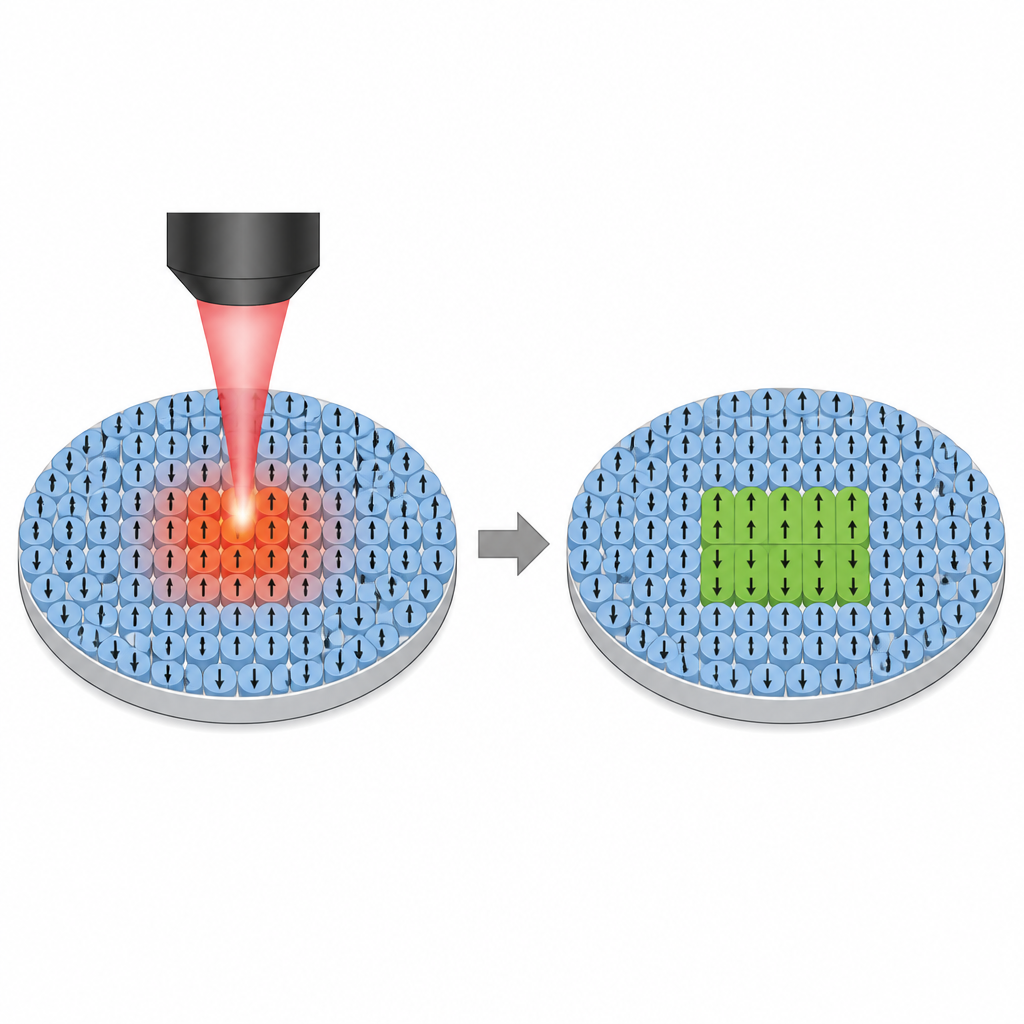
Heating tiny magnets to write more data
Modern hard drives are running into a basic problem: materials that can safely hold data in tiny regions also resist being written by ordinary magnetic heads. Heat assisted magnetic recording and a related idea called heated dot magnetic recording tackle this by briefly heating the storage layer with a tiny laser spot while a magnetic field writes the bit. At high temperature the material is easier to flip, and when it cools again the magnet becomes stiff and keeps the stored information. The study focuses on a favorite material for this job, an iron platinum alloy known as FePt, and asks how its grain size and other properties affect two key measures of performance: how many bits can be packed per square inch and how often those bits are written incorrectly.
When hot magnets change their minds
Heating the material close to its transition temperature makes it writable but also stirs up strong thermal agitation. Under those conditions some grains flip in the desired direction during writing, then flip back again as they cool. This “back switching” raises the bit error rate, meaning a higher chance that a stored 1 turns into a 0 or vice versa. Using detailed atomic level computer simulations of single FePt grains, the authors show that an intrinsic property called the damping constant, which describes how quickly spins settle after being disturbed, strongly affects this behavior. Higher damping allows the grains to follow the applied field more faithfully at lower peak temperatures, which reduces back switching and lowers the raw error rate.
How small is too small for FePt grains
The team then explores grains with diameters between 3 and 5 nanometers while keeping the thickness fixed. Smaller grains allow more bits per unit area, raising the areal density, but they also have lower total magnetic moment and are more vulnerable to thermal kicks when hot. The simulations confirm that 5 nanometer grains can reach an areal density of about 16.4 terabits per square inch with acceptably low error rates. Grains of 3 or 4 nanometers can in principle pack in even more bits, yet under realistic writing fields and short laser pulses their bit error rate becomes too high. The authors find that errors for these very small grains can only be tamed by using stronger magnetic fields, longer heating times, or materials with higher damping, all of which have engineering costs.
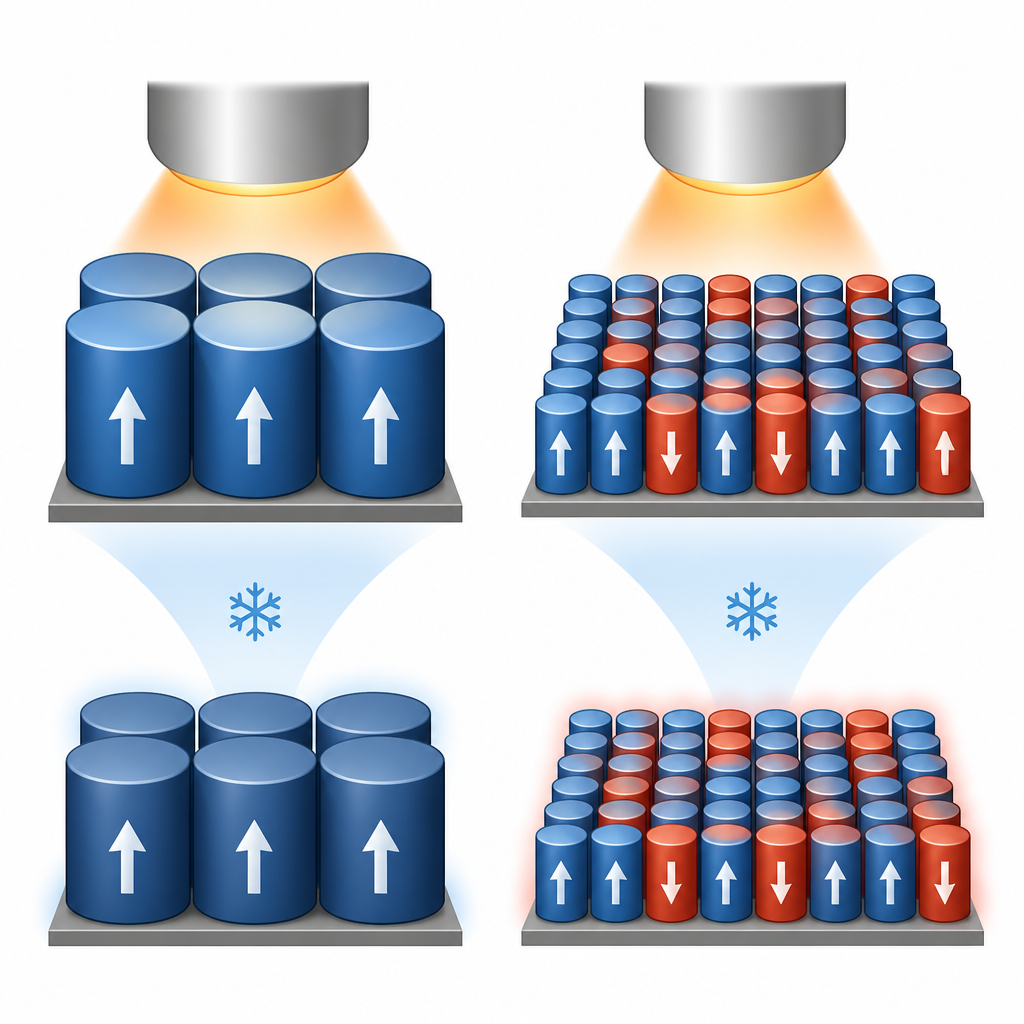
Simple models to guide complex design choices
To move beyond brute force simulations, the article also develops mathematical models that link error rate, writing temperature, and achievable data density. One approach treats the problem in terms of a blocking temperature at which the grain’s magnetization effectively freezes during cooling. A second, more refined master equation approach tracks how the average magnetization changes continuously as the material cools, accounting for how quickly grains can respond. By comparing both models with the full atomistic simulations, the authors show that carefully chosen parameters, including a size dependent attempt frequency that controls how often a grain tries to flip, can reproduce the detailed results while being much faster to evaluate. These tools can then be used to scan wide design spaces before committing to expensive device level simulations.
Practical lessons for future hard drives
Overall, the work paints a balanced picture of the trade-offs involved in pushing next generation recording media toward ever higher densities. It shows that simply shrinking FePt grains below about 5 nanometers is not enough, because thermal noise during the hot writing stage drives up the bit error rate. However, by selecting materials with strong damping, tuning the strength and duration of the writing field and laser pulse, and choosing an appropriate write temperature for each grain size, designers can keep errors within acceptable limits while still gaining capacity. The study thus offers a roadmap for how to juggle grain size, heating, and magnetic response when designing future heat assisted and heated dot recording technologies.
Citation: Yuanmae, K., Strungaru, M., Pantasri, W. et al. Role of FePt grain size on writing performance for next-generation magnetic recording technology. Sci Rep 16, 14816 (2026). https://doi.org/10.1038/s41598-026-45522-0
Keywords: heat assisted magnetic recording, FePt grains, bit error rate, areal density, magnetic data storage