Clear Sky Science · en
Soil phosphorus forms and their availability in six typical plantations at the southern foot of the Taihang Mountains, China
Why forest soil chemistry matters
Across the world, people are planting trees to stop erosion, store carbon, and restore damaged land. But not all forests build healthy soil in the same way. This study, from the southern foot of China’s Taihang Mountains, asks a simple but important question: which kinds of planted forests do the best job of supplying phosphorus—a key plant nutrient—while also storing it for the long term? The answer turns out to depend less on how many trees are present and more on which species grow together and how their roots and partners underground share nutrients.
Different tree neighbors, different soils
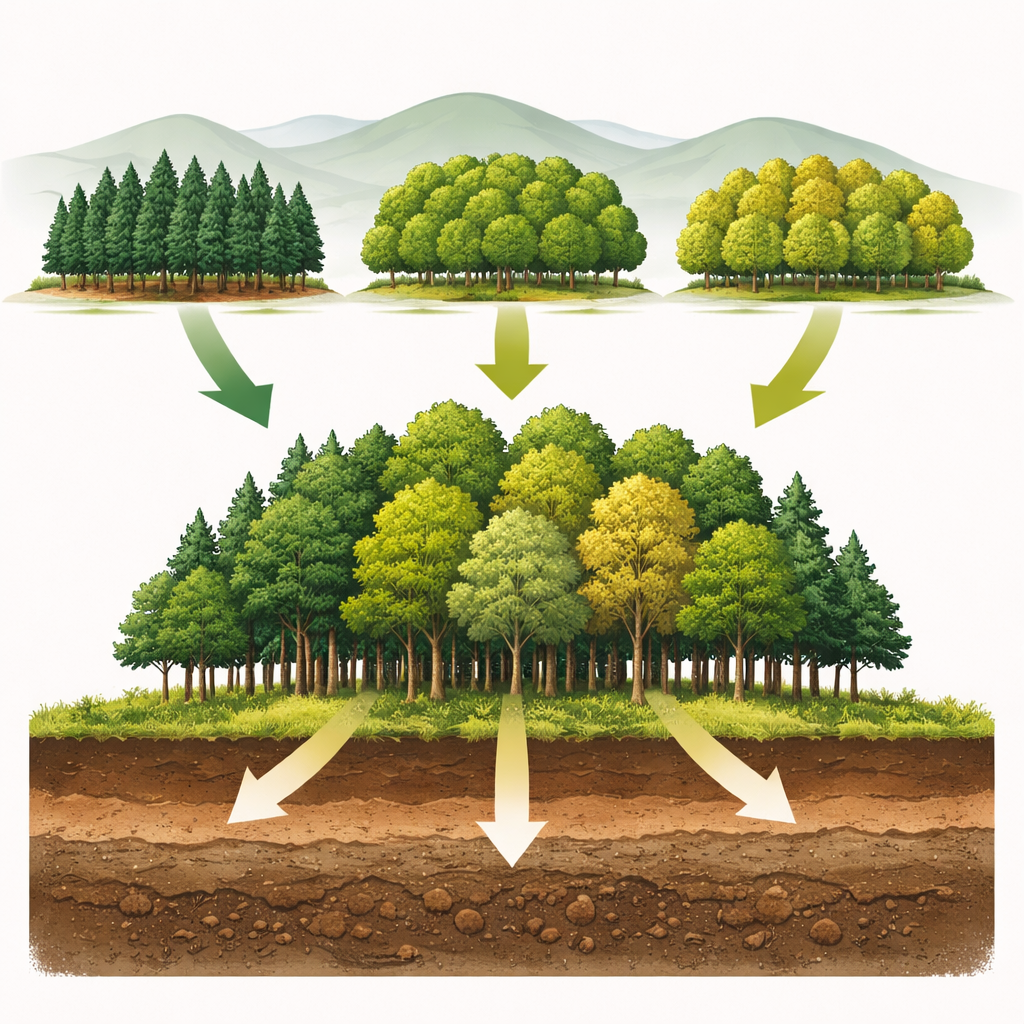
The researchers compared six plantation types built from three common trees in North China: a nitrogen-fixing locust (Robinia pseudoacacia), an oak (Quercus variabilis), and a conifer (Platycladus orientalis). They looked at pure stands of each species and every two-species mix between them. In each forest, they collected soil samples from three depths down to 30 centimeters and used a stepwise chemical extraction technique to separate phosphorus into forms that are easily used by plants, moderately accessible, or locked away inside soil minerals. They also measured basic soil properties such as organic matter, carbon, nitrogen, and potassium to see how these features tracked the phosphorus patterns.
Mixed forests that work together
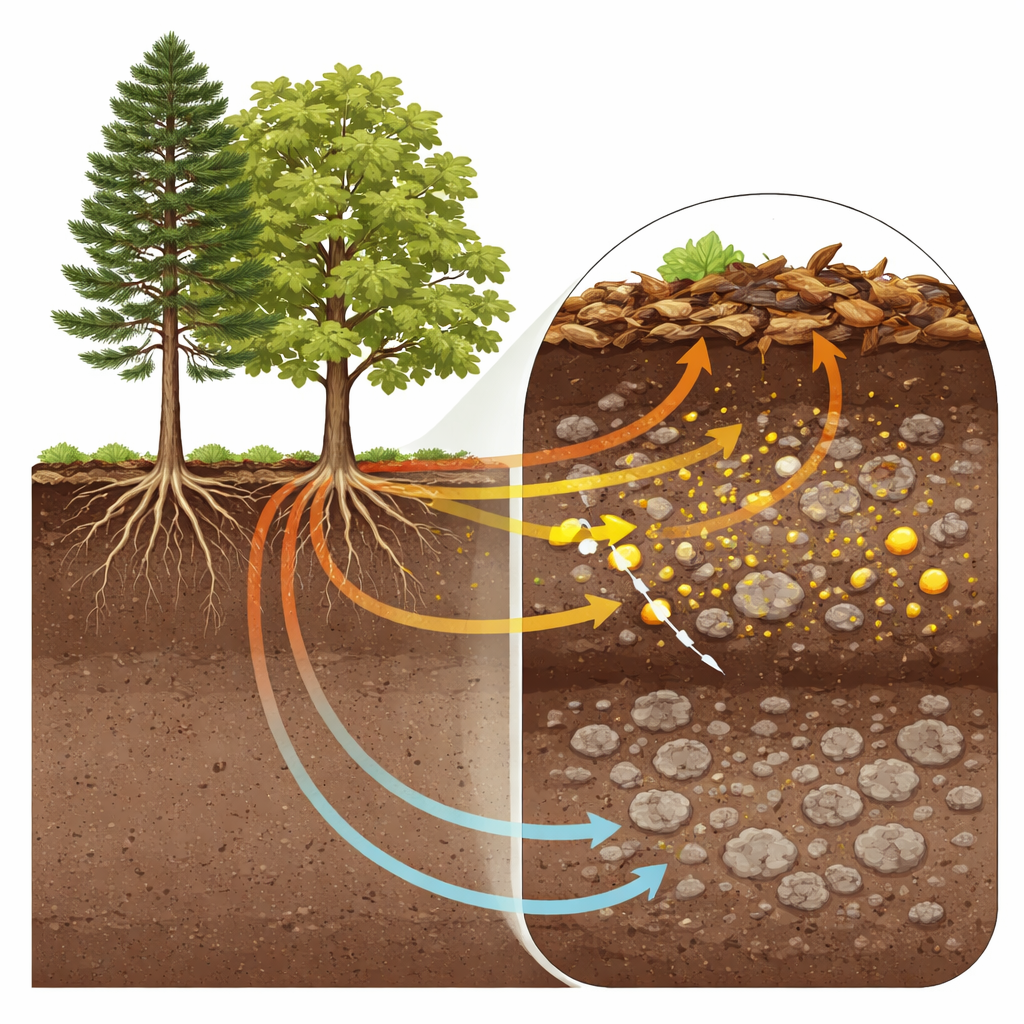
One mixed forest in particular—the pairing of Robinia and Quercus—stood out. In this combination, soils contained the highest levels of total phosphorus, organic phosphorus, and the forms most available to plants, especially in the upper 10 centimeters. In contrast, pure stands and the mix involving the conifer generally had poorer phosphorus status, with the Platycladus monoculture performing worst. The authors suggest that this success comes from “functional complementarity”: the locust adds nitrogen to the soil and fuels microbial activity, while the oak’s fungal partners are especially good at breaking apart organic material and mining hard-to-reach phosphorus. Together, they create a richer, more active topsoil than either species can alone.
Layers of soil, layers of phosphorus
Across all six plantations, phosphorus forms changed consistently with depth. The most biologically active forms were concentrated near the surface, where fallen leaves and roots are constantly decomposing. Deeper down, the total amount of phosphorus dropped, but a larger share became “occluded”—tightly bound within soil minerals and much slower to cycle. Interestingly, the Robinia–Quercus mixture not only had rich surface soils but also showed particularly high occluded phosphorus in the 20–30 centimeter layer, hinting that this forest type gradually shuttles some of its nutrient surplus into more stable underground storage. This pattern suggests a balance between feeding current growth and building a long-term reserve.
Soil life as the hidden engine
The study also revealed strong links between phosphorus and general measures of soil fertility. Soils with more organic matter, carbon, and nitrogen tended to have higher levels of plant-available and moderately active phosphorus. These relationships were especially strong in the Robinia–Quercus stands, supporting the idea that organic inputs from litter and roots, along with bustling microbial communities, drive the conversion of locked-up phosphorus into forms plants can use. By contrast, the most tightly bound phosphorus tended to increase where organic matter and other nutrients were lower, underscoring its role as a stable, less reactive pool.
What this means for future forests
For land managers and planners, the message is clear: the choice of tree mixtures strongly shapes the underground nutrient economy. In this region, mixing the nitrogen-fixing locust with oak appears to offer a double benefit—greater phosphorus availability in the surface soil and greater long-term storage deeper down—than planting single-species stands. The authors recommend favoring carefully chosen mixed plantations, protecting nutrient-rich topsoil from erosion, and maintaining high organic matter inputs. Doing so can help new forests grow vigorously while building resilient, phosphorus-rich soils that continue to support trees and other life for decades to come.
Citation: Zhuang, J., Ma, Y. & Cheng, C. Soil phosphorus forms and their availability in six typical plantations at the southern foot of the Taihang Mountains, China. Sci Rep 16, 10960 (2026). https://doi.org/10.1038/s41598-026-45512-2
Keywords: forest plantations, soil phosphorus, mixed-species forests, soil fertility, nutrient cycling