Clear Sky Science · en
Unconventional superconductivity in the presence of long-range interactions in transition metal dichalcogenide moiré heterobilayers
Why stacking atom-thin crystals can hide surprising behavior
When atomically thin crystals are stacked with a slight mismatch, they produce large-scale patterns called moiré lattices. In some of these designer materials, electrons slow down, interact strongly, and can form exotic states of matter, including superconductors that carry current without resistance. This paper explores whether a particular stacked system made from WS₂ and WSe₂ could host such an unusual superconducting state, even though electrons there strongly repel each other over both short and longer distances.
A new playground made from two layered crystals
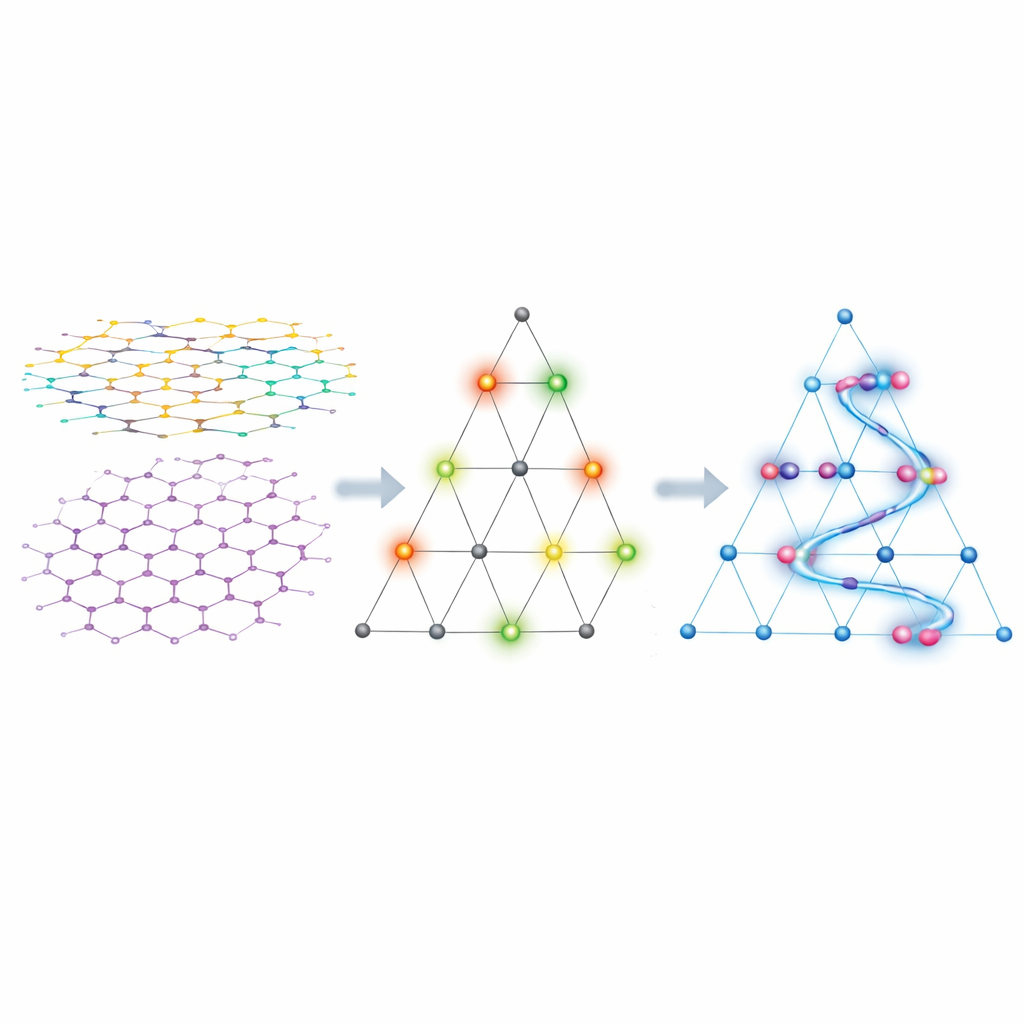
The authors focus on a family of materials called transition‑metal dichalcogenides, which can be peeled into single atomic sheets and then stacked with a twist or a small lattice mismatch. In a WS₂/WSe₂ “heterobilayer,” this stacking creates a triangular moiré pattern that reshapes the motion of electrons into an almost flat energy band. Flat bands mean electrons move sluggishly, making their mutual repulsion especially important and giving rise to striking states such as Mott insulators and Wigner‑like crystals, where electrons freeze into ordered patterns. Curiously, while similar systems have already shown superconductivity, WS₂/WSe₂ itself has not yet done so in experiments, raising the question of whether strong long‑range repulsion simply kills pairing, or whether superconductivity might still be hiding under the right conditions.
Building a simple but powerful model of the electrons
To tackle this question, the researchers build an effective model that keeps just the most important electronic states in the flat valence band of the moiré lattice. In this model, electrons can hop between sites of a triangular grid, experience a strong repulsion when sharing the same site, and also feel a significant repulsion between neighboring sites. Additional terms capture longer‑range hopping and subtle magnetic‑like exchange effects that tend to favor electron pairing. Because simple mean‑field approaches underestimate the impact of strong repulsion, the team uses a Gutzwiller‑type variational method, which effectively renormalizes (reshapes) both the electron motion and their interactions, mimicking the way strong on‑site repulsion suppresses double occupancy and enhances correlation effects.
How strong repulsion can still allow electron pairing
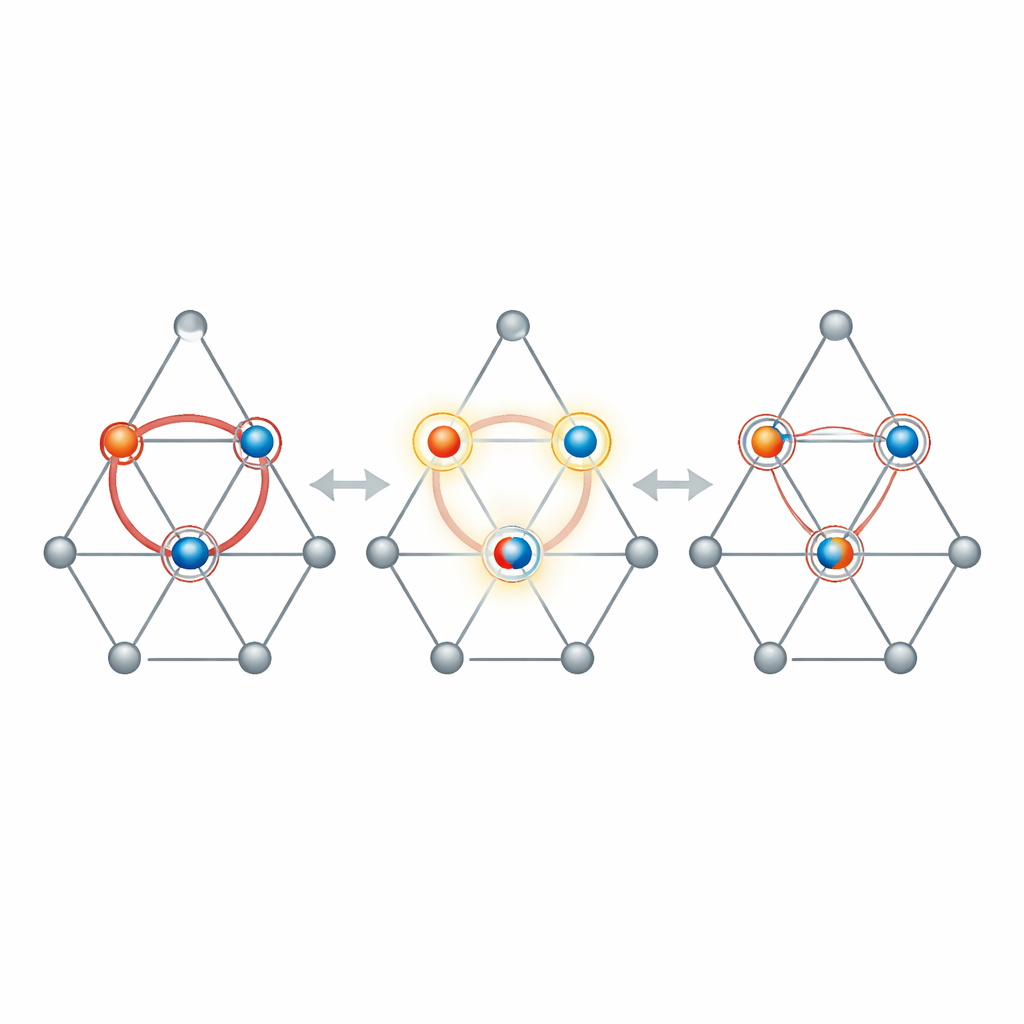
The core of the study is to see how superconductivity competes with, and sometimes survives, the strong intersite repulsion characteristic of WS₂/WSe₂. In a real‑space picture where neighboring electrons form pairs, repulsion between sites naturally works against pairing, while the exchange interaction promotes it. The calculations show that in a moderately interacting regime, realistic values of neighbor repulsion would completely destroy superconductivity. However, once the on‑site repulsion becomes much larger than the band width — the strongly correlated regime — the story changes. Near half filling of the moiré band, correlation effects strongly renormalize the interactions: the effective neighbor repulsion is dramatically reduced, while the exchange interaction is boosted. As a result, a robust superconducting phase with a mixed spin‑singlet and spin‑triplet character appears and forms two domes of stability around a central Mott insulating state.
Fine‑tuning the lattice and environment
The authors then include longer‑range hopping and exchange processes up to third‑nearest neighbors. These extra hoppings lower the density of electronic states at the energy where superconductivity is most favorable, which weakens but does not eliminate the paired state. By scanning over electron density and interaction strength, they identify a window of parameters where superconductivity should exist: strong on‑site repulsion about twice the band width and electron fillings slightly below or above one electron per moiré site. Importantly, this window does not coincide with the fractional fillings where charge‑ordered Wigner‑like crystals are known to form, suggesting that superconductivity and these charge patterns could, in principle, be realized in separate regimes of the same material.
What this means for future superconducting devices
In accessible terms, the paper concludes that WS₂/WSe₂ — despite its strong and extended electron repulsion — remains a promising candidate for unconventional superconductivity. Strong on‑site interactions can paradoxically protect pairing by weakening the most harmful part of the repulsion while enhancing the interactions that glue electrons into pairs. The resulting superconducting state is predicted to be topological and dominated by spin‑triplet pairing, with an estimated transition temperature around or below one kelvin. Experimentally, reaching this state would likely require carefully tuning the twist angle and surrounding dielectric materials to push the system into the optimal strongly correlated regime and probing electron densities close to half filling at very low temperatures.
Citation: Akbar, W., Biborski, A., Rademaker, L. et al. Unconventional superconductivity in the presence of long-range interactions in transition metal dichalcogenide moiré heterobilayers. Sci Rep 16, 10611 (2026). https://doi.org/10.1038/s41598-026-45510-4
Keywords: moiré superconductivity, transition metal dichalcogenides, strong electron correlations, WS2/WSe2 heterobilayer, flat band physics