Clear Sky Science · en
Comparing 600 years of extremely hot Central European summers to future projections
Why ancient heat can teach us about tomorrow
Central Europe has lived through blistering summers long before modern thermometers and satellite images existed. By piecing together weather patterns from the last 600 years and comparing them with state of the art climate model projections, this study asks a question many people care about today: how unusual are recent heatwaves, and what do the worst past summers suggest about the future of heat in Europe?
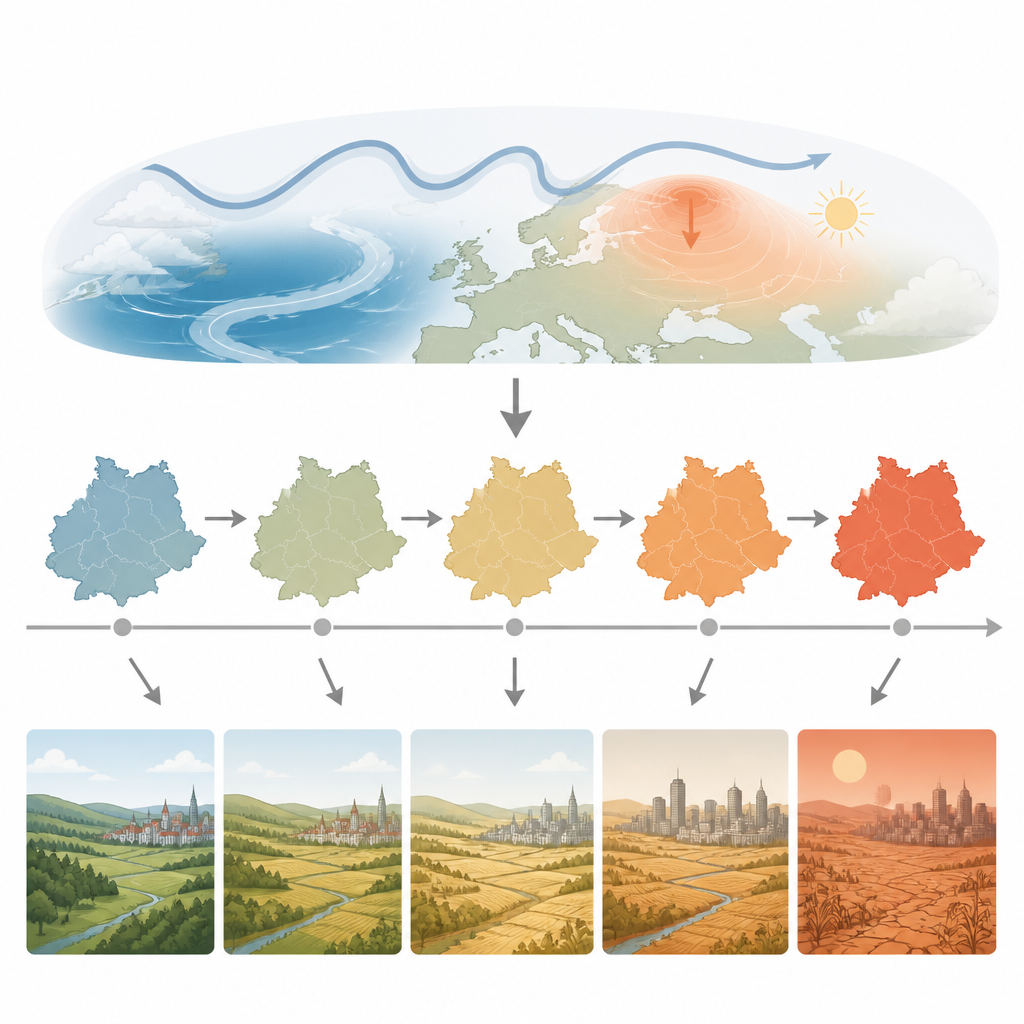
Looking back through six centuries of summers
The researchers combined several rich sources of information to reconstruct past European summers and explore future ones. They used a “paleo reanalysis,” which blends historical documents, natural clues such as tree rings, and modern climate models to recreate monthly weather fields from 1421 to 2008. They also examined a large set of computer simulations covering the same period and compared everything with the widely used ERA5 reanalysis and with global climate model projections used for future climate assessments.
Past heat that rivals and exceeds recent records
Many people remember the scorching European summer of 2003, and in simple fixed averages it does stand out. But when the authors accounted for the slowly changing background climate using a moving baseline, two earlier summers emerged as even more extreme relative to their time. The extended warm season of 1540, and the core summer months of 1590, each showed temperature spikes over Central Europe that exceeded those in 2003 when judged against their surrounding decades. The year 1540 coincided with an almost year long drought, while 1590 was a short, intense hot spell within an otherwise cooler, wetter stretch.
How blocking skies and dry soils feed the heat
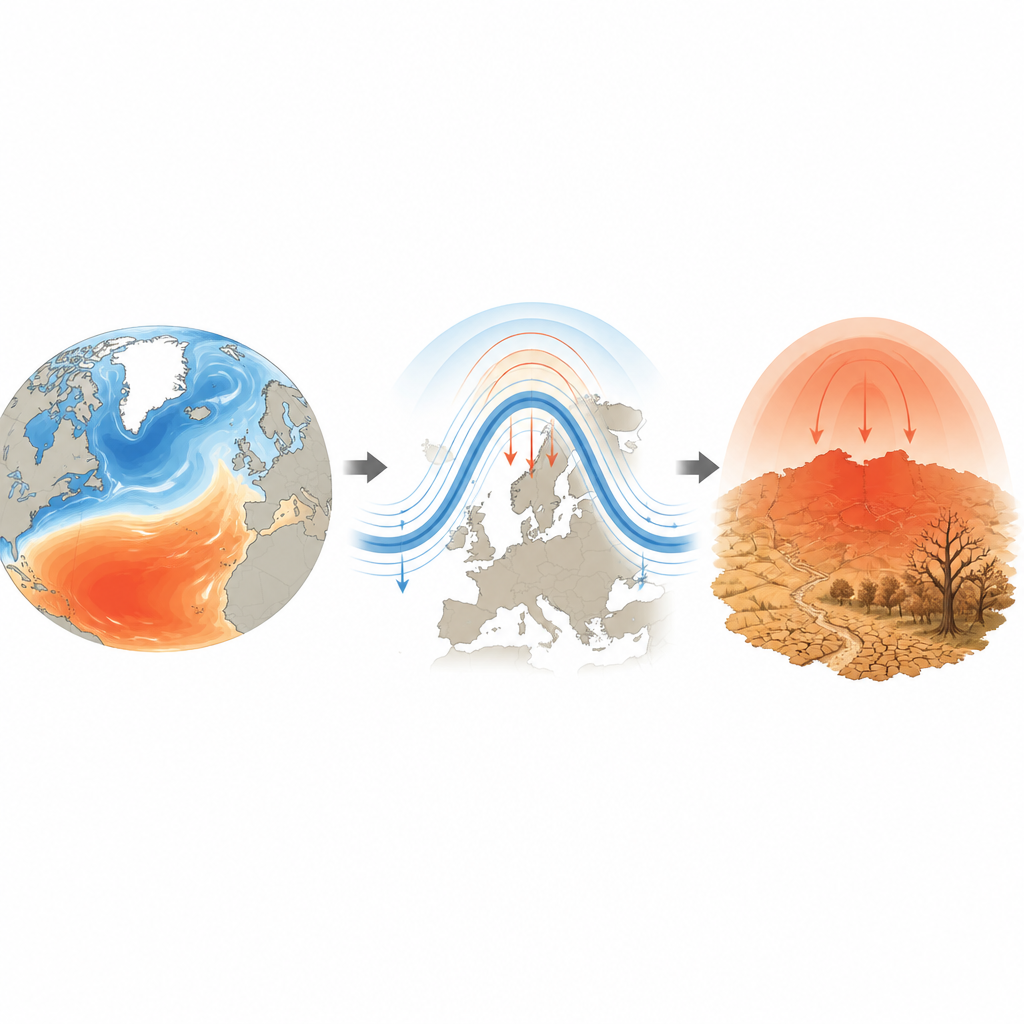
By mapping the atmosphere during these historic summers, the study found patterns that resemble those behind recent heatwaves. In both 1540 and 1590, the high altitude jet stream shifted north and strong, nearly stationary high pressure systems settled over Central Europe. These “blocks” deflected storms and allowed clear skies and sinking air to persist, drying out the land and reinforcing the heat. The unusual warmth was not clearly driven by ocean surface conditions in the models, suggesting that internal twists in the atmosphere alone can create extraordinary events when they lock in place for weeks or months.
Extremes in giant model worlds
The large ensemble of model simulations, spanning nearly 12,000 virtual years, produced summers that were as rare and sometimes even more intense than those of 1540 and 1590. Only a few tenths of a percent of summers reached or exceeded those historic anomalies, and the very hottest simulated June to August seasons were more than 4 degrees Celsius above their moving baseline. When the team turned to global climate projections for high and low greenhouse gas scenarios late in this century, they again found that summers as extreme as 1540 and 1590 are uncommon but do occur in the models, in both strong warming and strong climate protection pathways.
What the past suggests about future summers
Even though summers as exceptional as 1540 and 1590 remain rare in future projections, the moving baseline itself climbs as the planet warms. That means a “statistically similar” event in the late 2000s would be far hotter in absolute terms than its sixteenth century counterparts, with greater stress on crops, forests and people. The study shows that our best tools can now recreate centuries old extremes and link them to familiar circulation patterns, offering a clearer picture of how rare but devastating hot summers arise and how they may unfold in a warmer world.
Citation: Lipfert, L., Hand, R. & Brönnimann, S. Comparing 600 years of extremely hot Central European summers to future projections. Sci Rep 16, 15278 (2026). https://doi.org/10.1038/s41598-026-45507-z
Keywords: Central Europe heatwaves, paleoclimate, summer temperature extremes, climate projections, North Atlantic SST