Clear Sky Science · en
Fractional modeling of nonlinear dispersive systems: on the comparative study of Whitham–Broer–Kaup equations using various derivatives
Why waves with memory matter
From ocean swells to traffic jams, many wave-like patterns do not just depend on what is happening now, but also on what happened moments—or even long stretches—ago. This built-in “memory” shows up in fluids that are sticky or complex, in materials filled with tiny structures, and in systems where energy spreads in unusual ways. The paper behind this summary develops a refined mathematical lens for such waves in shallow water, aiming to describe their motion more faithfully while still allowing researchers and engineers to compute accurate solutions.
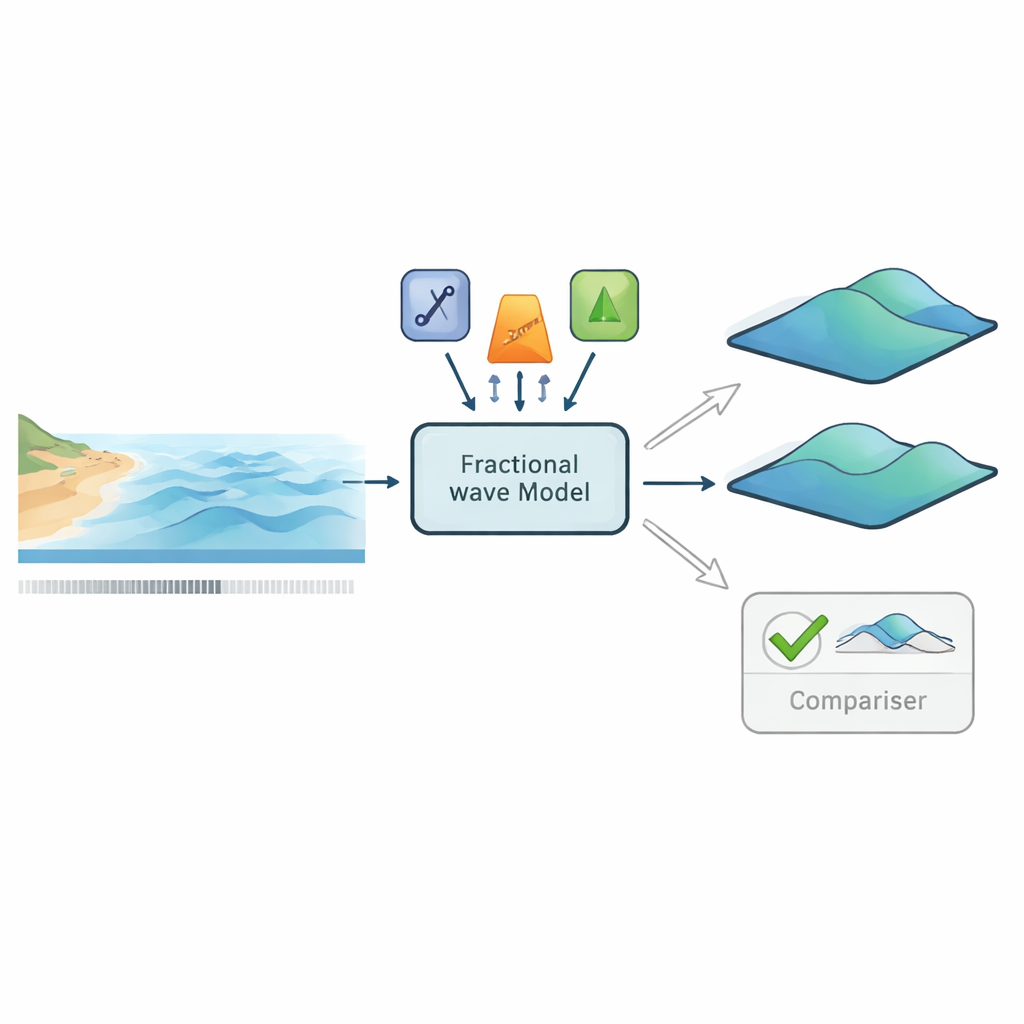
Shallow water as a testbed
The authors focus on a family of equations known as the Whitham–Broer–Kaup (WBK) system, a well-established model for long, low waves in shallow water. Unlike simpler formulas that track only the water surface, the WBK system simultaneously follows both the height of the water and the horizontal speed of the flow, capturing how these two quantities interact. This makes it a richer and more realistic description of wave motion than many single-equation models. The WBK system also includes the effect of dispersion—how different wave lengths travel at slightly different speeds—which shapes the familiar rolling patterns we see in coastal waves.
Adding memory with fractional tools
To bring memory into the picture, the authors replace the usual time derivatives in the WBK system with “fractional” ones. Instead of measuring how quickly something changes at a single instant, fractional derivatives blend information from the recent and distant past, with different mathematical kernels describing how strongly past events weigh in. The study compares three major choices: the traditional Caputo form, which emphasizes long-term memory; the Caputo–Fabrizio form, which uses an exponential kernel and favors short-to-medium range memory; and the Atangana–Baleanu form, which introduces a smooth, non-singular memory via the Mittag–Leffler function. By plugging each of these into the WBK equations, the authors obtain a suite of wave models with tunable memory strength and character.
A hybrid route to solvable equations
Equipping the WBK system with memory makes it much harder to solve directly. To tackle this, the authors build a hybrid analytical approach called the Sumudu Decomposition Method (SDM). It combines an integral transform known as the Sumudu transform with a technique that breaks complicated nonlinear terms into an infinite series of simpler pieces. The Sumudu transform shifts the equations into a new domain that is easier to manipulate while preserving the original time scale, and the decomposition method organizes the nonlinear wave interactions into a hierarchy of corrections. By iterating this procedure, the method produces series solutions for the wave height and velocity that converge quickly and do not require heavy numerical gridding or artificial simplifications.
Testing accuracy and flexibility
To check whether this framework is both trustworthy and practical, the authors apply it not only to the full WBK system but also to two important special cases: the modified Boussinesq equations and the approximate long wave equations, which describe related shallow-water situations. In each case they compare the SDM-based series solutions with known exact solutions and with results from other semi-analytical methods. Across a wide range of time, space, and fractional-order values, the errors remain extremely small—often many orders of magnitude below competing schemes. Graphs show that just a few terms in the series (three in the examples presented) are enough to capture the key wave features, even when the memory order is far from the classical value corresponding to no memory. The study also demonstrates how changing the fractional order smoothly morphs wave profiles, linking purely local behavior to strongly memory-driven dynamics.
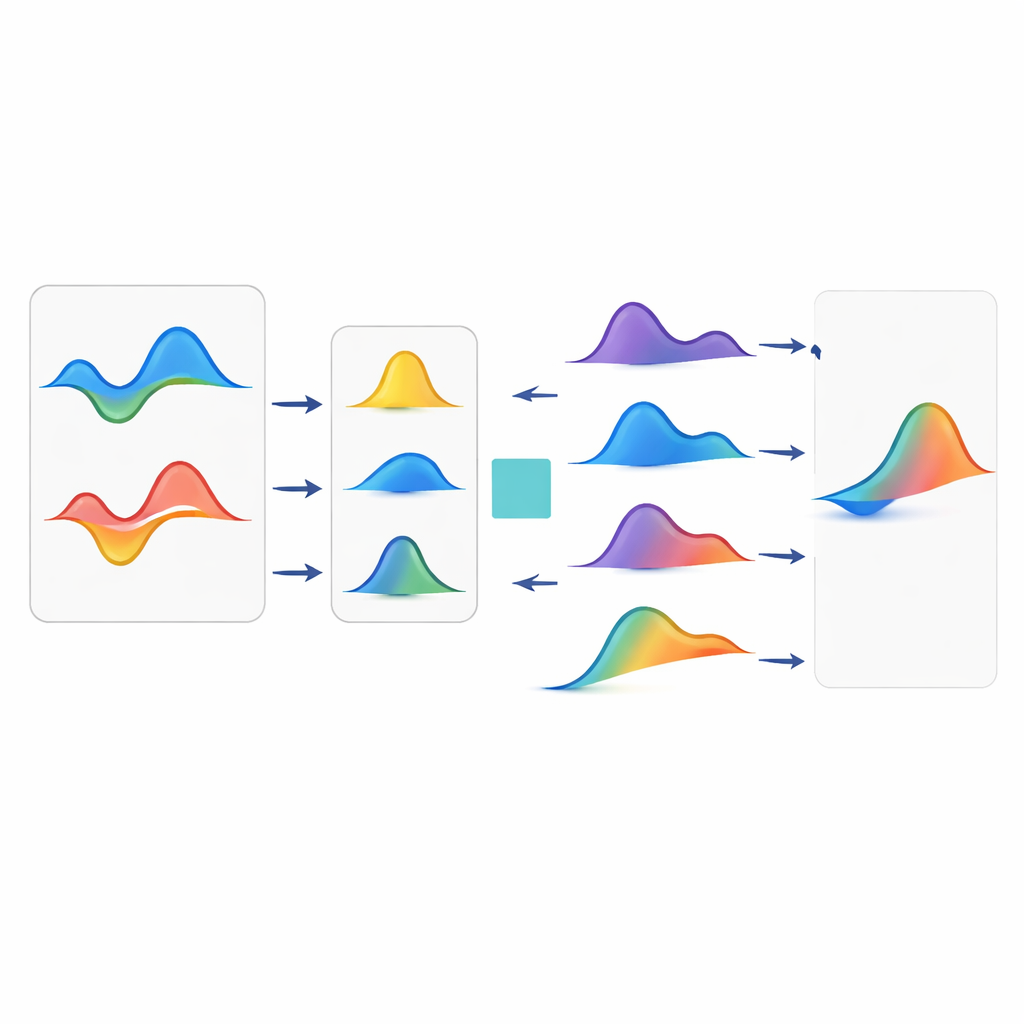
What this means for modeling real waves
In plain terms, the work offers a precise yet economical way to simulate waves in complex media where history matters, such as viscoelastic or layered fluids and other dispersive systems. By showing that their hybrid method is stable, rapidly convergent, and effective for several flavors of memory, the authors provide a toolkit that can be adapted to many other nonlinear wave models. While their tests focus on idealized, smooth conditions, the approach lays the groundwork for future extensions to higher dimensions, irregular boundaries, and random effects. For non-experts, the takeaway is that we now have a more flexible mathematical “engine” for predicting how waves with memory behave, one that can help bridge the gap between simple textbook waves and the intricate patterns found in nature and technology.
Citation: Ahmed, S.A., Shah, R., Mohamed, A. et al. Fractional modeling of nonlinear dispersive systems: on the comparative study of Whitham–Broer–Kaup equations using various derivatives. Sci Rep 16, 10823 (2026). https://doi.org/10.1038/s41598-026-45501-5
Keywords: fractional calculus, shallow water waves, nonlinear dispersive systems, integral transform methods, wave modeling