Clear Sky Science · en
An “off-on” CdTe QDs fluorescent nanosensor for detecting apoptosis in osteosarcoma and evaluating chemotherapy response
Why watching cells die can guide cancer care
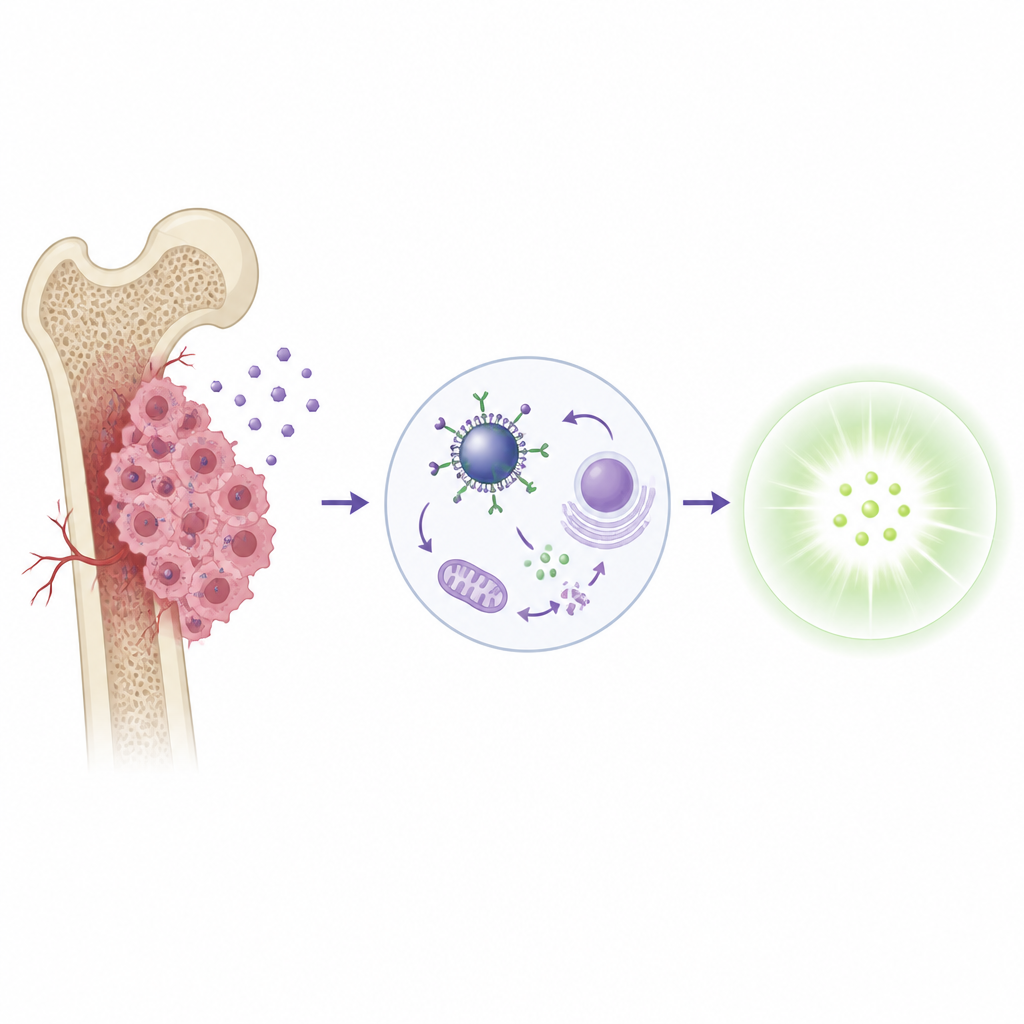
Chemotherapy works in part by pushing cancer cells to self-destruct, a process called programmed cell death. In aggressive bone cancer of young people, doctors still lack quick, reliable ways to see whether a given drug is actually killing tumor cells. This study introduces a tiny light-based sensor that turns from dark to bright when cells enter this death pathway, offering a potential new way to track how well treatment is working.
A tough bone cancer that needs better tracking
Osteosarcoma is the most common primary bone cancer in teenagers and young adults. It tends to grow quickly and spread early to the lungs, so patients usually receive strong chemotherapy before and after surgery. Right now, the main way to judge how well those drugs worked is to remove the tumor and examine it under a microscope after the fact. That approach is invasive, slow, and gives only a one-time snapshot. Clinicians and patients need tools that can sense drug response in a more direct and timely way during treatment, not months later.
Turning a quantum dot into a tiny light switch
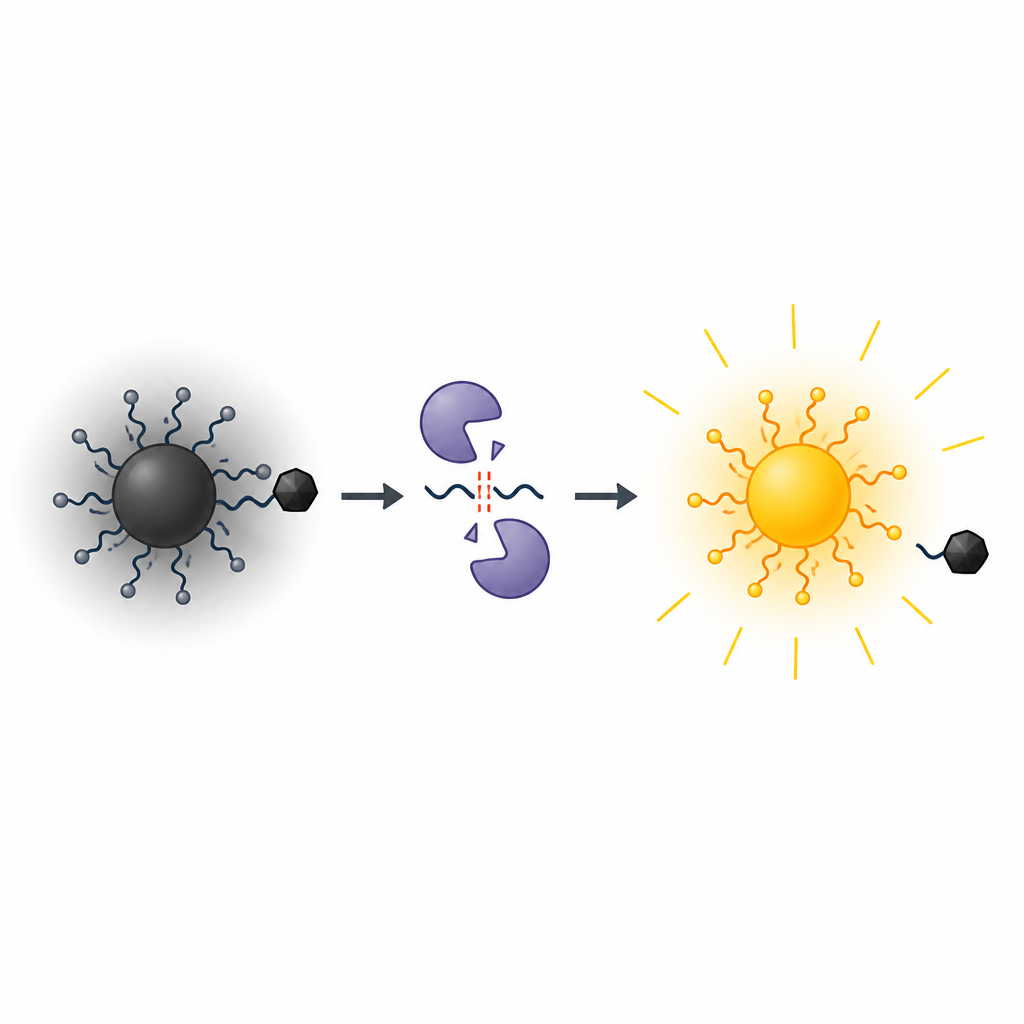
The team built a nanosensor around very small crystals called quantum dots, which shine brightly when lit with the right color of light. They coated these dots so they could attach a short chain that links two key parts: the glowing dot itself and a dark “sponge” that soaks up its light. In this starting state, the sponge sits close to the dot and keeps it dark. The clever twist is that the link is cut only by a specific protein that becomes active when cells commit to die during chemotherapy. When this protein cuts the link, the sponge drifts away, the dot can shine again, and the amount of light reveals how strongly the death pathway is turned on.
Proving the sensor works in the lab
First, the researchers confirmed that their quantum dots were uniform, stable, and safely coated for use in watery, body-like fluids. They showed that adding the dark sponge chain nearly erased the light signal, and that mixing in the target death protein restored the glow in a way that matched how quickly the cutting reaction unfolded. By carefully tuning conditions such as temperature, reaction time, and sensor amount, they achieved highly sensitive detection, picking up very low levels of the protein with little interference from other common molecules and enzymes found in cells or blood serum.
Reading drug response in bone cancer cells
Next, the group tested whether this tiny switch could reveal real changes in bone cancer cells. They confirmed that the sensor materials did not seriously harm either cancer cells or normal bone-forming cells at the amounts used. When they broke open untreated cells and added the sensor, lysates from osteosarcoma cells produced a stronger light signal than those from normal bone cells, indicating higher baseline activity in the cancer. More strikingly, when cancer cells were treated with two standard chemotherapy drugs at increasing doses, the light grew brighter in step with dose. This pattern meant the sensor was tracking how strongly the drugs were driving cells toward death, directly in complex cell mixtures.
What this might mean for future care
Overall, the work shows that a tiny, light-switching particle can act as a sensitive reporter of cell death activity in bone cancer models. By turning dark when inactive and bright only when the death protein is engaged, the sensor offers a clean, measurable readout that reflects how cancer cells respond to chemotherapy. While more refinements are needed before use in patients, this strategy points toward future tools that could help doctors judge, in near real time, whether a chosen drug is truly pushing a tumor toward self-destruction and guide more personalized treatment choices.
Citation: Lu, D., Tan, Z., Gao, Y. et al. An “off-on” CdTe QDs fluorescent nanosensor for detecting apoptosis in osteosarcoma and evaluating chemotherapy response. Sci Rep 16, 14887 (2026). https://doi.org/10.1038/s41598-026-45477-2
Keywords: osteosarcoma, caspase-3, quantum dot sensor, apoptosis detection, chemotherapy response