Clear Sky Science · en
Temperature dependent immunological responses of Spoladea recurvalis exposed to entomopathogenic fungi
Why this matters for your dinner plate
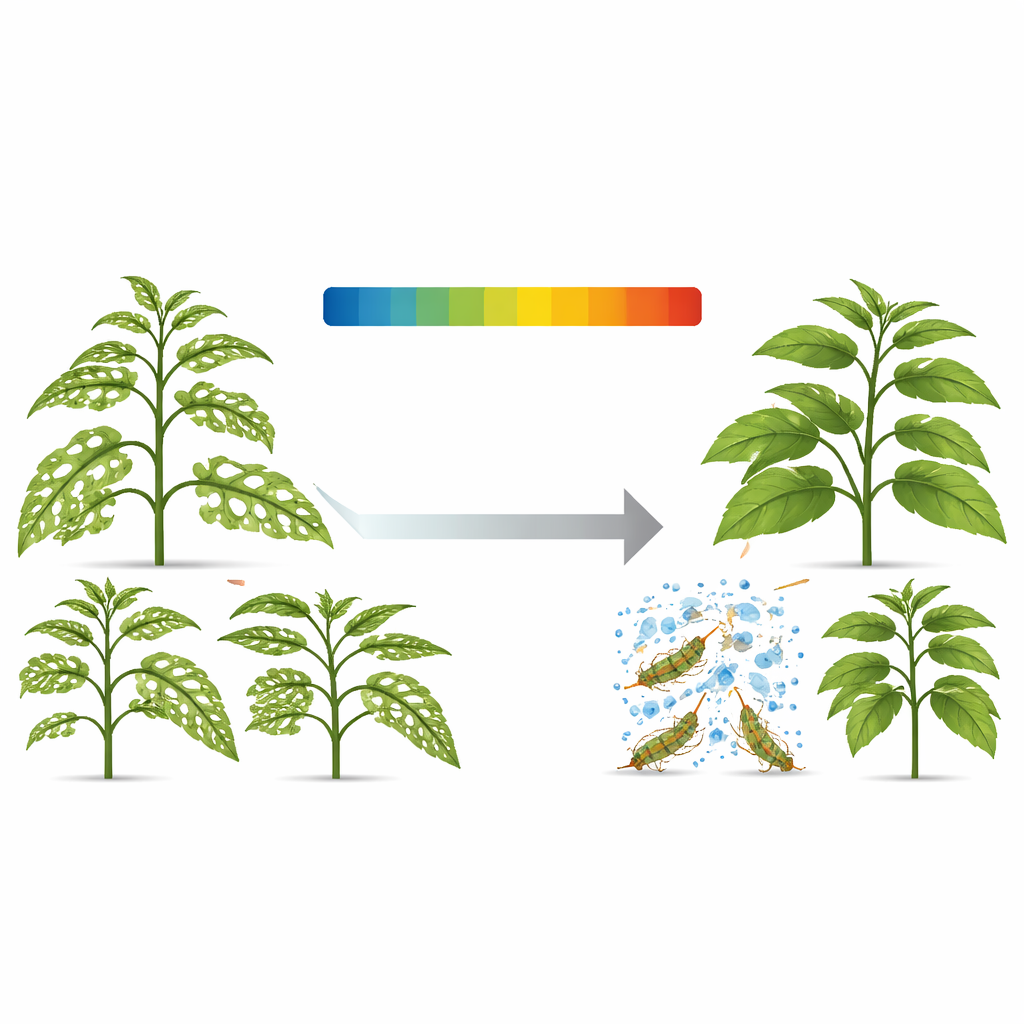
Leafy amaranth is a nutritious, fast-growing vegetable that helps feed families across Africa, Asia, and the Americas. But its biggest enemy is a small caterpillar, Spoladea recurvalis, that can strip fields bare and wipe out harvests. Farmers often turn to chemical sprays, which can leave residues on these quick-to-harvest greens. This study asks a practical question with big implications for food safety: can a naturally occurring fungus safely control this pest, and does temperature determine how well it works?
A pest, a helpful fungus, and the role of heat
The researchers focused on two strains of a natural insect-killing fungus, Metarhizium anisopliae, already used as a “biopesticide” against other pests. They exposed young S. recurvalis caterpillars to these fungi at different constant temperatures—15, 20, 25, 30, and 35 °C—and then watched how many larvae died, how their internal immune cells changed, and how the bacteria living in their guts responded. The goal was to pinpoint temperatures where the fungus works best and to understand how the insect’s own defenses help or hinder infection.
Warmer conditions, stronger control
Temperature turned out to be a powerful switch. One fungal strain, known as ICIPE 30, was especially lethal at 30 °C: more than four out of five larvae died, while the second strain, ICIPE 18, killed far fewer. At cooler temperatures, both strains performed poorly. This pattern suggests that in warm field conditions, the more aggressive strain can germinate and grow quickly inside the caterpillars, outpacing their defenses. At lower temperatures, the fungus is slower and the insects are more likely to survive, making biological control less reliable.
The caterpillar’s blood cells fight back
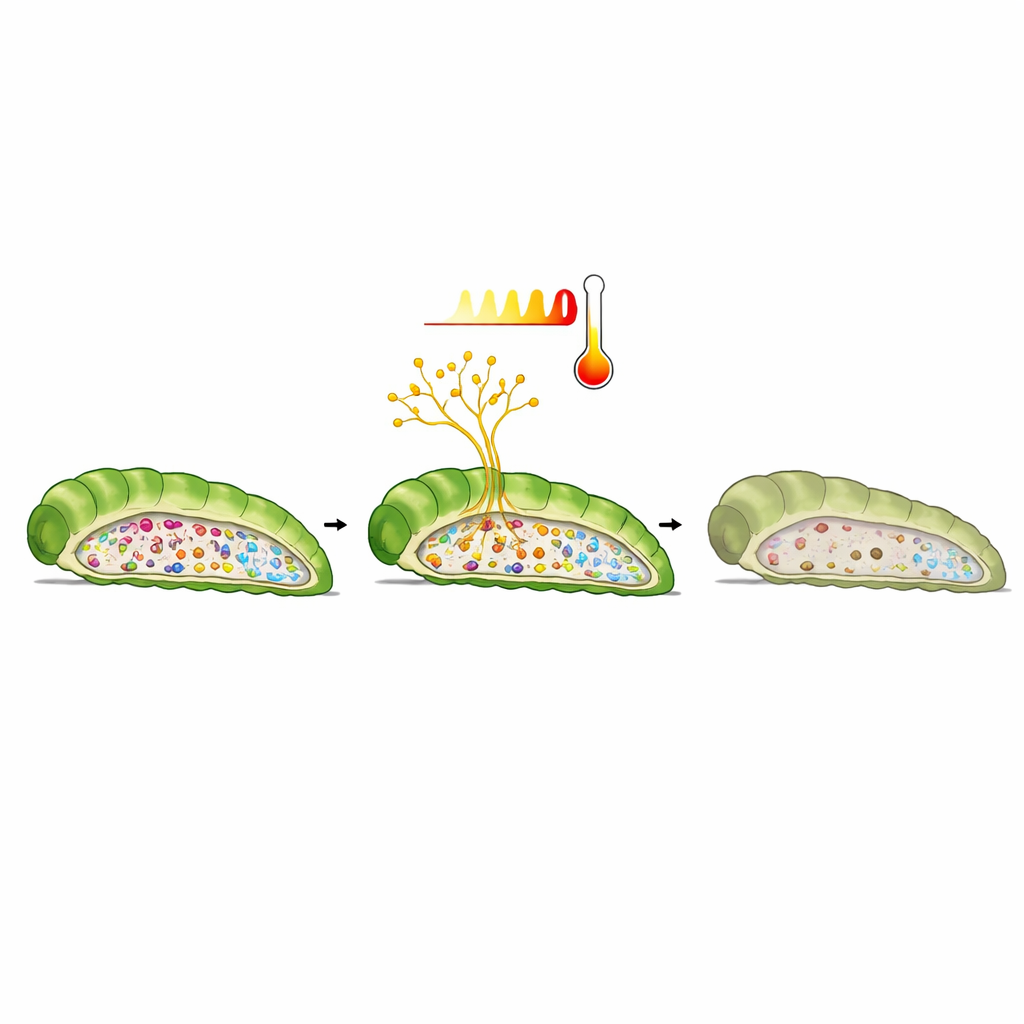
Inside each caterpillar, the “blood” (hemolymph) is filled with immune cells that act a bit like white blood cells in humans. The team counted these cells over a week after infection. At first, the total number of cells rose sharply, especially at 25 and 30 °C, showing that the insects were mounting an active defense. Two key cell types, granulocytes and plasmatocytes, increased as they moved to surround and trap invading fungal particles. But at 30 °C in larvae treated with the stronger ICIPE 30 strain, these cell counts later crashed, particularly by day seven. This drop suggests that once the fungus gains the upper hand, it can overwhelm or kill the very cells that were trying to stop it.
Gut microbes as hidden bodyguards
The story does not end with blood cells. The caterpillars’ intestines are home to a rich community of bacteria—over a thousand kinds in all. Some of the most common are Enterobacter, Enterococcus, and Klebsiella, microbes already known in other insects to support digestion, nutrition, and disease resistance. The researchers found that when these bacterial communities were abundant and diverse, the caterpillars were generally less susceptible to the fungal attack. At cooler temperatures and early in the infection, gut diversity stayed high and mortality was lower. In contrast, at 30 °C with the ICIPE 30 strain, the variety and balance of gut bacteria shrank markedly by day seven, just when caterpillar deaths peaked.
When balance breaks, the fungus wins
As the infection progressed under warmer conditions, some helpful bacterial groups declined, and overall diversity and “evenness” fell—a pattern called dysbiosis, or microbial imbalance. The strongest dysbiosis appeared in larvae exposed to the more virulent fungal strain at 30 °C, the same combination that produced the highest mortality and the steepest drop in immune cells. Together, these changes suggest that the fungus not only invades the insect’s body but also disrupts its inner microbial allies, weakening both cellular defenses and gut-based protection.
What this means for safer crop protection
For farmers and consumers, the takeaway is straightforward: the performance of fungal biopesticides against S. recurvalis depends strongly on temperature. Under warm field conditions around 30 °C, the ICIPE 30 strain can both suppress the caterpillar’s immune cells and disturb its gut bacteria, leading to effective pest control without synthetic chemicals. At cooler temperatures, however, the insects’ immune system and microbial partners are more resilient, and the fungus is less deadly. Knowing this helps growers and extension workers decide when and where fungal sprays are most likely to protect amaranth leaves safely, supporting healthier diets with fewer chemical residues.
Citation: Byonanebye, A., Khamis, F.M., Mwangi, M. et al. Temperature dependent immunological responses of Spoladea recurvalis exposed to entomopathogenic fungi. Sci Rep 16, 10820 (2026). https://doi.org/10.1038/s41598-026-45475-4
Keywords: amaranth pests, biological control, entomopathogenic fungi, insect gut microbiome, temperature effects