Clear Sky Science · en
Physicochemical responses of soil and caraway crop to drip irrigation with magnetized saline irrigation
Why this salty water story matters
Farmers in dry regions often have to make do with salty groundwater, which can quietly poison their soil and shrink harvests. This study explores an unusual helper: running that salty irrigation water through a strong magnetic device before it reaches the field. The researchers tested whether this treatment, combined with modern drip irrigation, could help caraway plants grow better, use less water, and still produce the flavorful oils that are valuable to the food and pharmaceutical industries.
Farming herbs in a thirsty land
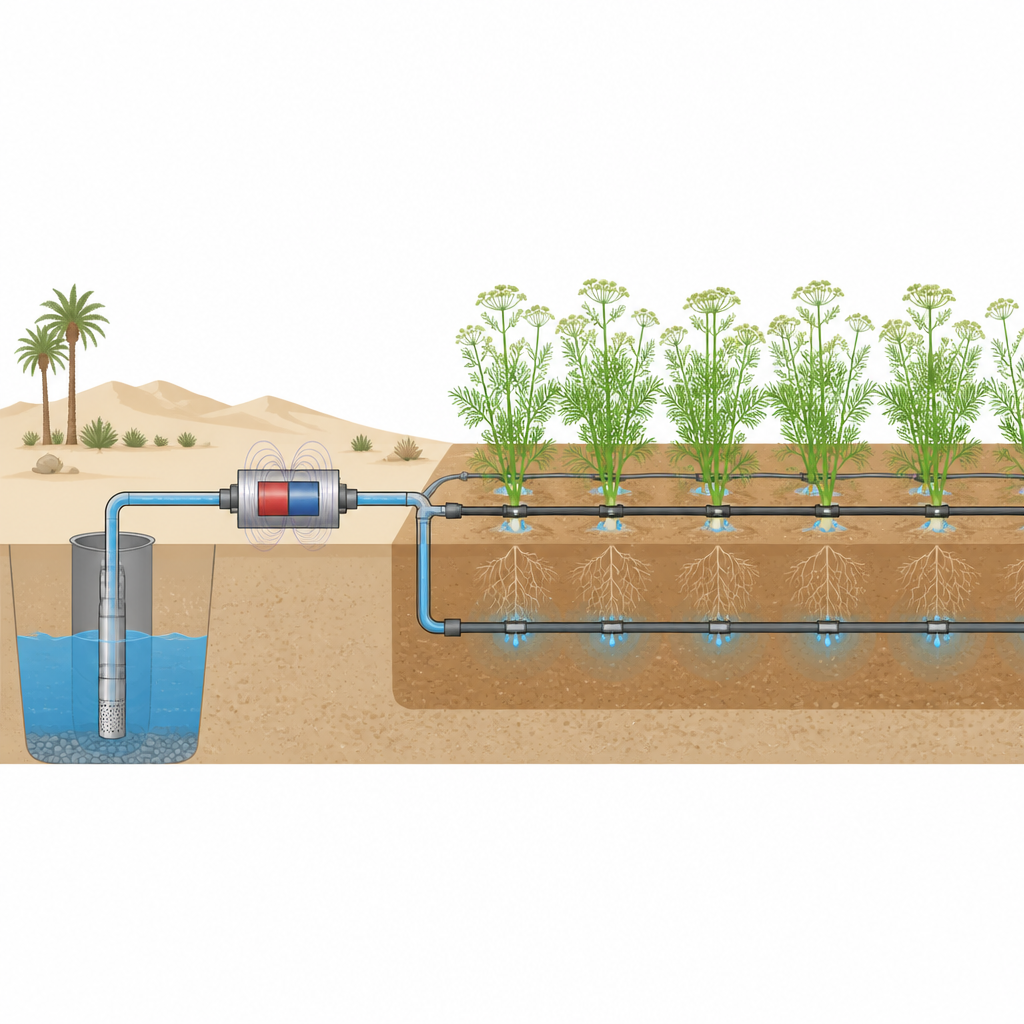
Egypt faces rising pressure on its limited water resources, while demand for medicinal and aromatic plants like caraway continues to grow. These crops can bring good income but are very sensitive to salt in soil and water. The team worked at Wadi El-Natrun, a newly reclaimed desert area with sandy, low-fertility soil and salty well water. They chose caraway because its seeds and essential oil are widely used as natural remedies and flavoring, yet its cultivation is restricted by harsh growing conditions.
How the field experiment was set up
To see what really happens under farm-like conditions, the researchers grew caraway over two seasons using four setups: magnetized or normal saline water, each combined with either surface drip lines on top of the soil or subsurface drip lines buried 15 centimeters below. All plots received the same fertilizer and crop care. The team tracked soil salinity, sodium levels, plant growth, fruit yield, essential oil content and composition, water use, and economic returns. This allowed them to tease apart the roles of water treatment and drip layout in shaping both soil health and crop performance.
What changed in the soil and water use
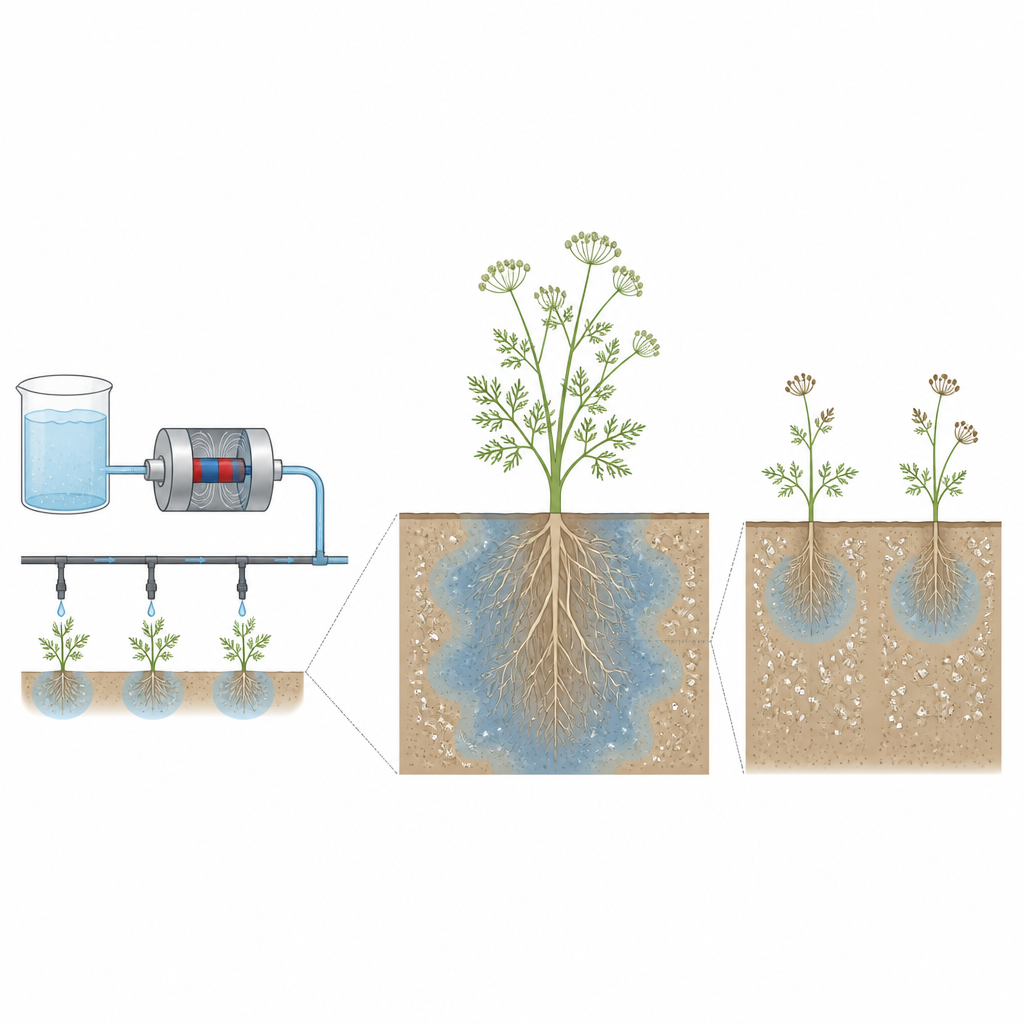
With normal saline water, salts built up in the root zone, especially under subsurface drip, where less water is lost at the surface and more salts stay near the roots. Electrical conductivity and exchangeable sodium rose after irrigation, signaling a creeping salinity problem. When the water was magnetized, this trend reversed: soil salinity either stayed steady or dropped, and sodium levels fell across the profile. The magnetized water also reduced the total irrigation needed, saving roughly 619 to 681 cubic meters of water per hectare compared with untreated water. At the same time, irrigation water productivity, a measure of how much crop is produced per unit of water, rose by about 14 to 16 percent, with the best values seen when magnetized water was combined with subsurface drip.
How the plants and oils responded
Caraway plants irrigated with magnetized water grew taller, developed more branches and flower clusters, and produced heavier fruits than those receiving untreated water. Subsurface drip generally outperformed surface drip, likely because it kept moisture more stable around the roots and cut evaporation losses. As a result, fruit yield per hectare increased by around 10 percent under magnetized subsurface drip. Essential oil yield per hectare climbed even more, by over 24 percent, even though the oil percentage in each fruit tended to decline slightly due to a dilution effect from higher biomass. Detailed chemical analysis of the oil showed a shift in its main components: the share of the compound carvone increased while D-limonene decreased under magnetized treatments, especially with subsurface drip. This suggests that changes in water behavior and plant stress signals can nudge the plant’s internal chemistry toward more oxygen-rich aroma compounds.
What this means for farmers and future work
For farmers wrestling with salty water, the study’s message is that combining a magnetic treatment unit with subsurface drip irrigation can keep more salts away from roots, grow more caraway with less water, and boost both the quantity and quality of the essential oil. The approach also improved the benefit–cost ratio, indicating better returns even after accounting for the device and system costs. The authors caution that magnetization is not a magic fix, but a tool that works best alongside good soil and water management. They suggest that future research should fine-tune magnetic field strength, exposure time, and device placement to better understand how this technology can support sustainable herb production in other salt-affected regions.
Citation: Abd Elkareem, N.S., Amer, A., Shahin, A. et al. Physicochemical responses of soil and caraway crop to drip irrigation with magnetized saline irrigation. Sci Rep 16, 16295 (2026). https://doi.org/10.1038/s41598-026-45468-3
Keywords: magnetized irrigation water, soil salinity, drip irrigation, caraway essential oil, water productivity