Clear Sky Science · en
In-situ evidence of volcanic ash aggregation during fallout from combined ground- and UAS-based observations
Why falling ash matters to us
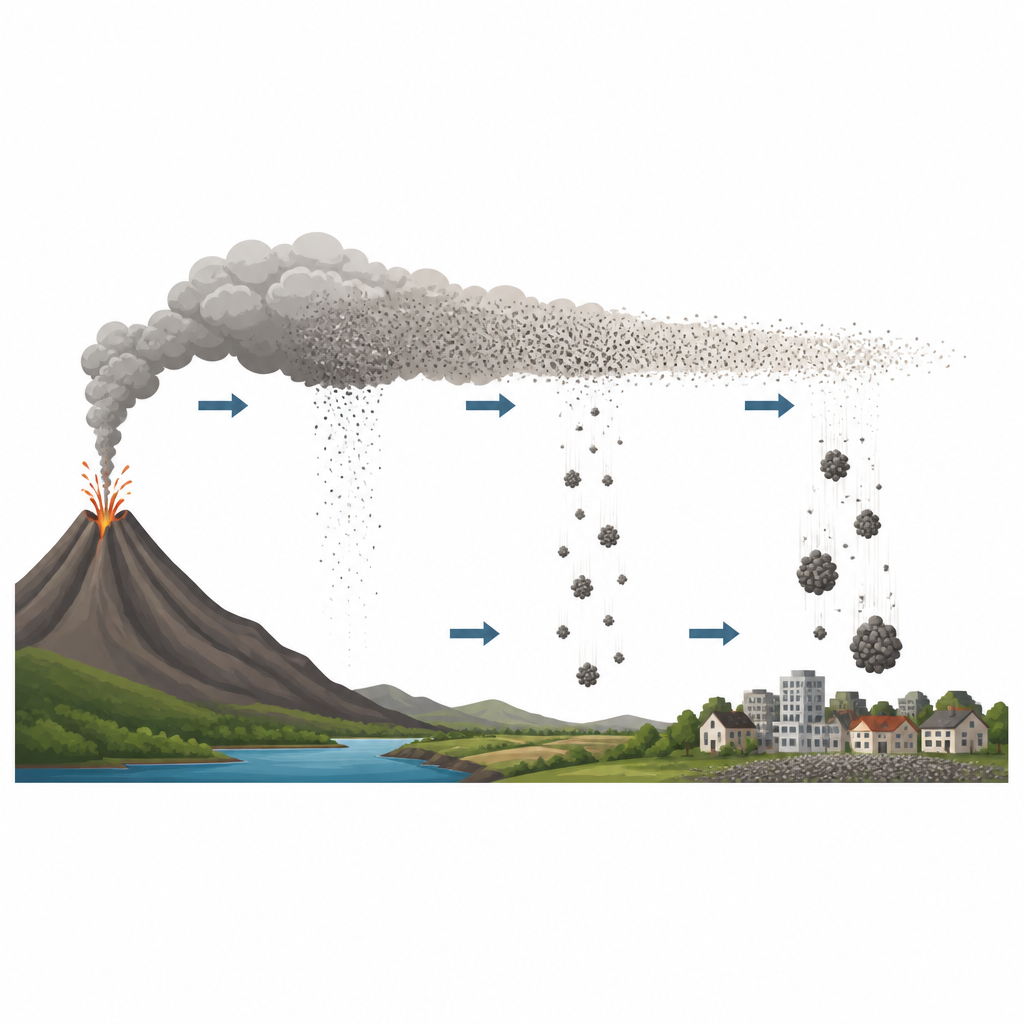
When a volcano erupts, its ash does not just drift like smoke and quietly settle. How those tiny grains clump together in the air controls where ash lands, how thick it piles up, and who or what lies in its path. This study at Japan’s Sakurajima volcano shows, for the first time using drones and ground instruments together, how ash grains rapidly gather into larger clumps even during relatively weak, everyday eruptions, reshaping our understanding of volcanic risk and air quality.
A volcano that erupts almost every day
Sakurajima is a constantly restless volcano that frequently releases low ash plumes rising less than two kilometers above sea level. Because these events are modest compared with spectacular major eruptions, they are often treated as routine. Yet they send fine and coarse ash into the sky above nearby communities almost daily. The researchers focused on four such events over several days, ranging from gentle ash venting to mild explosive bursts, to see how ash behaved as it traveled from the vent, through the cloud, and down to the ground.
Watching ash fall from sky to ground
To track this journey, the team combined a network of ground instruments with a custom drone system. Cameras kilometers away measured plume height and motion. Nearer the volcano, optical sensors on the ground recorded how many particles arrived each minute, how big they were, how fast they fell, and even whether they carried electrical charge. At the same time, a drone hovered about 500 meters above the takeoff point beneath the drifting cloud. Onboard counters measured the number and size of very fine airborne particles, while sticky sample plates collected ash grains in mid air. Matching sampling times and computer models of particle paths allowed the scientists to compare what the drone saw aloft with what finally reached the surface.
How ash grains stick together
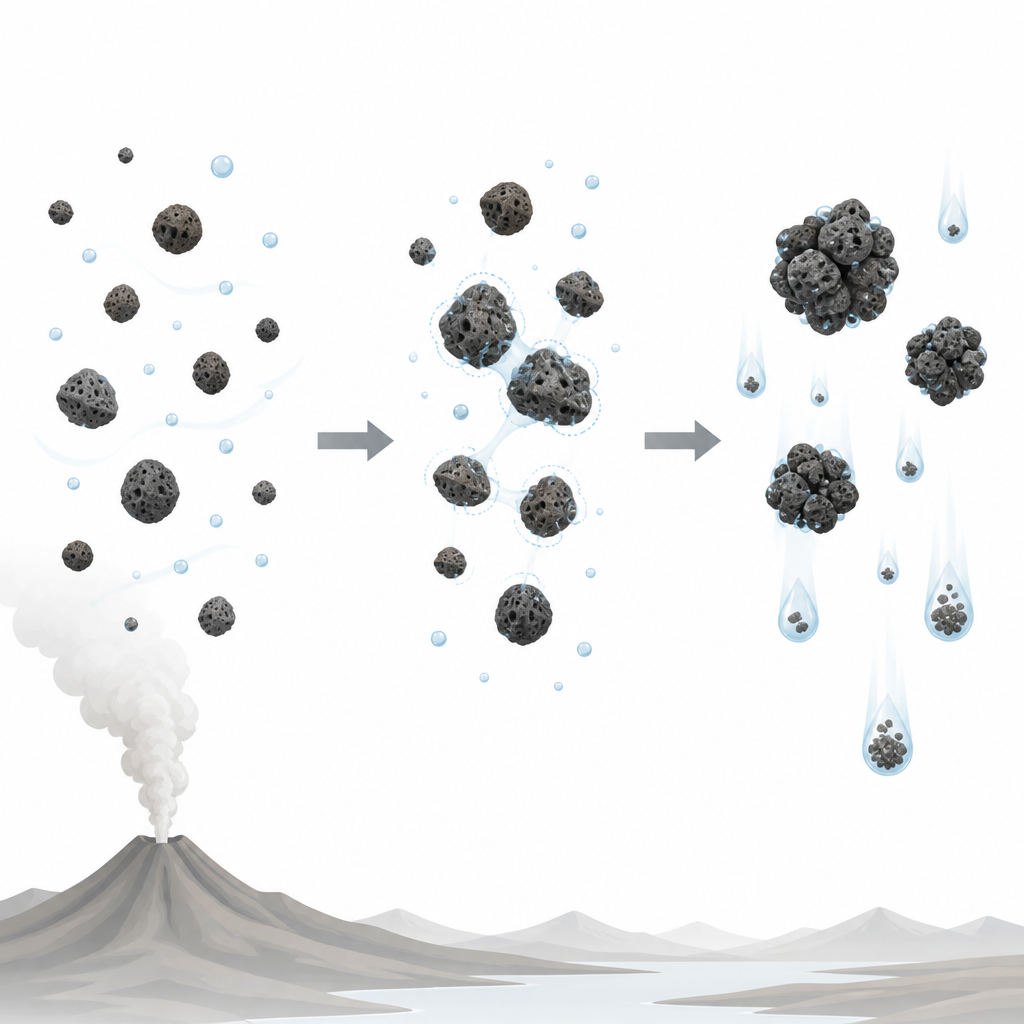
The samples and measurements revealed that ash grains commonly arrive not only as single particles but also as clumps. Under dry to slightly moist conditions, grains carried electrical charges that helped them attract one another, forming loose clusters made mainly of fine ash coating or surrounding larger pieces. In rainy conditions, water played the dominant role, gathering ash into more compact pellets and ash filled raindrops. Across all four events, the proportion of ash found inside aggregates was consistently lower in the drone samples than in the ground samples, showing that many clumps form during the last few hundred meters of descent, not only inside the main cloud.
Fast tracks for very fine ash
On their own, tiny ash grains should drift slowly and stay aloft for long periods. Yet the drone’s particle counter detected sharp, short lived layers of fine particles under the cloud, and the ground instruments recorded pulses of ash arrival that could not be explained by simple settling. Computer models of particle paths confirmed that many small grains could not have fallen individually from the plume to the sampling sites. Instead, they likely rode downward in ash rich fingers that peel off the cloud and in growing clumps that fall faster than single grains. As clumps form and break apart, some fine particles remain free but still reach the ground more efficiently than models of individual settling would suggest.
What this means for people living near volcanoes
For nearby communities, this work shows that even modest daily plumes can bring ash to the ground more quickly and closer to the vent than expected because grains stick together as they fall. The study makes clear that both electric forces and liquid water can strongly boost this clumping, and that the final few hundred meters above the ground are a particularly active zone where ash rapidly reorganizes. Better accounting for these processes in dispersion forecasts should improve estimates of where ash will land, how dense the air may become, and how long particles linger, helping planners and residents better manage the ongoing impacts of frequently active volcanoes.
Citation: Thivet, S., Simionato, R., Fries, A. et al. In-situ evidence of volcanic ash aggregation during fallout from combined ground- and UAS-based observations. Sci Rep 16, 15083 (2026). https://doi.org/10.1038/s41598-026-45460-x
Keywords: volcanic ash, Sakurajima, ash aggregation, drone measurements, tephra fallout