Clear Sky Science · en
Map-free vehicle trajectory prediction method based on heterogeneous graphs and dynamic scene constraints
Why predicting car movement without maps matters
As autonomous cars edge closer to everyday reality, they must safely guess where nearby vehicles are heading in the next few seconds. Many of today’s systems lean on ultra-detailed digital maps to guide these guesses. But such maps are costly to build, hard to keep up to date, and often missing in tunnels, rural roads, or fast-changing city streets. This study explores how self-driving systems can still make reliable short-term predictions about surrounding cars using only what they see on the road, without depending on pre-made maps.
Reading the road from how drivers move
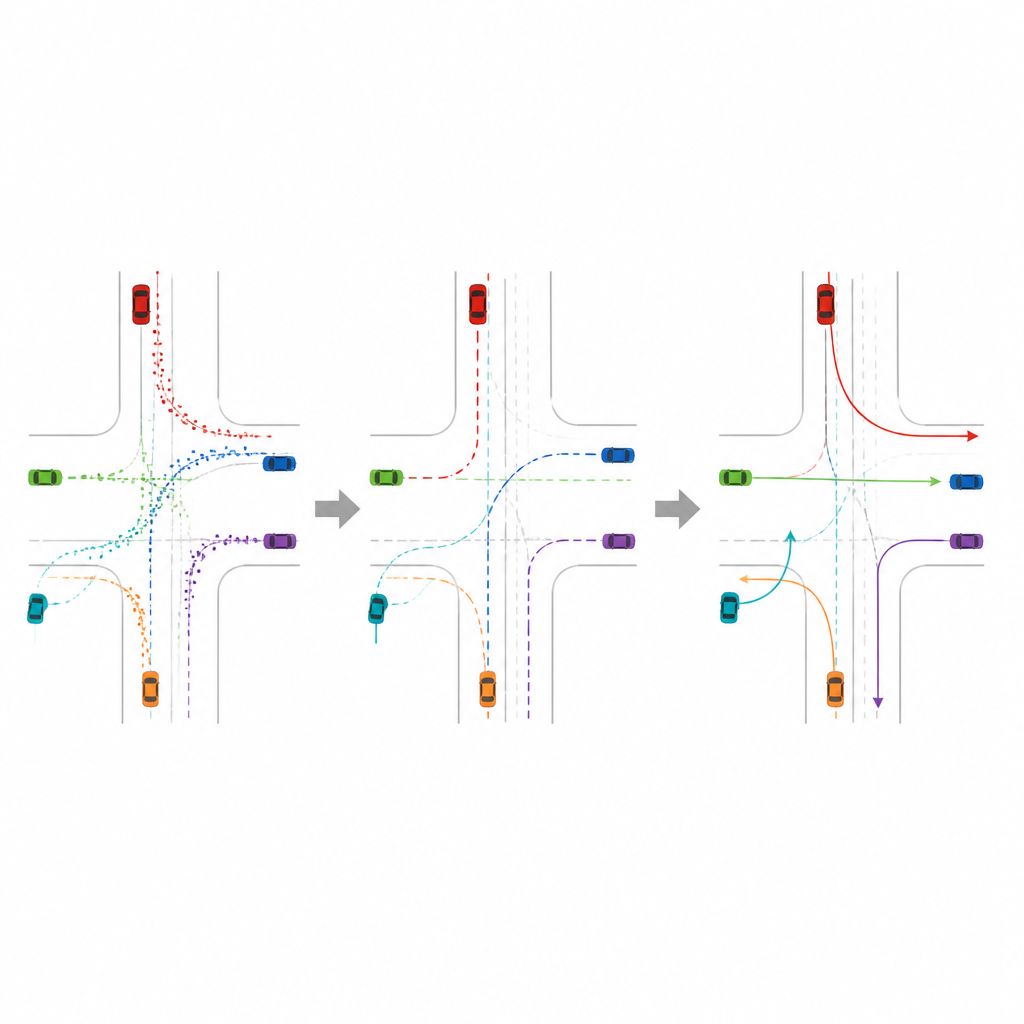
The authors start from a simple idea: the shape of the road is hidden in how people drive on it. If you watch many cars passing through the same place, their paths reveal the lanes, turns, and typical flows, even if you never see a painted line. The team’s method, called DynaScene-Pred, collects short snippets of recent motion from all vehicles in view. It then groups paths that look alike, such as cars going straight or turning left, and from these groups it draws smooth "virtual lanes" that trace the likely routes through the scene. These virtual lanes act like an internal sketch of the road, built on the fly from data instead of from a stored map.
Connecting vehicles and virtual lanes
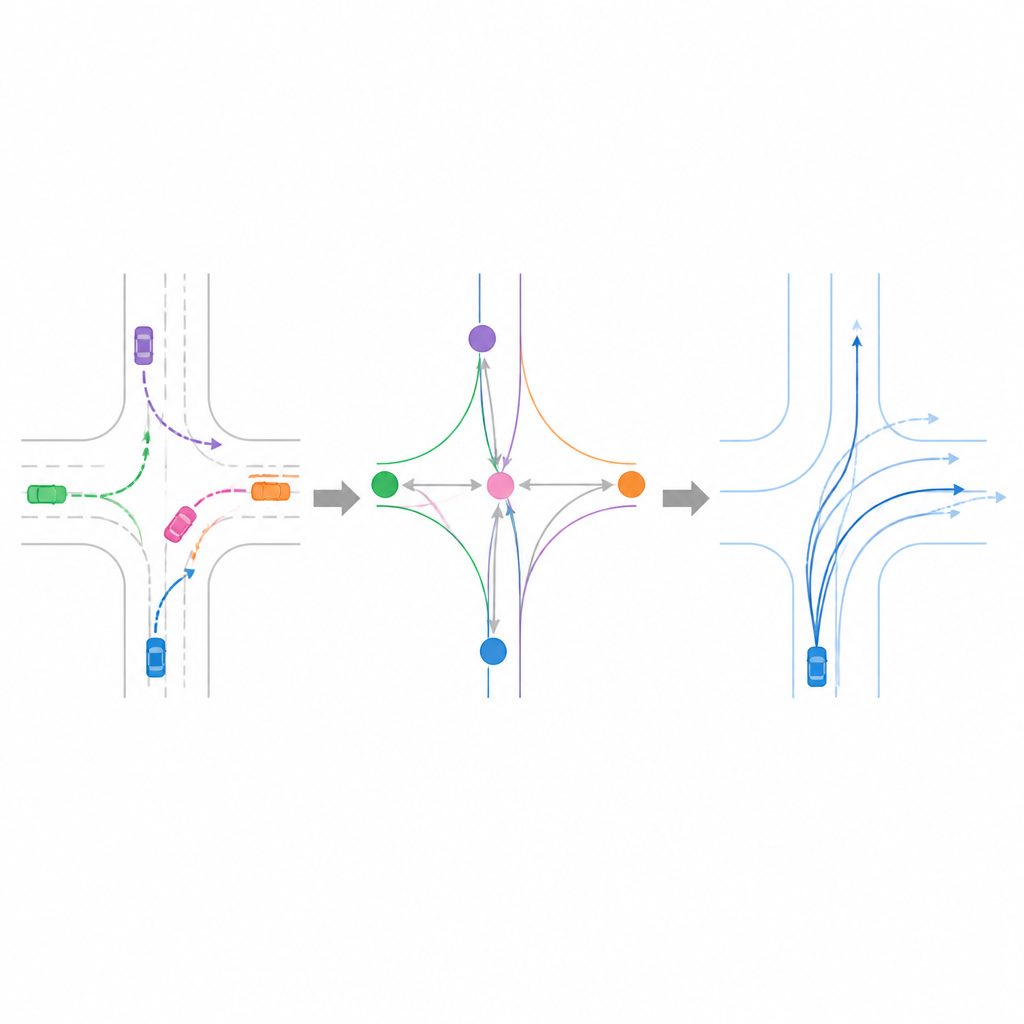
Once the virtual lanes are in place, the model treats every car and every lane as dots in a network and links them with lines that describe how they relate. Nearby cars are connected to show who might influence whom, and each car is also linked to the virtual lanes that best match its recent path and direction. A type of neural network that works on such networks of dots and lines then passes information along these links. At the same time, attention modules decide which neighbors, which lanes, and which past moments matter most. Together, these steps let the system reason about both social behavior, such as cars reacting to each other, and physical limits, such as staying within a bend in the road.
Imagining several possible futures
Driving is uncertain: a car might keep going straight, change lanes, or turn, even if its past motion looks similar. To cope with this, DynaScene-Pred does not output just one future path, but several. Inside the model, a compact hidden code represents different driving intentions. During training, this code is tuned so that its variations line up with how drivers actually behave in many recorded scenes. When making a prediction, the system samples a few versions of this code and, for each one, rolls out a possible future path that still respects the virtual lanes and the surrounding traffic. This leads to a small set of realistic options rather than a single brittle guess.
Testing on real city traffic
The researchers test their approach on Argoverse, a well-known public dataset of real urban driving in US cities. Unlike many competing methods, they deliberately ignore the rich built-in maps and use only vehicle positions over time. They compare their results with several other "map-free" systems as well as with leading methods that do use maps. On key measures of average and final position error, and on how often all predicted paths miss the true outcome, their system consistently beats other map-free baselines. While it does not quite match the absolute accuracy of the strongest map-based models, it comes close enough to show that learned virtual lanes can stand in for expensive maps in many situations, all while keeping processing fast enough for real-time use in a car.
What this means for future self-driving cars
For a non-specialist, the main takeaway is that self-driving cars may not always need finely detailed maps to behave safely and sensibly. By watching how drivers move, DynaScene-Pred rebuilds an internal picture of the road and uses it to forecast several plausible paths for each nearby car. This map-free strategy improves over earlier approaches that relied only on raw motion without any notion of lanes. It offers a more flexible way to handle roads that change often or are poorly mapped, bringing autonomous driving a step closer to working reliably in the messy, varied conditions of the real world.
Citation: Liu, H., Bao, Y., Hou, Y. et al. Map-free vehicle trajectory prediction method based on heterogeneous graphs and dynamic scene constraints. Sci Rep 16, 15052 (2026). https://doi.org/10.1038/s41598-026-45445-w
Keywords: autonomous driving, trajectory prediction, map-free, virtual lanes, traffic interactions