Clear Sky Science · en
A CEL simulation approach for penetration-leveling of the multi-bucket foundation incorporating the temperature analogy method
Keeping Sea Towers Standing Straight
Offshore wind farms and platforms rely on strong foundations fixed in soft seafloor sediments. When these foundations tilt during installation, their strength and safety drop, yet correcting that tilt at sea is expensive and hard to test. This study shows how computer simulations can cheaply and reliably predict how a special type of foundation, made of several large “buckets,” settles and levels itself on the seabed, including how seawater moves through the sand while this happens.
Why Multi Bucket Foundations Matter
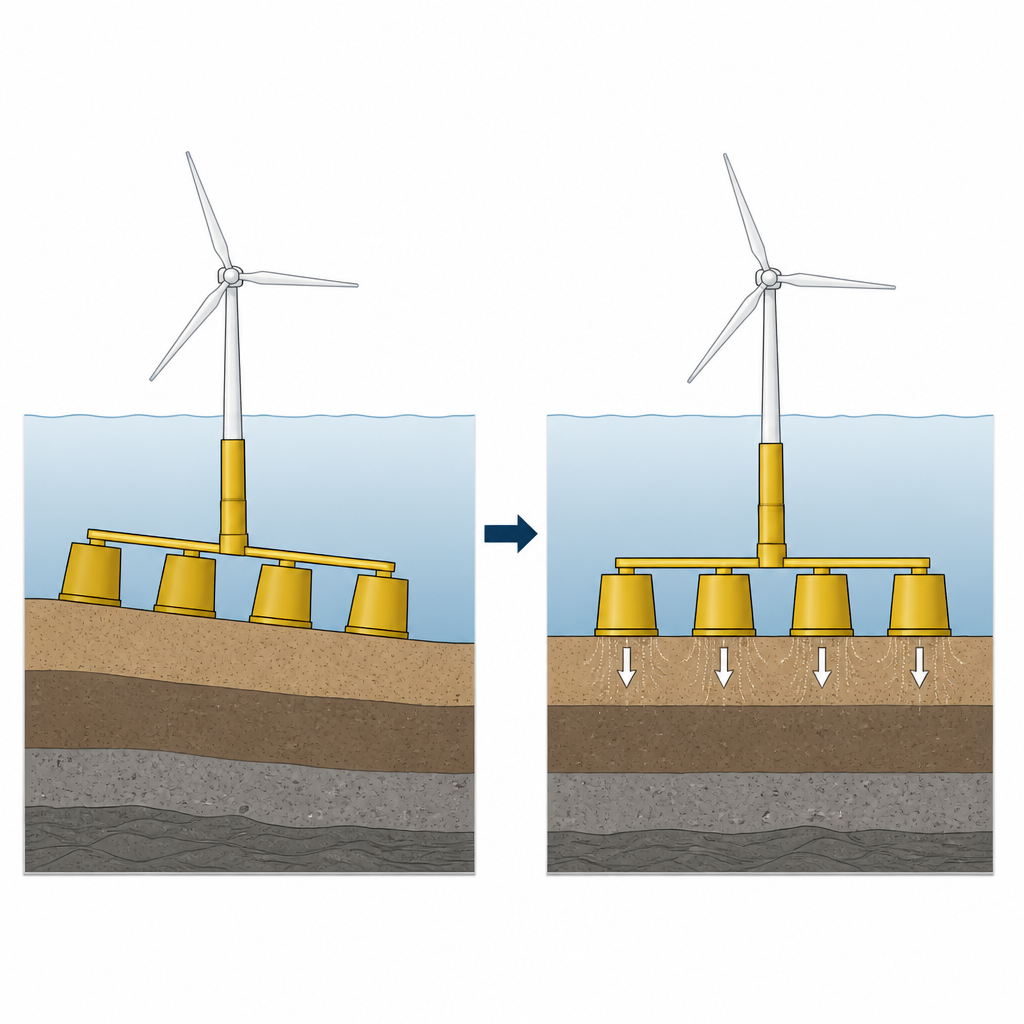
Instead of driving many long piles into the seabed, engineers can use multi bucket foundations, which look like a cluster of upside down cans connected by a frame. These systems are attractive because they are quicker to install, can sometimes be reused, and disturb the seafloor less than traditional methods. However, uneven seabed conditions or patchy soil strength can make the whole foundation lean as it sinks. Standards for offshore structures limit this tilt to a few degrees, so installers must carefully control how each bucket is pulled into the seabed using suction, a gentle vacuum applied inside the buckets. Until now, most guidance on how to do this has come from small, time consuming tank experiments.
Using Flow Like Heat in a Digital Sandbox
Simulating this process is tricky because the soil around the buckets deforms a lot and seawater seeps through the pores at the same time. Standard numerical tools struggle when the soil mesh stretches and twist too far, and many do not directly handle water flow with large deformations. The authors use a technique called the coupled Eulerian Lagrangian method, in which the soil is allowed to “flow” through a fixed grid while the steel buckets move within it. To capture water movement without special fluid elements, they exploit a mathematical coincidence: the equations that describe steady seepage through soil have the same form as those for heat spreading through a solid. By treating water pressure as if it were temperature, and flow as if it were heat flux, they can track seepage using the software’s heat transfer module.
Testing the Analogy and the Model
Before trusting this shortcut, the team checks it on two classic problems: water flowing through a tall sand column and water moving around an impermeable wall buried in soil. For both cases, the “temperature” based simulations match conventional seepage calculations in terms of stress, pressure change, and flow patterns, showing that the analogy is sound for slow, saturated flows. They then build a detailed virtual version of a four bucket foundation tested earlier in a laboratory tank. By tuning only a few soil parameters within realistic bounds, the simulation reproduces the measured depth reached under self weight, the extra force needed to push the foundation to a target depth, and how much tilt is removed when a gentle suction is applied to the higher bucket.
Looking Inside the Seafloor During Leveling
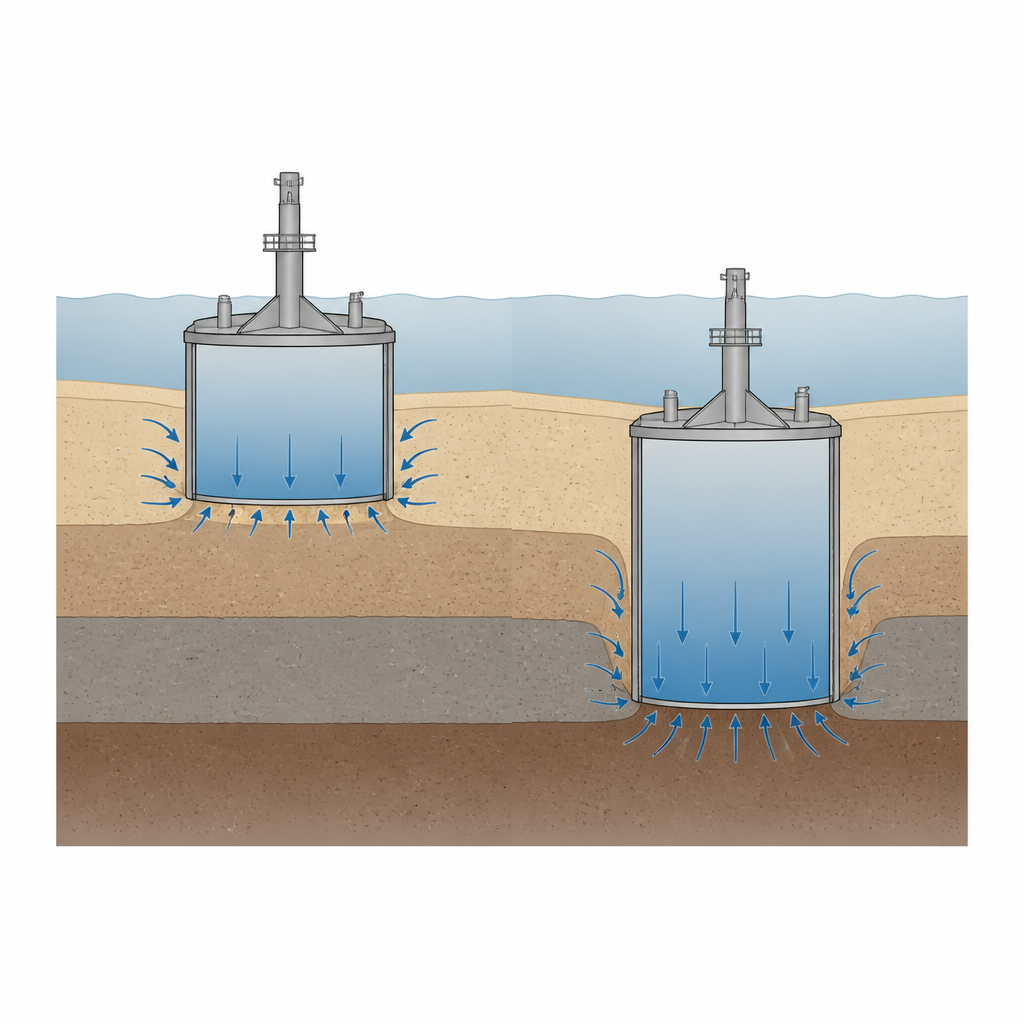
With confidence in the model, the authors use the temperature analogy to peer into the soil during leveling, something not possible in the laboratory. They freeze the bucket motion at several key moments and compute the steady seepage pattern around a pair of buckets. The results show that changes in pore water pressure are concentrated beneath and close to the bucket where suction is applied, spreading more deeply downward than sideways. The highest water speeds occur at the bucket edge, especially along the inner wall, while flow in the middle area inside the bucket is much slower. As the buckets penetrate deeper, these seepage speeds gradually drop, suggesting that deeper embedment allows slightly stronger suction without triggering soil failure.
What This Means for Offshore Design
In simple terms, the study delivers a fast and practical way to “dry run” leveling strategies for multi bucket foundations on a computer instead of relying only on costly tank tests. Within its limits slow, saturated conditions and a simplified soil model the approach can predict how much a tilted foundation will move when suction is adjusted, and where in the surrounding sand seepage is most intense. This gives engineers a tool to refine installation plans, reduce the risk of excessive tilt or local soil erosion, and better understand how these bucket clusters interact with the seabed as offshore wind and other marine structures expand into deeper waters.
Citation: Gao, K., Cheng, Z., Yu, K. et al. A CEL simulation approach for penetration-leveling of the multi-bucket foundation incorporating the temperature analogy method. Sci Rep 16, 16165 (2026). https://doi.org/10.1038/s41598-026-45440-1
Keywords: offshore wind foundations, multi bucket foundation, soil seepage, numerical simulation, seabed engineering