Clear Sky Science · en
Ultraviolet metasurface-enabled flat-top beam shaping with size preservation uniformity and broadband robustness
Sharper light for sharper chips
Modern computer chips are etched with ultraviolet light, but the light itself is not ideal for drawing crisp patterns. Laser beams usually have a bright center and dim edges, which can blur tiny features on a wafer. This study explores a new kind of ultra-thin optical surface that reshapes ultraviolet laser beams into a more even, table-like profile without changing the beam’s size, a trick that could help make smaller, more reliable electronic devices.
Why the shape of a light beam matters
In chip making and other precision tools, engineers want the light to act like a perfectly even paint roller: every part of the target should receive almost the same dose. Real ultraviolet lasers, however, behave more like spotlights, with most of the energy packed in the center and fading toward the edges. This uneven pattern leads to blurred edges, slanted walls in etched features, and the need for multiple overlapping scans to even out the exposure. It is not enough just to flatten the beam; its footprint must also stay the same size so that the illuminated area matches the rest of the optical system.
Flat beams from a flat surface
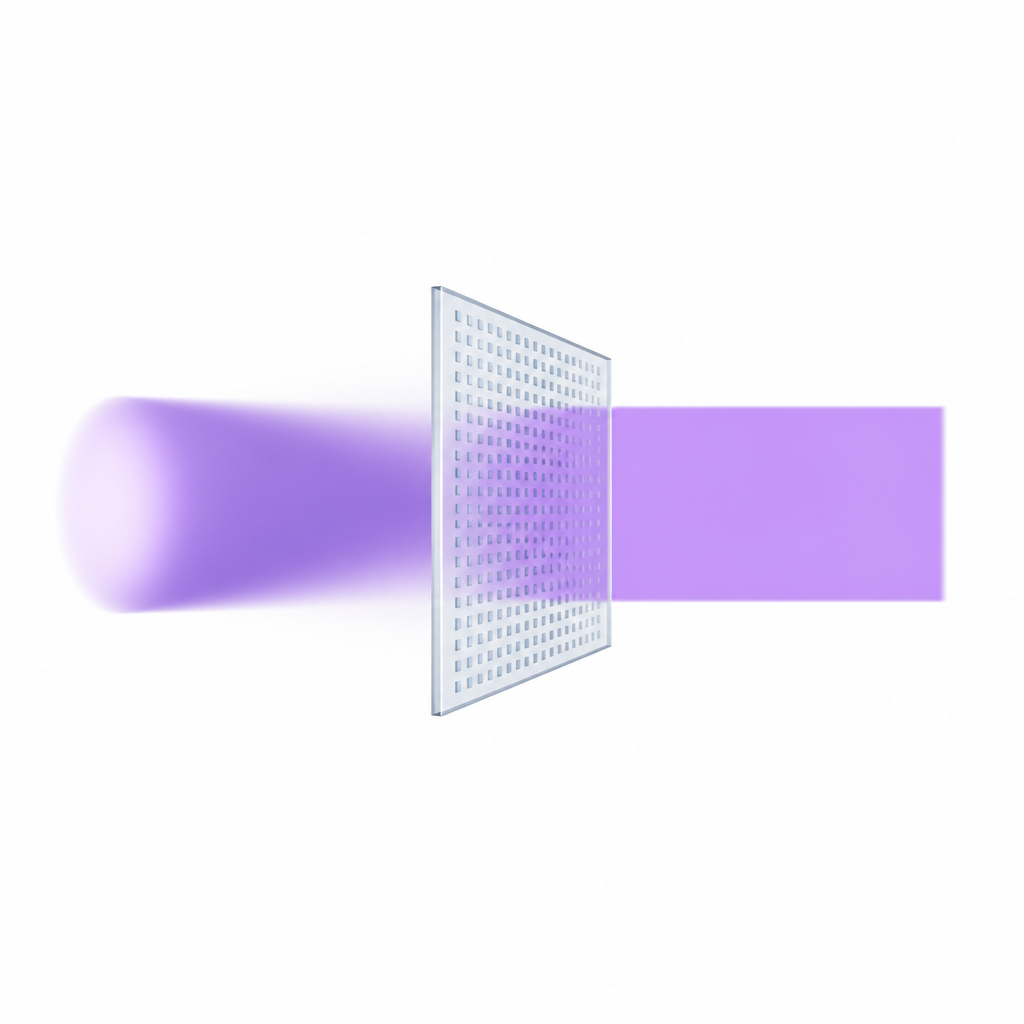
The authors design a flat optical element called a metasurface that can turn a familiar bell-shaped beam into a uniform “flat-top” beam in the ultraviolet range around 300 nanometers wavelength. The device is made of a grid of tiny pillars of hafnium dioxide, a material that works well for deep ultraviolet light with low loss. Each pillar acts like a small antenna that delays the passing light by a controlled amount. By rotating these pillars, the metasurface uses a geometric phase effect to sculpt the wavefront of the beam. The result is a square beam with nearly constant brightness across its center and with a width that closely matches that of the incoming beam.
Two ways to design the same trick
The researchers compare two strategies for deciding how each tiny pillar should shape the light. The first, called a mapping method, starts from the idea of conserving energy: it calculates how to move light from the bright center of the original beam to fill out the dimmer edges of the desired flat-top pattern, giving a direct formula for the needed phase shifts. The second, an iterative computer-based method, repeatedly simulates light traveling back and forth between the metasurface and the target beam until the calculated pattern matches the goal. Both routes produce workable designs that can be implemented on the same metasurface platform, allowing a fair head-to-head comparison.
Stable performance across colors and angles
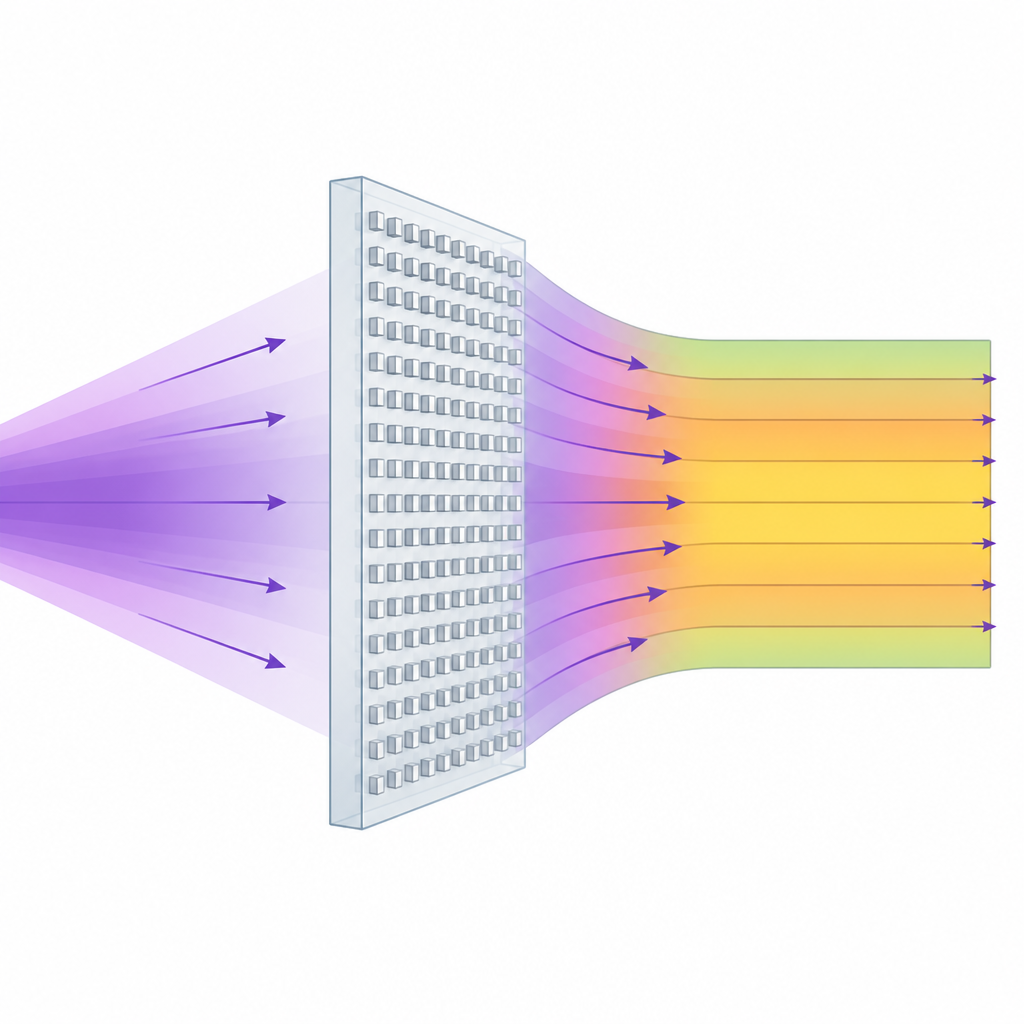
Simulations show that the best-performing design produces a flat-top beam with very high uniformity and uses nearly 80 percent of the incoming light in the useful region. Most importantly, the width of the shaped beam differs from that of the starting beam by less than one quarter of one percent, meaning the footprint is essentially preserved. The team also tests how the device behaves when the ultraviolet color shifts across a broad range or when the light arrives at angles up to ten degrees away from straight on. The flat-top shape and beam size stay largely intact, though efficiency declines at the shortest wavelengths, revealing how real-world variations might affect performance.
What this means for future tools
The work suggests that ultra-thin patterned surfaces can deliver uniform, size-preserving ultraviolet beams using a compact element that could fit into existing optical systems more easily than bulky lenses or holographic plates. While the results are based on detailed computer models rather than experiments, they point toward practical designs that current nanofabrication methods should be able to build. If realized in the lab, such metasurfaces could help improve ultraviolet lithography, laser micromachining, and other technologies that depend on sharp, even illumination over very small areas.
Citation: Li, W., Li, J., Zhao, T. et al. Ultraviolet metasurface-enabled flat-top beam shaping with size preservation uniformity and broadband robustness. Sci Rep 16, 15687 (2026). https://doi.org/10.1038/s41598-026-45434-z
Keywords: ultraviolet metasurface, flat-top beam, beam shaping, lithography, nanophotonics