Clear Sky Science · en
Defining the safe operational window for holmium laser lithotripsy in impacted ureteral stones: an analysis of power, operator duty cycle, and irrigation flow
Why this matters for people with kidney stones
Kidney and ureteral stones are common and often very painful. A popular way to treat them is with a tiny camera and a holmium laser that breaks the stone apart from inside the urinary tract. But the same laser that shatters stone can also overheat the delicate wall of the ureter, possibly leading to scarring and long-term blockage. This study asks a practical question with real consequences for patients: under what settings can surgeons use these lasers effectively while keeping the ureter safely below damaging temperatures?
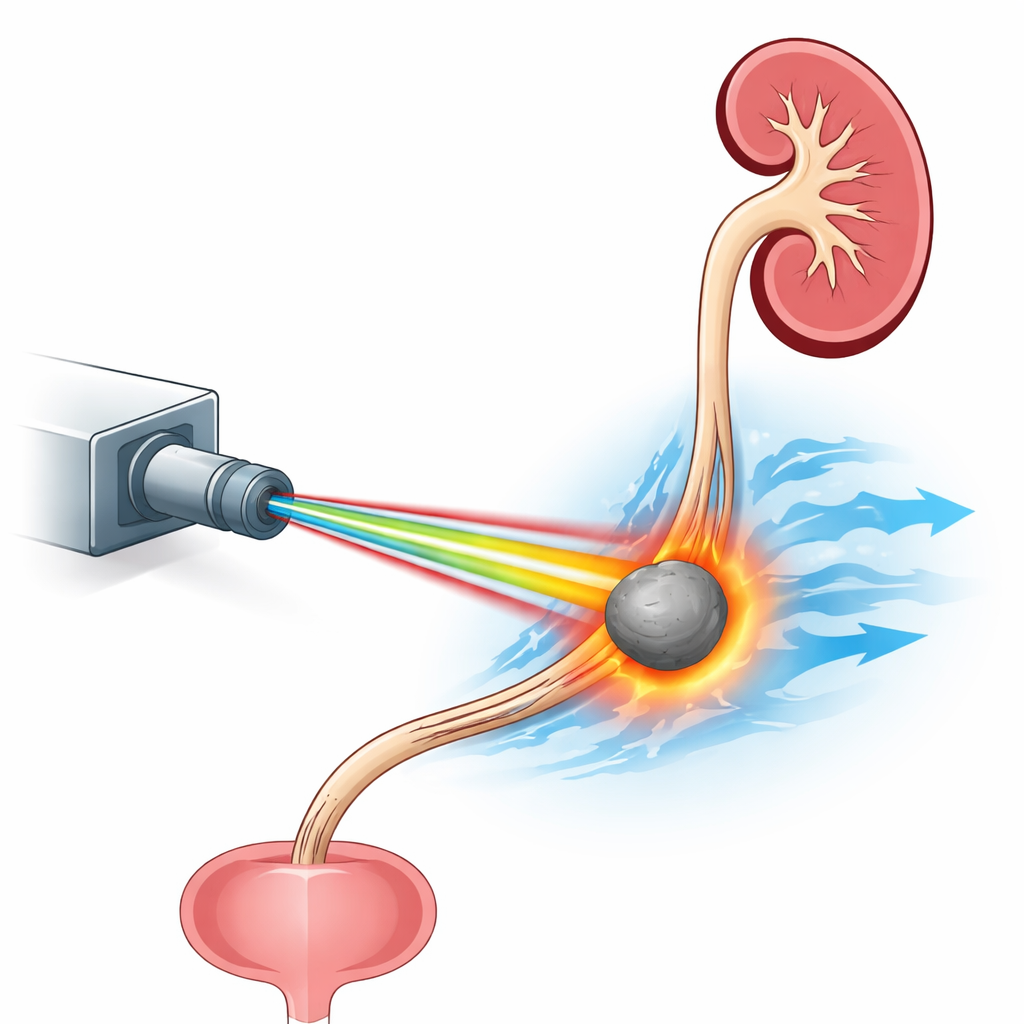
Blocked tube, trapped heat
The researchers focused on “impacted” ureteral stones—stones that have been stuck in place long enough to cause swelling and scarring around them. In these tight spaces, irrigation fluid that normally cools the area may not circulate well, raising concern that laser heat could build up. To study this safely, the team built a detailed silicone model of a human kidney and ureter using 3D printing. They placed artificial or real human stones in the upper ureter, introduced a surgical scope and holmium laser fiber, and flushed saline through the system to mimic operating-room conditions.
Testing power, pulse rhythm, and cooling
The authors systematically varied three knobs a surgeon can control: laser power (10, 20, 30, or 40 watts), how long each burst of laser stayed on versus off (duty patterns of 1 second on/1 second off, 3 on/3 off, or 5 on/5 off, all at a 50% rhythm), and how fast cooling fluid flowed past the stone (10 or 20 milliliters per minute). Tiny temperature probes placed just above and below the stone recorded the local heat every second during 90 seconds of use. Instead of looking only at peak temperature, the team calculated a “thermal dose” that combines how hot it gets and for how long, expressed as CEM43—an index widely used to judge when tissue is likely to suffer lasting heat damage.
When laser settings cross into the danger zone
At the lowest powers, the news was reassuring. With 10 watts, temperatures stayed below the 43 °C threshold linked to damage for all flow rates and burst patterns, giving a wide safety margin. Most 20-watt settings were also safe, except when cooling was weak (10 mL/min) and laser bursts were long (5 seconds), which produced a small but measurable thermal dose. Trouble began at 30 watts: with low flow and long bursts, the thermal dose shot far past the commonly accepted injury limit of 120 CEM43 minutes within just 90 seconds. At the highest tested power, 40 watts, risk rose sharply. Stronger irrigation at 20 mL/min and shorter bursts (1–3 seconds) could pull the thermal dose back into a relatively low range, but any 5-second burst at 40 watts produced clearly hazardous values, no matter how hard the team pushed the fluid flow.
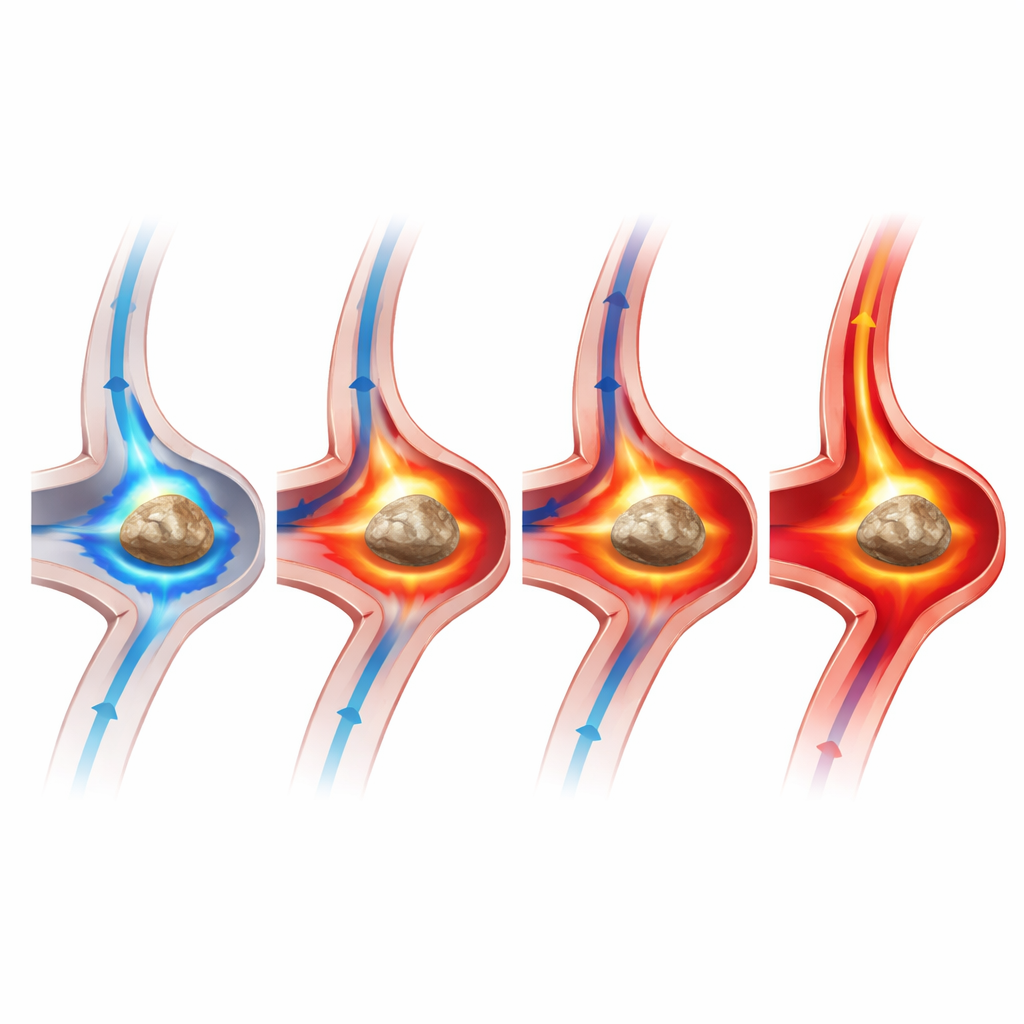
How timing and cooling reshape the heat
Beyond raw power, the pattern of laser use and the strength of cooling proved crucial. Short bursts allowed the fluid to rapidly remove heat between activations, while long on-times let heat accumulate near the ureter wall. The model showed that temperatures could drop quickly—within about two seconds—once the laser stopped or irrigation alone was applied, suggesting that careful pulsing can harness this fast cooling. However, the authors caution that their silicone system is a best-case scenario: real patients have variable blood flow, stone shapes, and irrigation outflow, and inexperienced technique can direct the laser too close to the tissue. All of these factors could make real-world heating worse than what the model predicts.
What this means for patient safety
For people undergoing holmium laser treatment of impacted ureteral stones, these findings support a conservative approach. In this controlled model, 10-watt power settings were safe across all tested conditions, and 20 watts was usually safe unless cooling was poor and laser bursts were long. Once the power climbed above 30 watts, safety depended heavily on strong irrigation and short, carefully controlled activations—and even then, the margin for error was narrow. Because thermal dose adds up over the entire procedure, longer total laser time in real surgeries could push seemingly safe settings into the danger zone. The take-home message for clinicians is to favor lower power, robust irrigation, and brief, well-spaced laser bursts to protect the ureter while still effectively breaking stones.
Citation: Luo, J., Li, X., Ren, R. et al. Defining the safe operational window for holmium laser lithotripsy in impacted ureteral stones: an analysis of power, operator duty cycle, and irrigation flow. Sci Rep 16, 10768 (2026). https://doi.org/10.1038/s41598-026-45412-5
Keywords: holmium laser lithotripsy, ureteral stones, thermal injury, laser safety, irrigation flow