Clear Sky Science · en
Optimization of asymmetric gyrostatic satellite kinematics in a resistive medium: A novel elliptic function solution
Keeping Spacecraft Steady in a Messy Environment
Modern satellites are rarely simple spinning boxes in the void. They carry moving parts, fly through wisps of atmosphere, and must point cameras, antennas, and solar panels with great precision. This paper presents a new mathematical way to predict and optimize how a lopsided, internally spinning satellite rotates while it feels both gentle air drag and limited control pushes. The approach promises faster mission design tools and smarter use of precious power onboard.
Why Uneven Satellites Are Hard to Tame
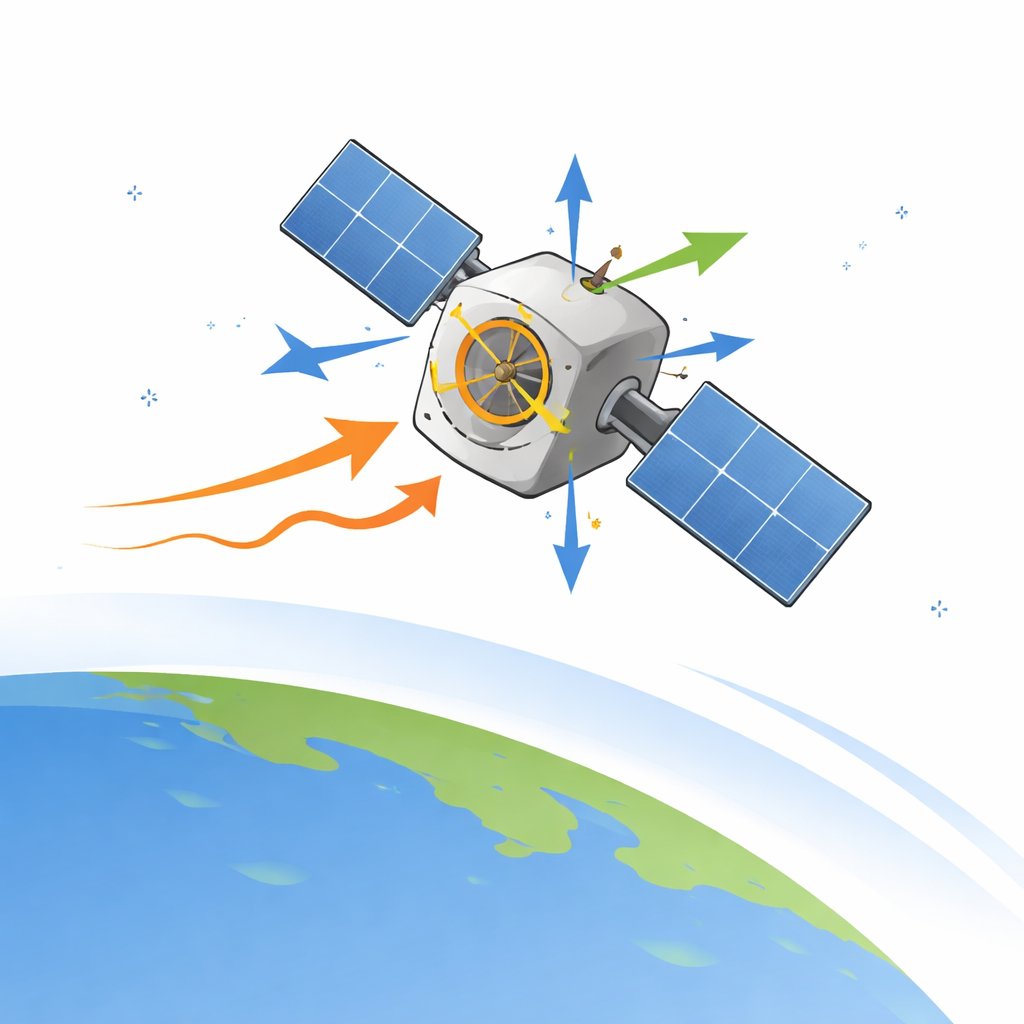
Many real spacecraft are asymmetric: their mass is not spread evenly because of large solar panels, antennas, or internal equipment. When such a body spins, it does not simply rotate like a rigid wheel; instead, its motion can wobble, tumble, or precess in complicated ways. At the same time, satellites in low Earth orbit still move through a thin atmosphere that slowly resists their motion. Inside the spacecraft, spinning wheels or gyroscopes used for pointing add their own influence. Balancing all these effects at once is challenging, and most current designs rely heavily on slow numerical simulations rather than clear analytical formulas.
A New Shortcut Using Smooth Mathematical Waves
The authors revisit a classic description of rigid-body rotation, which usually assumes no outside influence, and extend it to include both internal spinning devices and small control torques in a resisting medium. They assume that the steering pushes are relatively weak compared to the natural spin of the satellite—an assumption that actually matches power-limited space hardware. Under this condition, they show that the main rotational motion can still be written in terms of special smooth oscillating functions known as elliptic functions. These functions act like refined versions of sine and cosine waves and allow the entire fast tumbling motion to be captured in compact formulas, rather than step-by-step numerical integration.
Designing Energy-Savvy Steering Rules
On top of this compact description, the authors derive a steering rule that tries to reduce a combined measure of control effort and stored rotational momentum. In simple terms, their rule always points the control torque directly opposite to the satellite’s current spin direction, a known good practice in momentum management. What is new here is the proof that this particular choice keeps the underlying motion “integrable,” meaning it remains solvable in closed form with their elliptic functions. This preservation of structure is crucial: it allows the slow drift of total spin and energy, caused by drag and control, to be tracked analytically over long times, while the fast wobbling motion is handled with their exact formulas.
What the Simulations Reveal About Spacecraft Behavior
Using these formulas, the team runs extensive parameter studies that mimic a medium-size Earth observation satellite with realistic shapes, masses, and actuator limits. They find that stronger internal spinning (gyrostatic torque) boosts the amount of rotational momentum the spacecraft can store while still settling into a stable pattern. The surrounding medium acts like a stabilizing brake: more resistance simplifies the motion and helps it settle faster, but it also forces the control system to burn more energy to maintain performance. Perhaps most intriguingly, the three control axes play different roles. The first axis contributes little beyond a certain point, the second axis is the main driver of useful momentum and energy buildup, and the third axis shows an inverse relationship with energy, behaving more like an internal regulator than a simple thruster.
Faster Planning and Longer-Lived Missions
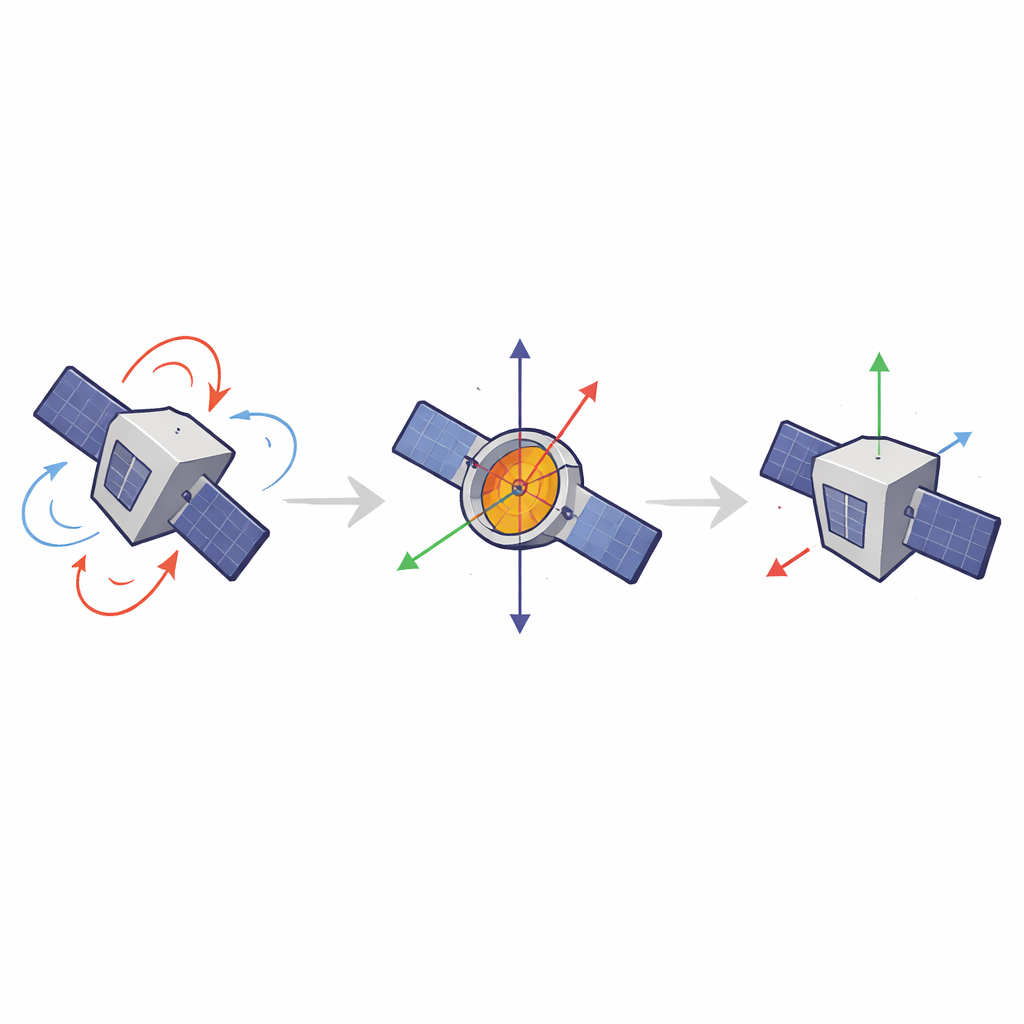
Because the new method replaces heavy repeated simulations with explicit formulas, it can speed up mission design computations by roughly a factor of one hundred. For operators of low Earth orbit satellites—such as imaging platforms, communication relays, or small telescopes—this means quicker trade studies on how to size reaction wheels, how much power to allocate to pointing, and how different drag conditions affect long-term stability. In everyday language, the paper shows a more efficient way to keep oddly shaped, spinning spacecraft steady and power-frugal in a thin but troublesome atmosphere, turning a once messy problem into something that can be scanned and optimized almost at a glance.
Citation: Elneklawy, A.H., Amer, T.S., Elkilany, S.A. et al. Optimization of asymmetric gyrostatic satellite kinematics in a resistive medium: A novel elliptic function solution. Sci Rep 16, 12212 (2026). https://doi.org/10.1038/s41598-026-45403-6
Keywords: satellite attitude control, gyrostatic effects, low Earth orbit, optimal torque steering, rigid body rotation