Clear Sky Science · en
Multi-objective optimization for 3D heterogeneous WSN deployment using an enhanced Genghis Khan shark algorithm
Smarter Sensors in a Three-Dimensional World
From monitoring forest canopies to managing smart buildings and industrial plants, wireless sensor networks are becoming the invisible nervous system of modern infrastructure. But deciding where to place hundreds of sensors in a complex three-dimensional space—while keeping everything connected and within budget—is far from trivial. This paper introduces a new algorithm that helps engineers automatically design such networks so they watch every corner, talk reliably to each other, and do so without wasting money.
Why Placing Sensors Is Harder Than It Looks
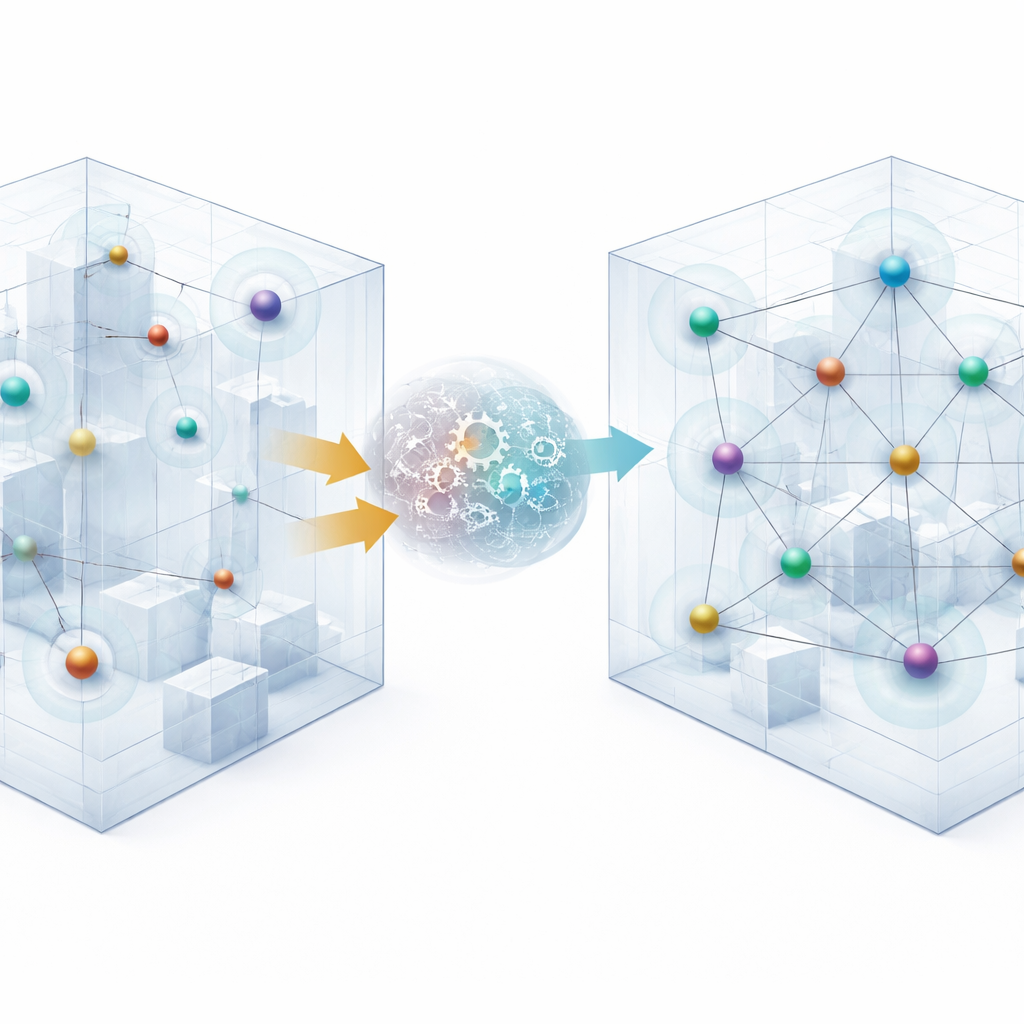
In many real settings, sensors are not just scattered on a flat plane. They are mounted on ceilings and walls, woven through machinery, or suspended in air or water. Each sensor type can see and talk over different distances and comes at a different price. The designers’ wish list is simple to state but hard to satisfy: every important spot in the volume should be watched by several sensors (for reliability), every sensor must be able to pass its data along to a base station through a chain of neighbors, and the total cost should stay within budget. Trying to meet all three goals at once turns the design into a maze of conflicting choices that cannot be solved exactly for large systems.
Balancing Watching, Talking, and Spending
The authors describe this design challenge as a “multi-objective” problem: they want to simultaneously maximize coverage (how many sensors see each target point), maximize connectivity (how many neighbors each sensor can reach), and minimize total cost. They model the monitored volume as a set of possible sensor sites and target points scattered in three dimensions. Some sites are more expensive than others to install, for example because of difficult access. Sensors belong to several classes, each with its own sensing radius, communication reach, and price. A candidate design is a yes/no choice of which sensor type, if any, to place at each site. The design must obey strict rules: every target must be watched by at least a certain number of sensors, and every installed sensor must have enough neighbors to keep the network robust.
A Nature-Inspired Search Party
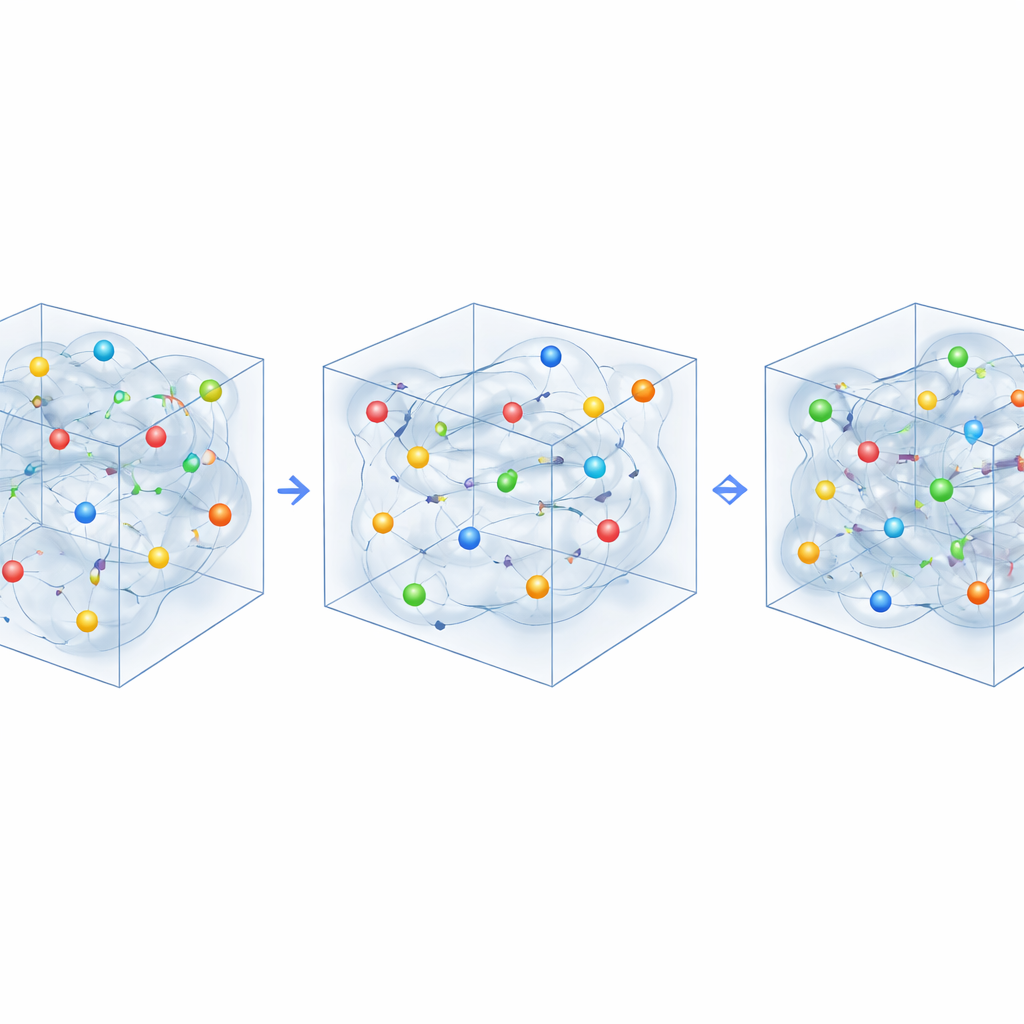
To explore the enormous space of possible designs, the paper builds on a swarm-based search method inspired by hunting behavior, called the Genghis Khan shark optimizer. The enhanced version, EnMOGKSO, treats each possible network design as an individual in a population that moves through the search space. These individuals wander widely at first, then gradually focus around promising regions, mimicking exploration and hunting. Crucially, the method keeps two memory banks: one that stores the best designs found so far and another that preserves unusual or sparsely explored designs. This dual memory helps avoid getting stuck on a single narrow family of solutions and instead recovers a broad menu of trade-offs between coverage, connectivity, and cost.
From Smooth Numbers to Concrete Layouts
Because the actual decisions—install this sensor type here or not—are yes/no choices, they are difficult to adjust gently. EnMOGKSO sidesteps this by working first with smooth numerical “scores” that express how much each sensor type is favored at each site. At every evaluation step, these scores are translated into an actual layout by picking, at most, one sensor type per site and possibly leaving some positions empty. The resulting design is then tested: the algorithm computes how many sensors see each target point, builds a communication graph showing which sensors can talk to which, and totals the installation cost. Designs that break the coverage or connectivity rules are not discarded outright; instead, they are ranked by how badly they fail, allowing the search to climb steadily toward fully valid solutions.
Putting the Method to the Test
To show that their approach is not tuned to a single example, the authors first evaluate EnMOGKSO on a standard suite of difficult mathematical test problems used to benchmark multi-objective algorithms. By measuring how closely the algorithm’s results match ideal trade-off curves, they find that EnMOGKSO typically achieves better spread and accuracy than several well-known alternatives, including popular evolutionary and particle-swarm methods. They then turn to realistic three-dimensional sensor deployment scenarios. Across many settings that vary the required redundancy of coverage and the strictness of connectivity, EnMOGKSO consistently finds designs that cover more targets and maintain denser communication links than rival methods, at a cost that is higher but comparatively stable.
What This Means for Real-World Sensor Networks
For practitioners, the key outcome is not a single “best” layout but a collection of high-quality choices that reveal the trade-off between performance and expense. The new algorithm tends to populate this trade-off surface more completely, making it easier for engineers to pick a design that matches their tolerance for risk and budget. The work suggests that carefully crafted swarm methods, which respect both the physics of sensing and the logic of network connections, can turn an otherwise intractable design puzzle into a manageable planning exercise for three-dimensional monitoring tasks in buildings, factories, and the environment.
Citation: Houssein, E.H., Ibrahim, I.E., Wazery, Y.M. et al. Multi-objective optimization for 3D heterogeneous WSN deployment using an enhanced Genghis Khan shark algorithm. Sci Rep 16, 12075 (2026). https://doi.org/10.1038/s41598-026-45399-z
Keywords: wireless sensor networks, 3D deployment, multi-objective optimization, swarm intelligence, network coverage and connectivity