Clear Sky Science · en
Optimising pandemic response through vaccination strategies using neural networks
Why smarter vaccination plans matter
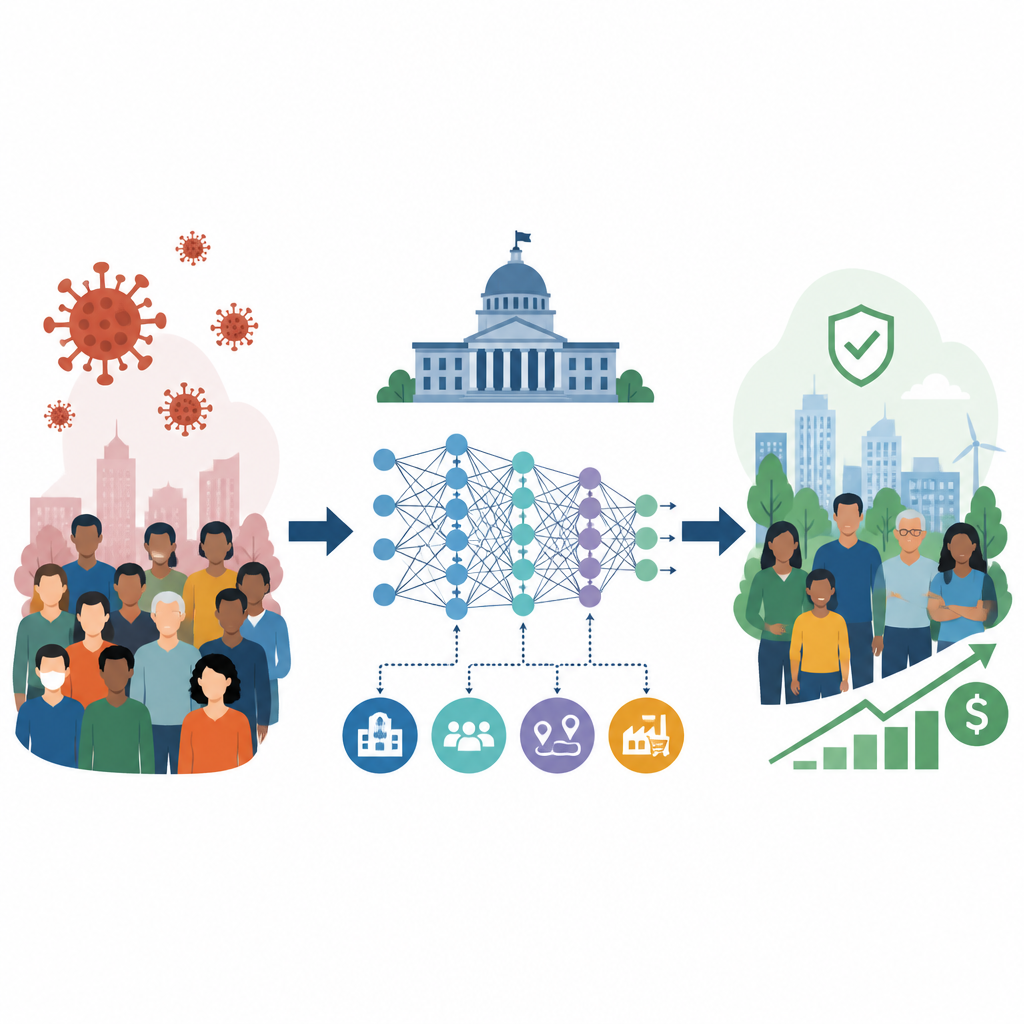
Pandemics force governments to protect public health while keeping societies and economies running. This paper shows how modern data tools can help design smarter vaccination plans that not only save lives but also cut overall costs. Using COVID-19 in Victoria, Australia, as a test case, the authors combine disease modeling, economics, and neural networks to search for vaccination schedules that work better than simple rules or ad hoc decisions.
Breaking an outbreak into clear building blocks
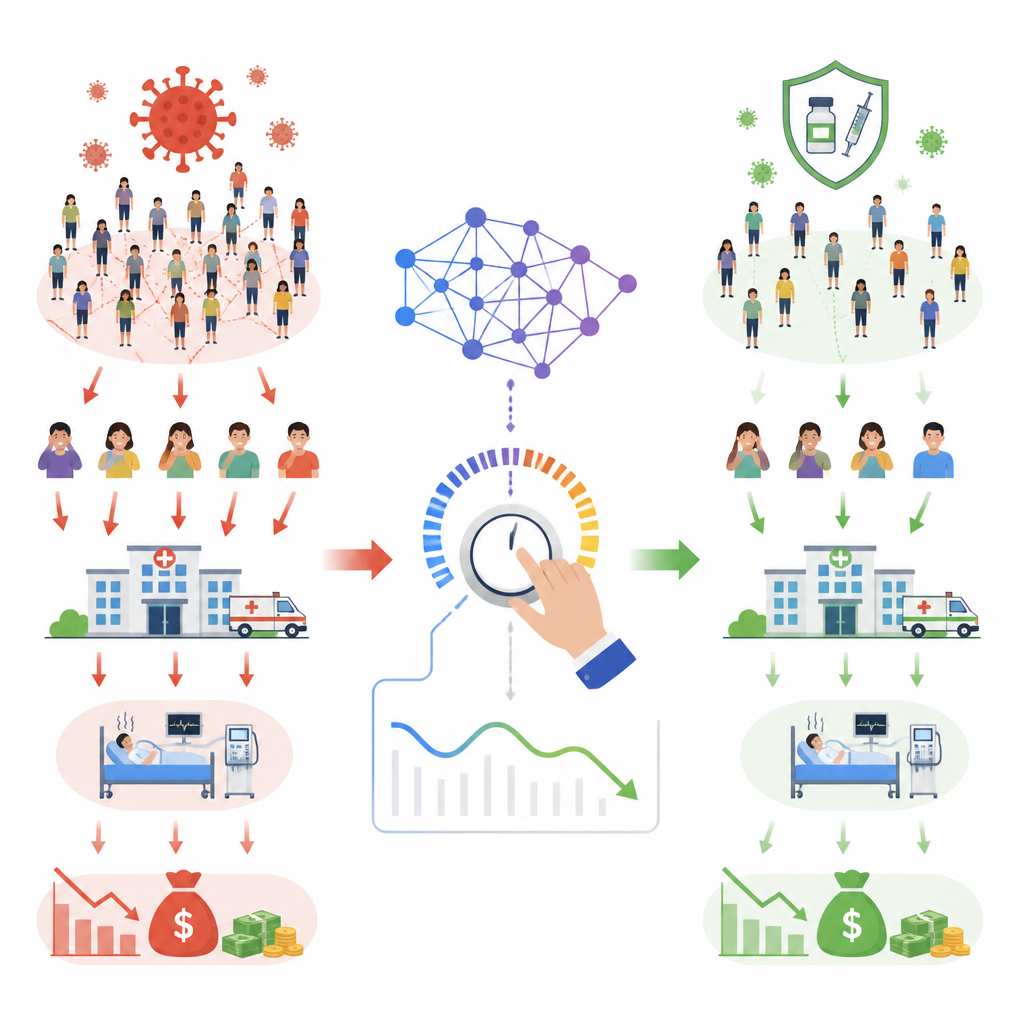
The study begins by describing how a virus moves through a population. Instead of just counting who is healthy, sick, recovered, or dead, the authors use a richer picture with eight groups, including vaccinated people, those who are infected but not yet showing symptoms, and patients with mild, hospital-level, or intensive-care illness. This layered view lets them link the number of severe cases to hospital beds, intensive care use, and deaths. They also allow for random ups and downs in how quickly people move between these groups, reflecting the uncertainty of real outbreaks and changes in conditions over time.
Turning health and money into one yardstick
Next, the authors build an economic lens on top of this health model. They total up four kinds of costs a government faces during a pandemic: buying and delivering vaccines, paying quarantine support, running the healthcare system, and losing economic output when people cannot work. In their framework, the main policy lever is the vaccination rate over time. By changing how fast doses are given, the government can cut hospital use and deaths but will pay more upfront for the rollout. The model brings these forces together into a single measure of total spending so that different vaccination plans can be compared on level ground.
Teaching neural networks to find better strategies
Because the model includes many states and random shocks, standard mathematical tools become too slow or inaccurate. To handle this, the authors turn to neural networks, a form of machine learning. First, they use a physics-informed neural network to tune the disease model so that its simulated paths match real COVID-19 data from Victoria. This step pins down how quickly people move between health states and how much random noise the system shows. Then, a second deep network is trained to act as a decision maker: at each point in time it proposes a vaccination rate, the model simulates what happens, and the network adjusts its choices to reduce the total bill across health and economic costs.
What the case study reveals about timing and impact
Applying the framework to Victoria’s COVID-19 data, the authors compare four scenarios: no vaccination, a constant vaccination rate, the actual rollout used by the government, and the data-driven optimal plan. The best-performing strategy starts with very high vaccination rates early on and then gradually eases off as infections fall. Compared with no vaccination, this approach cuts hospital-bed days by more than 85 percent, deaths by over 80 percent, and total costs by about 22 percent. It also outperforms the real-world rollout, trimming hospital use, deaths, and total spending by a few extra percentage points. The results suggest that getting ahead of the virus with an early surge of vaccinations can pay off later in fewer severe cases and smaller economic losses, even though the initial outlay is higher.
How this toolkit can support future decisions
Beyond COVID-19, the authors argue that their framework can be updated with new data and reused for other non-catastrophic epidemics, such as flu-like outbreaks. Policymakers can adjust cost assumptions, plug in local data, and explore how different vaccination paths affect both health and budgets. While ethical questions and fairness concerns still need separate attention, the core message is simple: by combining detailed disease models with economic thinking and neural networks, governments can design vaccination plans that are both more effective and more efficient.
Citation: Zhai, C., Chen, P., Jin, Z. et al. Optimising pandemic response through vaccination strategies using neural networks. Sci Rep 16, 14815 (2026). https://doi.org/10.1038/s41598-026-45396-2
Keywords: pandemic modelling, vaccination strategy, neural networks, economic epidemiology, COVID-19 policy