Clear Sky Science · en
AI-based detection of Certas Plus shunt valve settings in CT scans
Why this matters for people with brain fluid drains
Many people with a condition called hydrocephalus rely on tiny implanted tubes, called shunts, to drain excess fluid from the brain. These shunts include a small adjustable valve that doctors can set like a dial to control how much fluid is removed. If the setting is wrong or the valve malfunctions, patients can become very sick, and doctors often need quick answers from brain scans. This study explores whether artificial intelligence (AI) can read those valve settings directly from routine CT scans, potentially saving time, extra tests, and even hospital transfers.
The challenge of reading a tiny dial inside the head
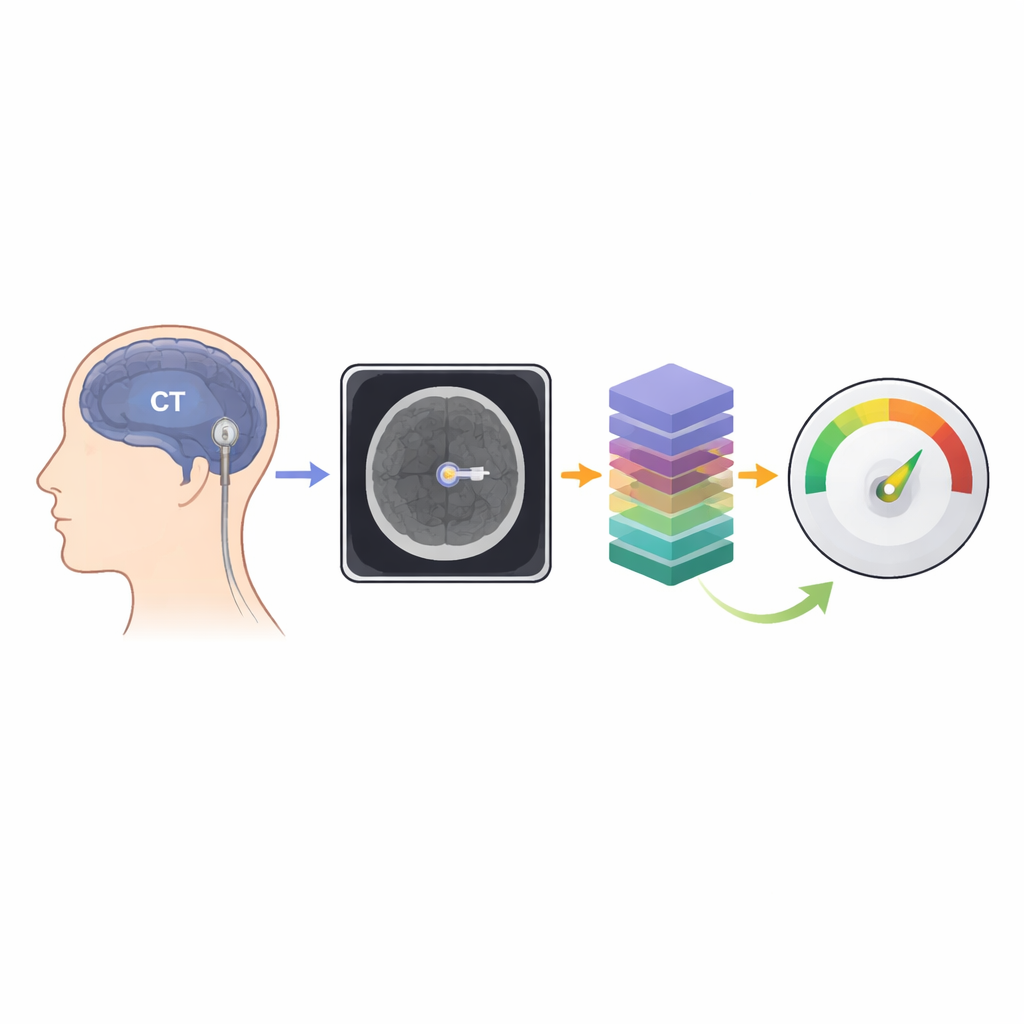
For patients with adjustable shunts, knowing the current valve setting is crucial. The setting can change accidentally, for example after exposure to strong magnets in MRI machines, leading to too much or too little fluid drainage. In theory, doctors can see the setting on special X-ray images or with a handheld tool, but in real life many hospitals only have a CT scanner readily available. Unfortunately, metal parts in the shunt and the three-dimensional nature of CT images make the tiny indicator hard to read, even for experienced neurosurgeons. In this study, the researchers focused on one common model, the Certas Plus valve, and asked whether an AI system could reliably figure out its setting from standard CT scans.
Turning CT images into a simple angle
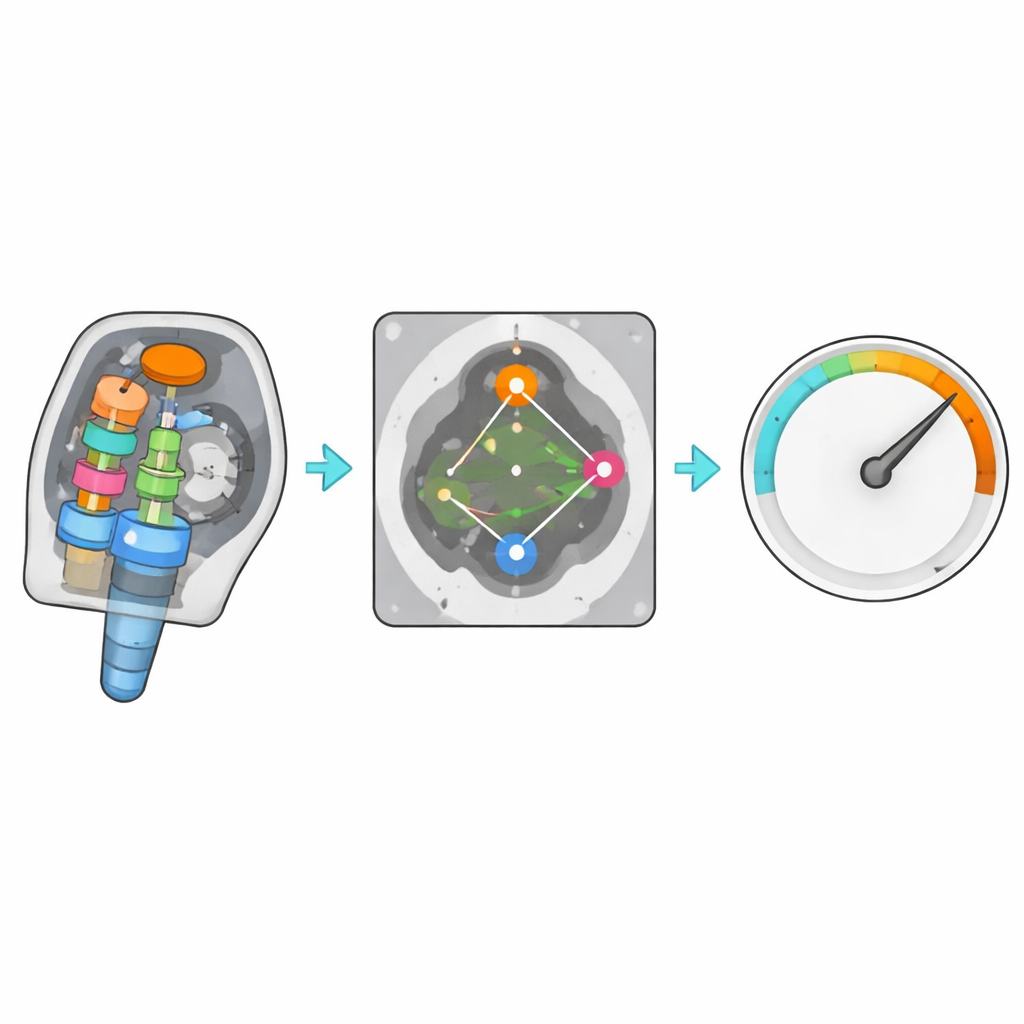
The team collected 391 head CT scans from patients who had Certas Plus valves over seven years. For each scan, they made sure the documented valve setting in the medical record matched what two neurosurgeons saw on the images, creating a strong ground truth. They then used a modern type of AI for 3D images, called a U-shaped neural network, to teach a computer to find five small metal markers within each valve. Once these markers were located, custom software calculated the center of each one and reconstructed the orientation of the valve. By comparing the line through two special magnets with the line through other reference markers, the software measured an angle, which could then be translated into one of the eight possible valve settings.
How well the computer matched real-world settings
On a separate test group of 75 CT scans, the AI system successfully found the markers and computed an angle in 97.3% of cases. It predicted the exact documented valve setting in 81.3% of scans. Importantly, when the system was “wrong,” it almost always chose a setting that was directly next to the true one on the dial, never jumping from a very low-flow setting to a fully closed one. Because the valve itself can be adjusted continuously between the labeled positions, even the official tools can struggle to distinguish neighboring settings. When the researchers counted a prediction as acceptable if it was the correct setting or one step away, overall performance rose to 96%, which they argue is meaningful for everyday clinical decisions.
What this could change in everyday care
Hydrocephalus care is expensive, and one major cost comes from transferring patients between hospitals for specialized tests. If a routine CT scan at a small hospital could be analyzed automatically to confirm that a valve’s setting is reasonable, some of these transfers might be avoided. The AI model also produces colored outlines of the valve parts on the image, so clinicians can visually inspect and verify what the computer has done rather than blindly trusting a single number. While the study was done at a single center with CT scanners from mainly one manufacturer, the results suggest that automated reading of shunt valve settings is technically feasible.
Where this might lead next
The authors conclude that AI can reliably identify the settings of Certas Plus shunt valves on CT scans, reaching an accuracy that rivals human experts and is likely good enough to support real-world care. They emphasize that larger, multi-hospital studies are needed to confirm that the method works across different scanners and patient populations, and to adapt it to other valve types or patients with more than one valve. If those efforts succeed, future patients with hydrocephalus could have their valve settings checked quickly and safely from scans they are already receiving, reducing the need for extra imaging and helping doctors spot shunt problems sooner.
Citation: Scheffler, P., Shah, M., Amirah, R. et al. AI-based detection of Certas Plus shunt valve settings in CT scans. Sci Rep 16, 9647 (2026). https://doi.org/10.1038/s41598-026-45388-2
Keywords: hydrocephalus, cerebrospinal fluid shunt, computed tomography, medical imaging AI, programmable valve