Clear Sky Science · en
Biochemical and molecular responses of Spodoptera frugiperda to insecticide exposure: detoxification enzymes, gene expression, and genotoxic effects
Why a crop-eating moth matters to your dinner table
The fall armyworm may be small, but it has a big impact on global food supplies. This caterpillar chews through maize and many other crops, and it is spreading quickly across Africa, Asia, and beyond. Farmers often rely on chemical sprays to keep it in check, yet the insect is famous for learning how to survive these treatments. This study looks inside the bodies and cells of fall armyworm larvae to see how they react when exposed to commonly used insecticides, offering clues to how early warning signs of future resistance might appear.
Peeking inside a powerful crop pest
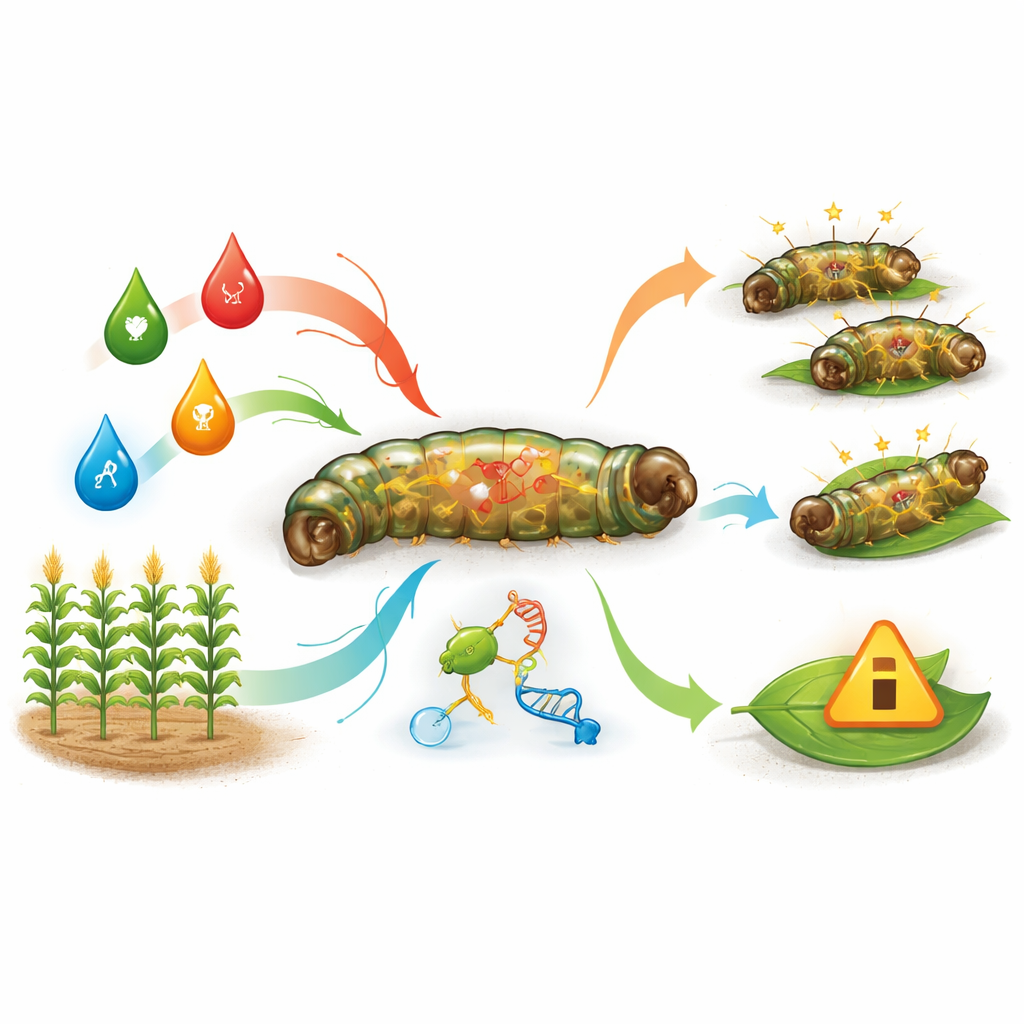
Researchers in Egypt raised fall armyworm larvae in the lab under carefully controlled conditions, then exposed them to four insecticides that farmers commonly use: emamectin benzoate, indoxacarb, methomyl, and a mixture of acetamiprid plus bifenthrin. First, they measured how toxic each chemical was by finding the dose that kills half of the larvae. Emamectin benzoate turned out to be by far the most lethal at very low concentrations, while the acetamiprid–bifenthrin mix was the least effective and showed signs that the insects were already relatively tolerant to it. Surviving larvae were then used to probe what was changing inside their bodies at the biochemical and genetic levels.
How the caterpillar’s chemistry fights back
The team tracked a suite of enzymes that handle nerve signals, break down food, and detoxify foreign chemicals. Some, such as acetylcholinesterase and carboxylesterases, dropped in activity after insecticide exposure, reflecting nerve-related stress and shifts in how the larvae process certain compounds. Others, especially glutathione S-transferase and peroxidase, rose markedly, signaling that the insects were ramping up their internal clean-up crews to neutralize harmful by-products and cope with oxidative stress. Changes in digestive enzymes and fat-processing enzymes suggested that the larvae were also rebalancing their energy use, trading normal growth for survival under chemical pressure.
Genes and DNA under chemical stress
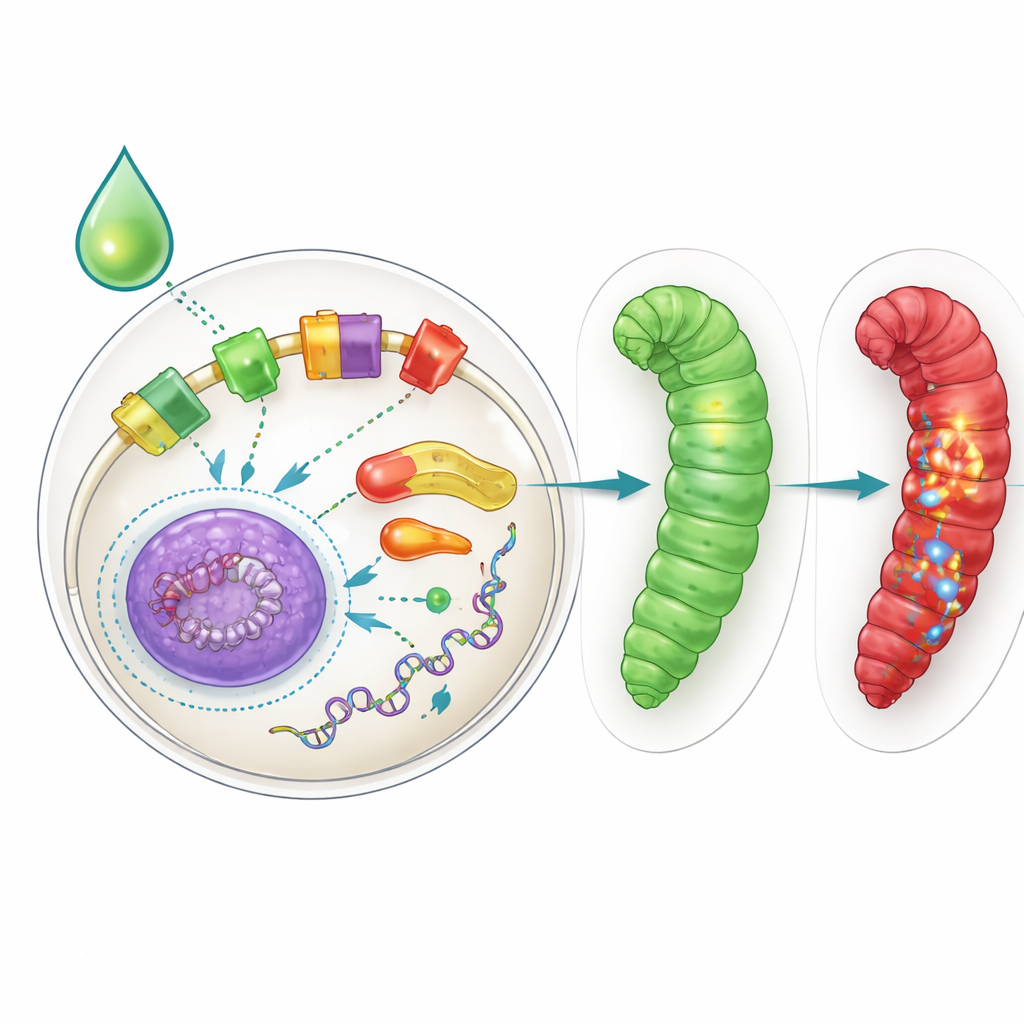
To understand the longer-term response, the researchers measured the activity of several key genes linked to detoxification and stress. Most of the tested genes in the cytochrome P450 family, along with a gene for a calcium-release channel and a common housekeeping gene, were strongly switched on after treatment, particularly under the acetamiprid–bifenthrin mixture. One P450 gene, however, was consistently dialed down, hinting that different detoxification routes are selectively favored. The team also used a sensitive “comet assay” to look at DNA damage in blood-like cells. All insecticides caused more DNA strand breaks than in untreated larvae, with emamectin benzoate producing the most severe damage, in line with its high toxicity and the strong stress responses it triggered.
Computer models of invisible molecular battles
Because the detailed 3D shapes of several insect nerve and ion-channel proteins are not yet known from experiments, the scientists built computer models of these targets and simulated how emamectin benzoate might bind to them. The docking results suggested that this insecticide can interact strongly not only with its main known target, a glutamate-gated chloride channel, but also with acetylcholinesterase and sodium channels through a network of hydrophobic contacts and hydrogen bonds. These simulations do not prove what happens in living insects, but they support the idea that emamectin may act on multiple sites, helping to explain its strong impact on the larvae.
What this means for future pest control
Taken together, the study paints the fall armyworm as a highly adaptable opponent. Even when insecticides do not immediately kill all larvae, they trigger a cascade of chemical, genetic, and DNA-level changes that help the survivors cope with the toxic assault. Over many generations, such adjustments could pave the way to full-blown resistance in the field. By mapping these early warning signals—including boosted detox enzymes, altered gene activity, and measurable DNA damage—this work provides tools that can help monitor how populations are responding to different sprays. In practical terms, it supports smarter, rotating use of insecticides and integrated pest management strategies that slow resistance, protect crop yields, and reduce the need for ever higher doses.
Citation: El-Ansary, R.E., El-Lebody, K.A., Aburawash, R.A. et al. Biochemical and molecular responses of Spodoptera frugiperda to insecticide exposure: detoxification enzymes, gene expression, and genotoxic effects. Sci Rep 16, 12887 (2026). https://doi.org/10.1038/s41598-026-45372-w
Keywords: fall armyworm, insecticide resistance, crop protection, detoxification enzymes, DNA damage