Clear Sky Science · en
Machine learning-driven drug repurposing for HER2-positive breast cancer
Why old drugs for tough breast cancers matter
For many people with an aggressive form of breast cancer called HER2 positive, today’s targeted drugs can lose their punch over time, and new medicines are slow and expensive to develop. This study explores whether some of the thousands of pills already on pharmacy shelves might secretly be able to block HER2 driven tumors, using advanced computer tools to search for hidden anticancer potential.
Understanding the problem in simple terms
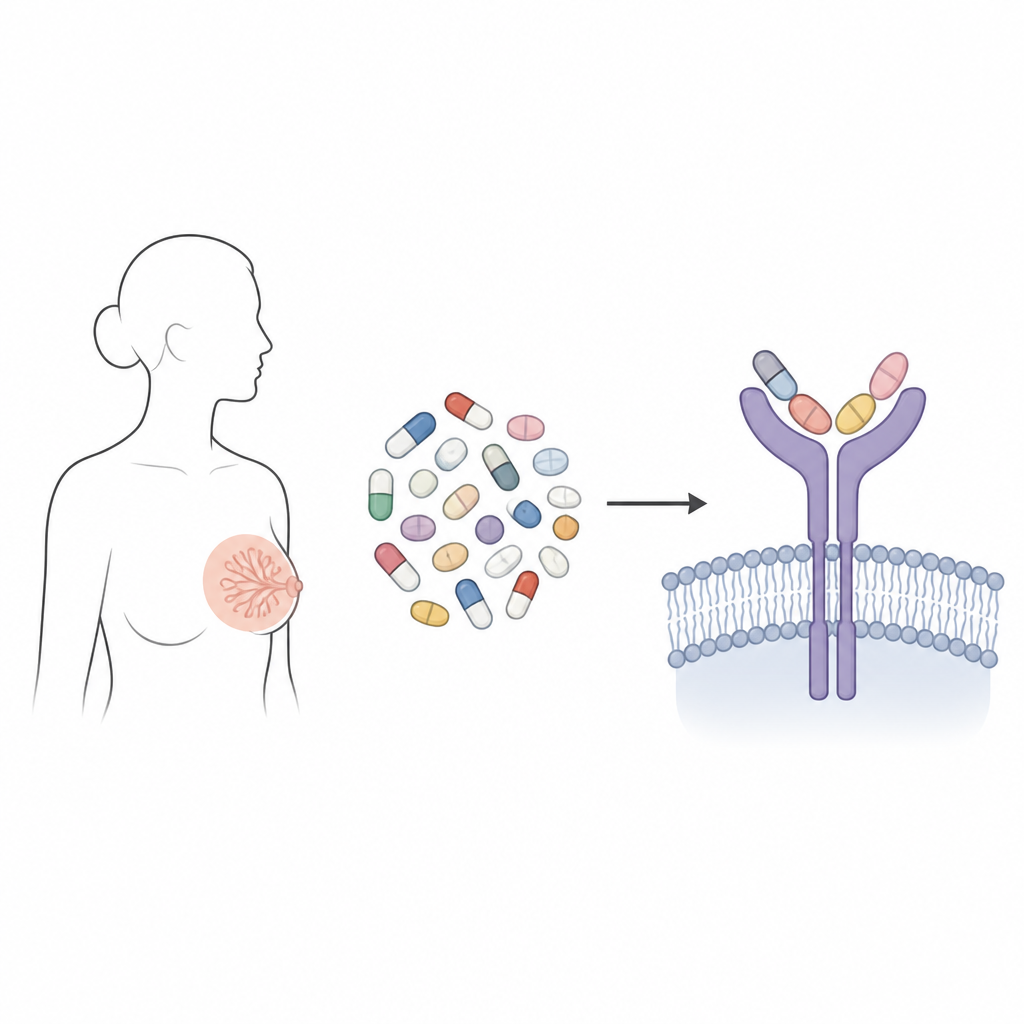
HER2 positive breast cancer is driven by a protein that sits on the surface of cancer cells and keeps sending strong grow and divide signals. When too much HER2 is present, these cells multiply rapidly and often spread, and they can learn to sidestep modern HER2 drugs. Because creating brand new medicines can take a decade or more, the idea of drug repurposing looks attractive: instead of starting from scratch, scientists test whether existing approved drugs, already known to be safe for other diseases, might also switch off HER2 in cancer cells.
How computers help search thousands of medicines
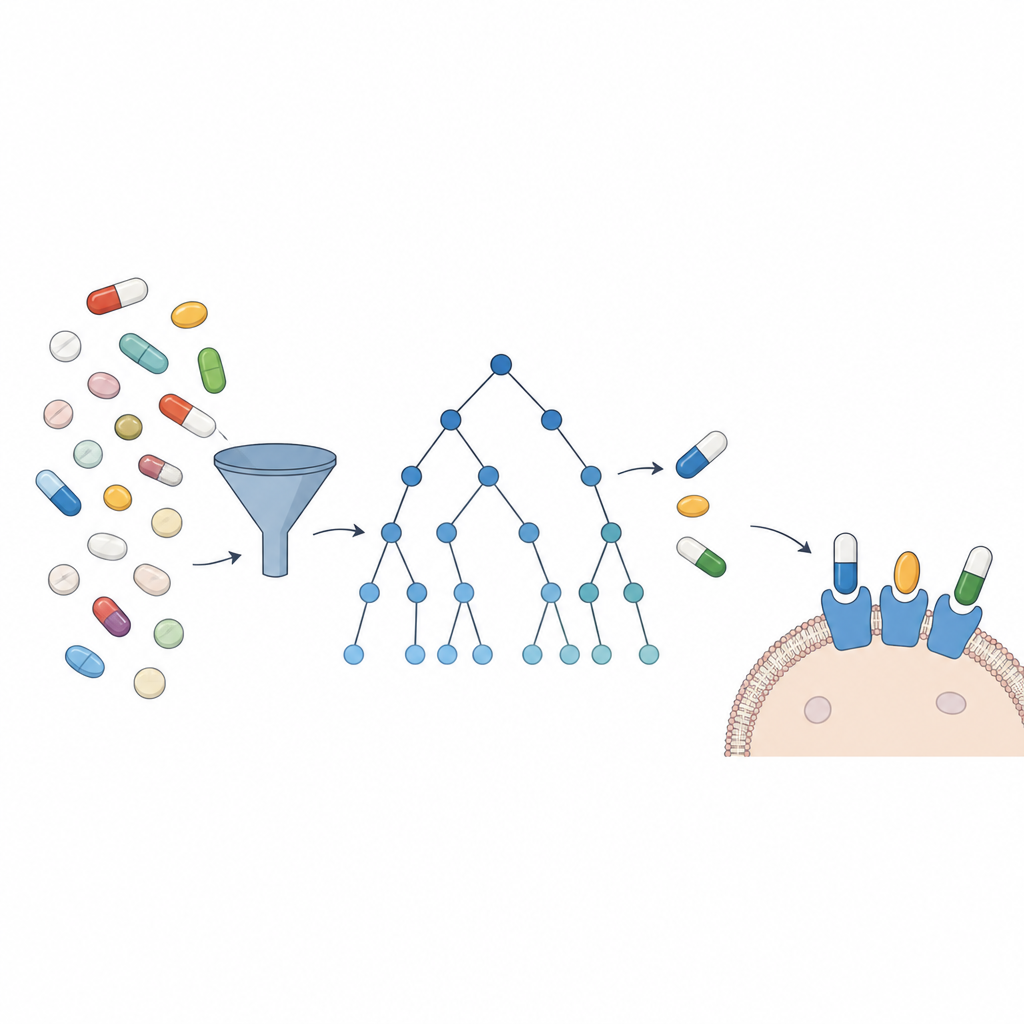
The researchers first gathered detailed information on nearly 14,000 chemical compounds that had been tested against HER2, including how strongly each one blocked the protein. They converted each molecule into hundreds of numerical features that describe its size, shape, charge, and other properties. Using these data, they trained several types of machine learning models to learn the link between a molecule’s structure and its ability to inhibit HER2. After carefully cleaning the data and trimming away weak or redundant features, a model type called Random Forest gave the most reliable predictions, correctly explaining about four fifths of the variation in activity for new molecules.
From prediction to docking inside the cancer target
Armed with this model, the team turned to a real world library of 4,099 approved drugs and narrowed it down to more than 1,600 clean, well defined small molecules. The computer model estimated how strongly each drug might block HER2, highlighting a subset predicted to be especially potent. These top candidates were then “docked” into three dimensional structures of the normal HER2 protein and a troublesome mutant form found in some resistant cancers. Docking simulations act like a virtual lock and key test, checking how snugly a drug fits into the active pocket of HER2 and what kinds of atomic level contacts it can form.
Following the most promising candidate over time
One heart and eye drug, timolol maleate (labeled FDA0870 in the study), repeatedly stood out. It ranked among the top scorers in both the machine learning screen and the docking tests for normal and mutant HER2, forming strong hydrogen bonds and hydrophobic contacts with key regions that control the protein’s activity. To see whether this fit would hold up under more realistic conditions, the researchers ran long molecular dynamics simulations that mimic how molecules jiggle and move in a watery, body like environment. Over nanoseconds to microseconds of simulated time, timolol remained stably lodged in the HER2 pocket for both forms of the protein. Additional computer tests of absorption, distribution, metabolism, excretion, and toxicity suggested that its existing drug like profile, moderate permeability, and safety were generally suitable for further exploration.
What this could mean for patients
In everyday language, this work shows that smart computer pipelines can sift through huge numbers of known medicines to find those most likely to work against difficult cancers, long before any lab or animal testing begins. Among the many approved drugs examined, timolol emerged as a strong candidate to be repurposed as a dual blocker of both standard and mutant HER2 in breast cancer. While the results are purely computational and still need to be confirmed by experiments in cells and animals, they point toward a faster and potentially cheaper route to add new tools against HER2 positive disease by giving familiar drugs a new job.
Citation: Dinesh, B.G.H., Ganjipete, S., Kumar, B.S. et al. Machine learning-driven drug repurposing for HER2-positive breast cancer. Sci Rep 16, 15868 (2026). https://doi.org/10.1038/s41598-026-45361-z
Keywords: HER2 positive breast cancer, drug repurposing, machine learning, molecular docking, timolol