Clear Sky Science · en
Calcium sulphate-based soybean salting-out urease purification for enzyme-induced carbonate precipitation in road base stabilisation
Greener roads from everyday beans
Modern roads rely heavily on cement and lime to keep their stone foundations strong, but making those materials emits large amounts of carbon dioxide. This study explores a cleaner alternative that uses natural enzymes from common soybeans to glue crushed rocks together with minerals, potentially cutting both emissions and energy use in road building.
Turning kitchen chemistry into road glue
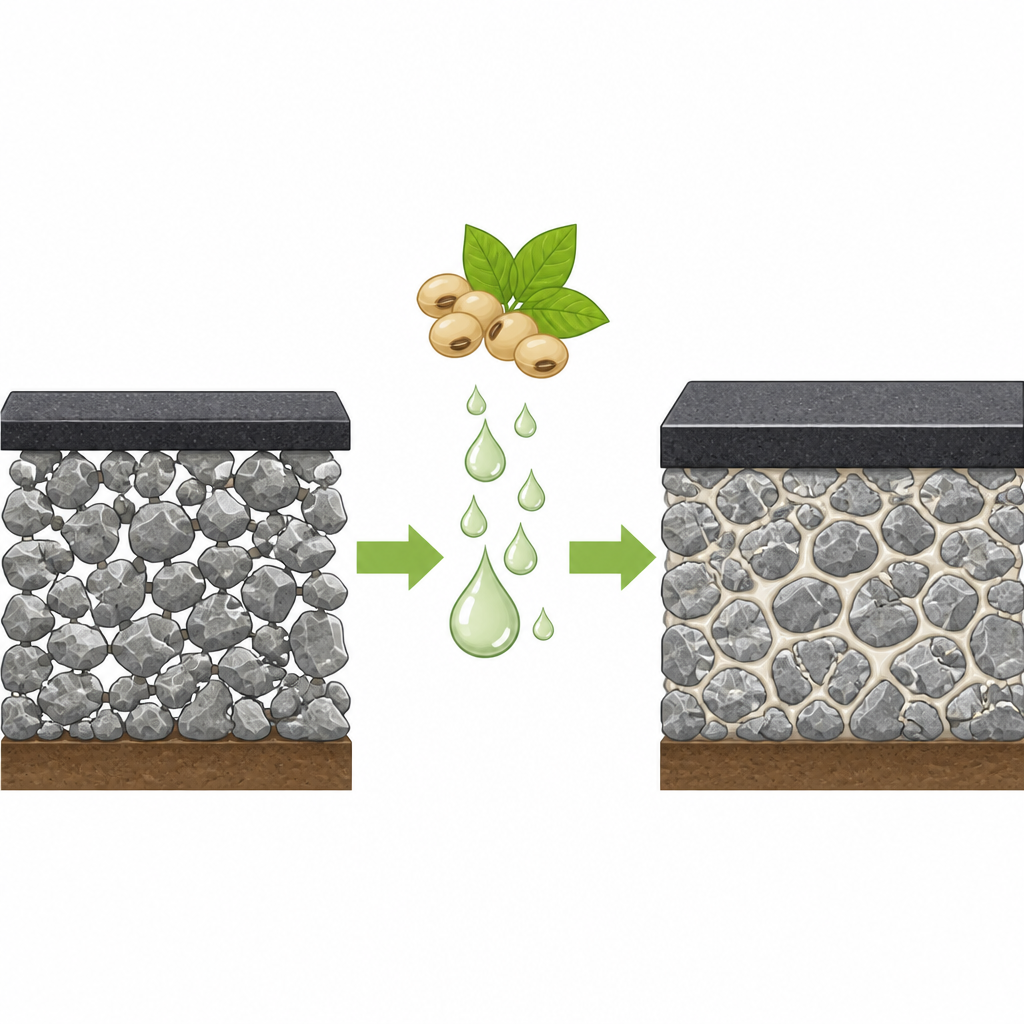
The research focuses on a process called enzyme-induced carbonate precipitation, where an enzyme helps break down urea into ingredients that react with dissolved calcium to form calcium carbonate, the same mineral found in seashells. When this mineral forms inside the gaps between crushed rocks in a road base, it acts like a natural cement. The twist is that the enzyme comes from soybeans, a cheap and widely available crop, which makes the approach attractive for large-scale use if the enzyme can be prepared efficiently.
Cleaning up the soybean soup
Raw soybean extracts are messy mixtures full of proteins and fats as well as the useful enzyme. When this crude liquid is pumped through rocks, the extra organic material can clump together with the new mineral, clogging pores and leaving some areas poorly treated. The team compared three ways to prepare the enzyme solution: simple filtering, spinning it in a centrifuge, and a "salting-out" method that adds calcium sulphate so unwanted organic matter separates and can be removed. They found that the salting-out method produced the clearest liquid and stripped out the most organic material while keeping enough enzyme activity to drive mineral formation.
Building stronger rock layers with less mineral
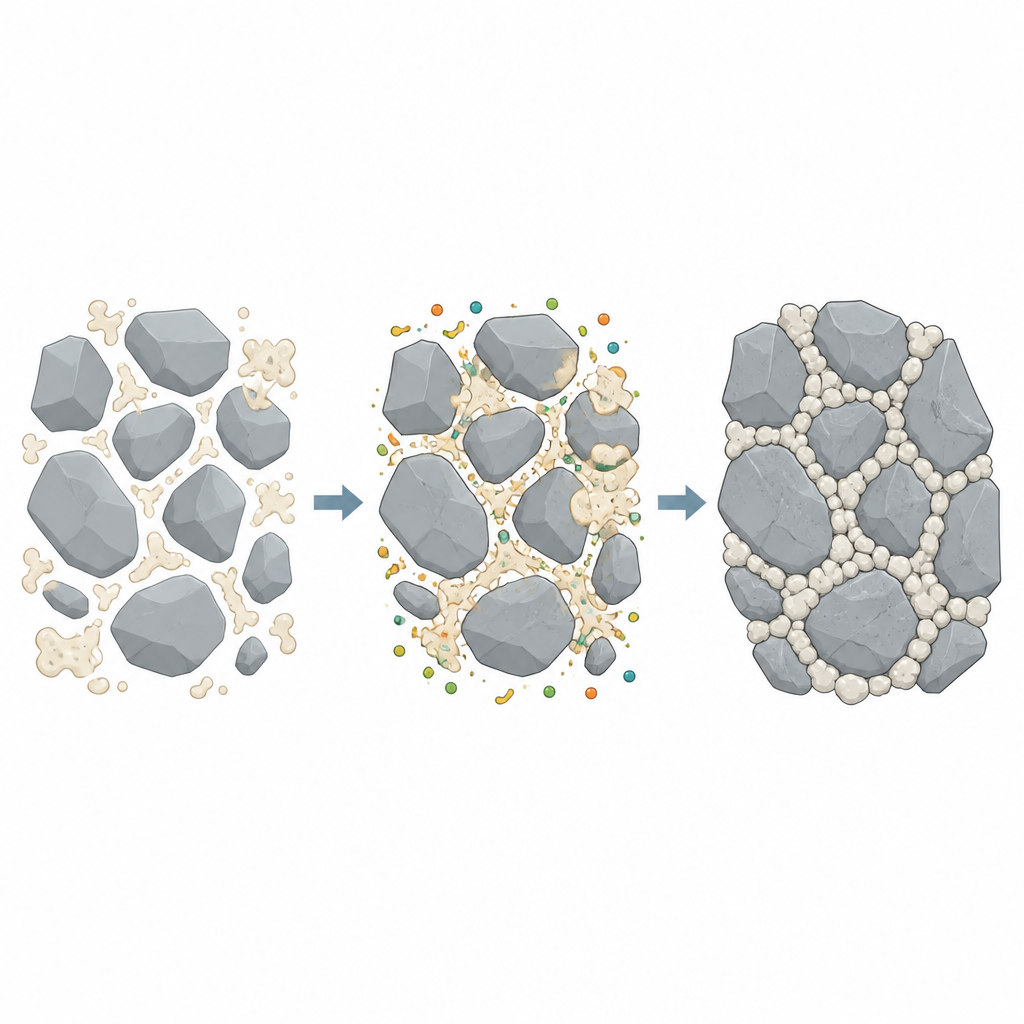
With the three enzyme preparations in hand, the researchers treated cylinders of crushed rock similar to the base layers used under paved roads. They varied soybean amount, mineral-forming solution strength, and the number of treatment cycles, then measured how much calcium carbonate formed and how strong the samples became in compression tests. Surprisingly, the salting-out enzyme produced less total mineral than the less-purified extracts but delivered more strength per unit of mineral because the crystals were spread more evenly through the rock skeleton. Microscopy images showed that, with cleaner enzyme, calcium carbonate tended to form as well-distributed spherical and irregular particles that bridged neighboring stones instead of forming soft, mixed clumps with organic material.
Adding milk for a better mineral glue
Removing most of the soybean organics made the flow of treatment solution more uniform, but it also took away natural proteins that help stabilize the enzyme and give crystals places to start growing. To restore the helpful part of that organic content without bringing back the clogging problem, the team added small, controlled amounts of non-fat skim milk to the purified enzyme. The milk proteins improved how the mineral bonded to the rock, boosting strength by more than double in some tests without noticeably changing how fast urea was broken down or how much calcium carbonate formed. Microscopy confirmed that this combination encouraged dense clusters of smooth mineral particles that locked grains together and filled gaps.
What this means for future road building
Overall, the study shows that carefully purified soybean enzyme, aided by a modest dose of milk powder, can turn loose crushed rock into a stiffer, lightly cemented material suitable for use in road bases while using less energy than conventional treatments. The key is not just how much mineral is produced, but how cleanly and uniformly it forms between the stones. With further work on durability and full-scale construction methods, this plant-based "biocement" approach could offer transport agencies a practical way to strengthen pavements while lowering both emissions and chemical hazards.
Citation: Lemboye, K., Shahin, M.A., Cheng, L. et al. Calcium sulphate-based soybean salting-out urease purification for enzyme-induced carbonate precipitation in road base stabilisation. Sci Rep 16, 15699 (2026). https://doi.org/10.1038/s41598-026-45356-w
Keywords: biocementation, enzyme-induced carbonate precipitation, soybean urease, road base stabilisation, sustainable pavements