Clear Sky Science · en
Pathway-specific regulation of the paraventricular thalamic nucleus in depressive-like behavior
Why this brain study matters for mood
Many people with bipolar disorder cycle through periods of deep depression, yet scientists still know little about the exact brain wiring that drives these mood shifts. This study in mice looks inside a tiny brain region and its connections to see which specific pathway helps tip behavior into a low energy, depression-like state. Understanding that wiring could one day help researchers design more precise ways to ease depressive episodes.
A small hub deep in the brain
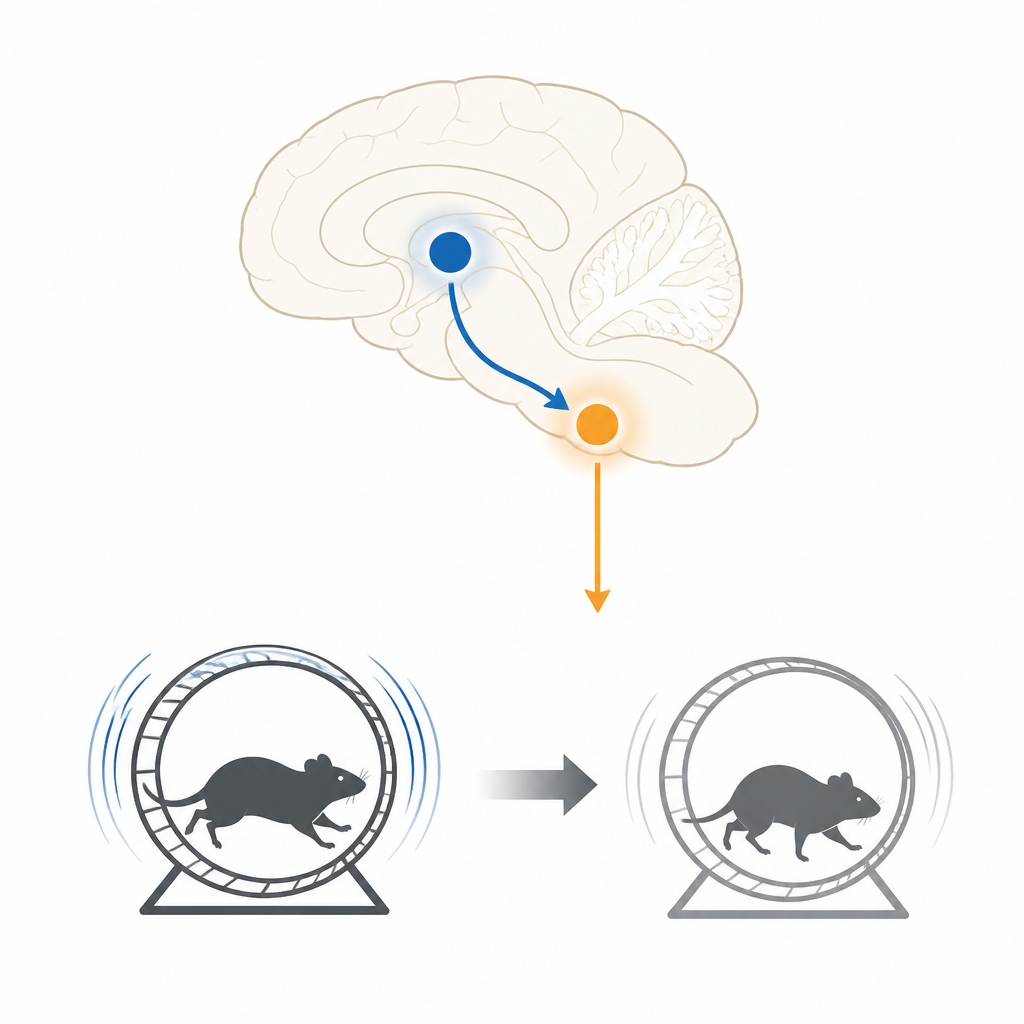
The researchers focused on a little structure buried in the middle of the brain called the paraventricular thalamic nucleus. This hub receives signals from several mood-related regions and then sends its own outputs to areas involved in motivation and emotion. Earlier work in a genetic mouse model of bipolar disorder suggested that this hub might be important for repeated depression-like episodes, because damaging its cell powerhouses and artificially overactivating it both led to long stretches of reduced wheel running, a sign that the animals had lost interest in a normally rewarding activity.
Two different routes to feeling low
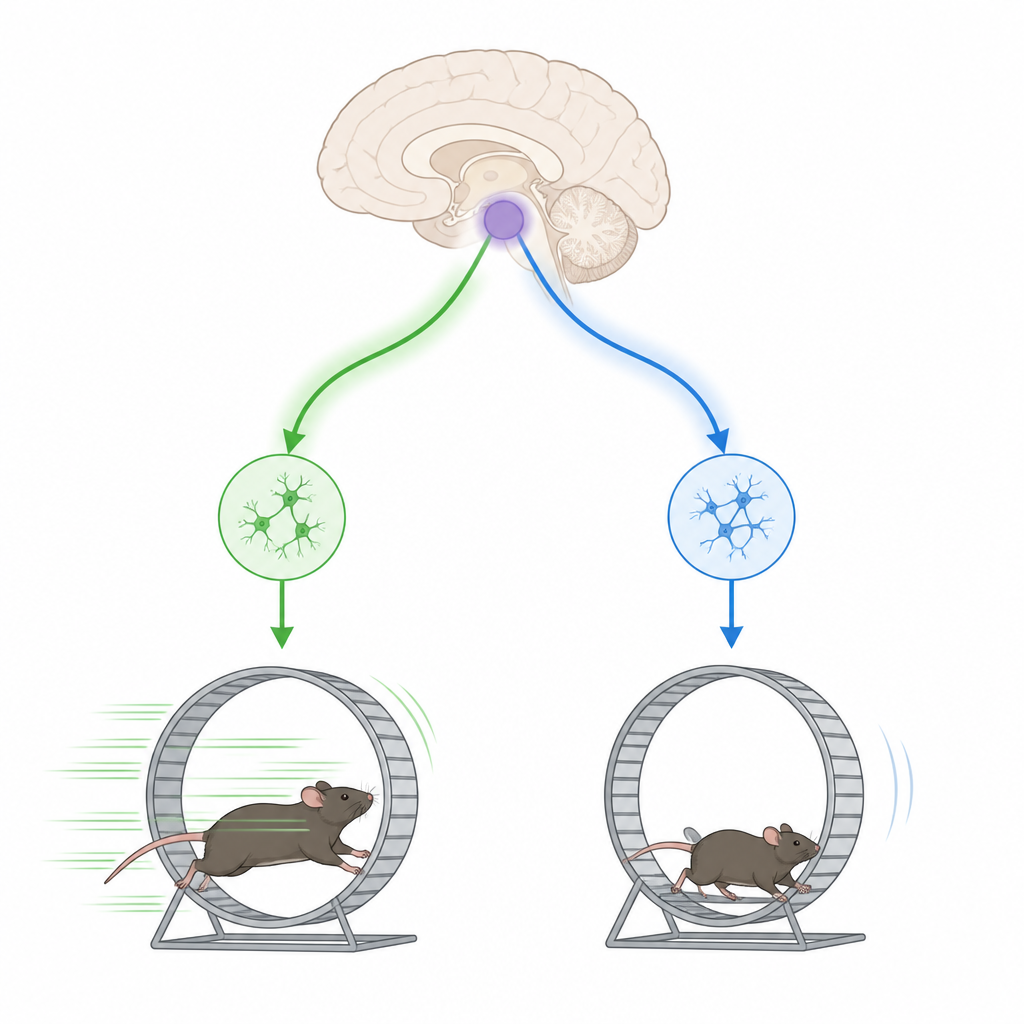
This hub sends strong projections to at least two key regions: the nucleus accumbens, which is central to motivation and reward, and the basolateral amygdala, which helps process fear and anxiety. The team asked whether activating either of these routes could trigger depression-like episodes on its own. Using viruses as delivery tools, they engineered mice so that only the hub cells that project to one target or the other carried a special designer receptor that can be turned on by a custom drug. In this way, they could selectively "press the gas pedal" on just one pathway while watching how freely the mice chose to run in wheels over many weeks.
A custom chemical switch with minimal side effects
To drive this artificial receptor safely over long periods, the team tested a drug called compound 21. At the doses mixed into the animals’ food, compound 21 reached levels in the brain well above what is needed to activate the designer receptor but did not change body weight, food intake, sleep wake patterns, or baseline wheel running in normal mice. Although the drug can bind to some other brain receptors in a test tube, its chronic use in these animals did not noticeably slow them down or disturb their daily rhythms, giving the researchers confidence that later changes in activity truly came from switching on the engineered pathway.
Switching on the reward route dims running
When the scientists chronically activated the hub cells that send signals to the nucleus accumbens, the mice showed more frequent depressive-like episodes defined by long, clearly separated stretches of low wheel running. Importantly, their overall daily running counts before and after drug treatment did not shift dramatically, and their timing of activity over the light and dark cycle stayed similar, suggesting that the key change was in the pattern of sustained, low motivation bouts rather than simple tiredness. Under the microscope, these targeted cells showed strong activation markers, confirming that the engineered pathway had been successfully engaged.
The fear route leaves running intact
In contrast, when the researchers activated the hub cells that project to the basolateral amygdala, the animals’ wheel use looked much like that of control mice. They did not show a rise in depressive-like episodes, their delayed activity index did not change significantly, and their overall running levels before and after drug exposure remained comparable. Tracing experiments revealed that the two sets of projection cells are largely separate populations, with hub cells that talk to the reward region rarely sending branches into the fear region, and vice versa. This separation helps explain why only one route appears to shape the long dips in motivated behavior.
What this means for understanding depression
Together, these findings point to a specific line of communication from a small thalamic hub to the brain’s reward center as a key driver of depression-like episodes in this mouse model, while a parallel route to an emotion center linked to fear plays little role in this particular form of low mood. For a lay reader, the takeaway is that not all mood circuits are alike: even tiny differences in where a pathway ends can change whether an animal loses interest in normally enjoyable activities. Mapping and gently tuning such pathways in the future may offer more targeted options for easing depressive phases in bipolar disorder, although much work remains before this knowledge can be applied to people.
Citation: Kassai, M., Tachibana, D., Sato, F. et al. Pathway-specific regulation of the paraventricular thalamic nucleus in depressive-like behavior. Sci Rep 16, 15779 (2026). https://doi.org/10.1038/s41598-026-45354-y
Keywords: bipolar disorder, depressive episodes, brain circuits, nucleus accumbens, paraventricular thalamus