Clear Sky Science · en
Temporal Learning with Dynamic Range (TLDR) for modeling recurrent exposure and treatment outcomes
Why timing in medical records matters
When you visit a doctor, your health history is written into electronic health records, but most computer models read this history as if the order and timing of events do not matter. This study shows that when and how often events like infections, treatments, or diagnoses occur can strongly shape a person’s future health. The researchers introduce a new way for computers to “pay attention” to timing in these records, and they use it to better predict who will develop long lasting problems after COVID-19 infection, often called long COVID.
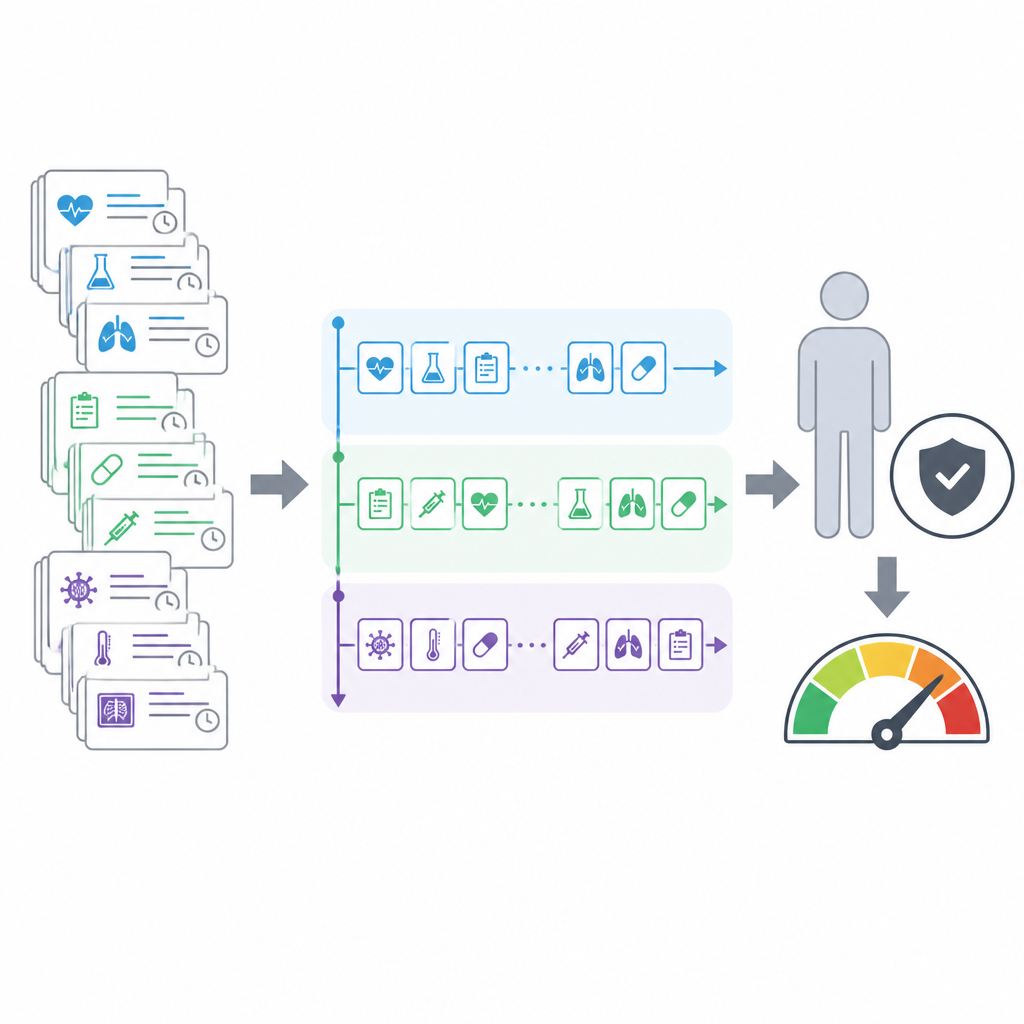
Looking at health as a timeline, not a list
Traditional prediction tools often treat a patient’s record like a shopping list: they count how many times things happened but ignore when they happened. In real life, doctors think very differently. A heart problem last week may matter much more than the same problem ten years ago. The new method, called Temporal Learning with Dynamic Range (TLDR), is built to mirror this kind of reasoning. Instead of shuffling everything together, it breaks each person’s medical story into clear time segments around each key event, such as a COVID-19 infection.
Breaking the past into “far,” “middle,” and “recent”
TLDR divides the timeline into three simple zones for every infection or treatment. The “history” zone holds events before the first infection, the “past” zone covers the period between the first and later infections or treatments, and the “last” zone captures what happens right before and after the outcome of interest, such as the onset of long COVID symptoms. Short buffer periods can be added around these zones to reflect how long an infection or treatment is expected to influence the body. This structure lets the model ask not just “Did this diagnosis ever occur?” but “Did it occur long ago, in the middle period, or right around the outcome?”
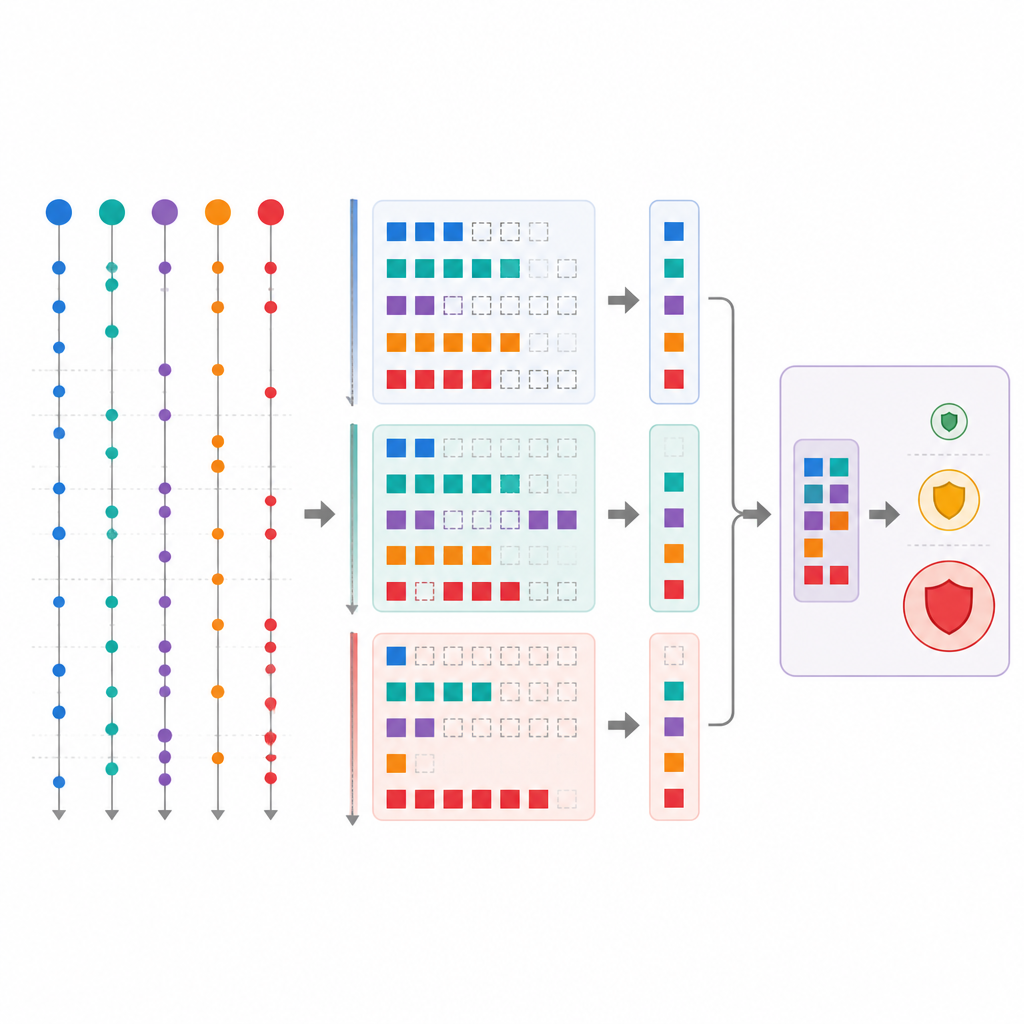
Choosing only the most telling clues
Modern deep learning systems can scan thousands of data points and assign varying degrees of “attention” to each one, but they are often hard to interpret and demand heavy computing power. TLDR takes a simpler path. After dividing events into time zones, it applies an information based filter that keeps only the most informative signals and discards the rest. This “hard attention” creates a compact set of features that are easier for researchers and clinicians to inspect. For example, a code indicating long term drug treatment that appears in the recent zone may be far more predictive of long COVID risk than the same code buried in distant history.
Testing the method on long COVID risk
The team evaluated TLDR using records from more than 85,000 people treated in a large health system after testing positive for COVID-19. About 24,000 later developed long COVID, while the rest did not. The researchers compared TLDR to a standard, time blind approach and to several advanced deep learning models, including transformer based systems and recurrent neural networks. Across many repeated experiments and different types of prediction models, TLDR consistently delivered higher accuracy. It not only made better use of the same basic data but also showed less overfitting, meaning its good performance held up on new patients and was less likely to be a fluke.
What this means for patients and health systems
For a general reader, the key message is that timing in medical records is not just a detail, it is central to understanding risk. TLDR offers a practical way for hospitals and researchers to capture this timing while still keeping models understandable. Instead of relying on opaque “black box” systems, health systems can use this framework to see which past conditions and treatments, and in which periods of a patient’s journey, are linked to long COVID or other outcomes. While TLDR does not solve every challenge and still depends on good quality records and well chosen time windows, it points toward more transparent prediction tools that think about medical history in a way that resembles how clinicians already reason about their patients.
Citation: Cheng, J., Hügel, J., Tian, J. et al. Temporal Learning with Dynamic Range (TLDR) for modeling recurrent exposure and treatment outcomes. Sci Rep 16, 14824 (2026). https://doi.org/10.1038/s41598-026-45346-y
Keywords: electronic health records, long COVID, machine learning, risk prediction, temporal modeling