Clear Sky Science · en
Development of an HRM-qRT-PCR platform for fast and cost-effective genotyping of infectious bronchitis virus in Egypt
Why a Chicken Virus Matters to Your Dinner Table
Infectious bronchitis virus is a coronavirus that attacks chickens, damaging their lungs, kidneys, and egg-producing organs. For farmers, that means fewer eggs, slower growth, and more deaths in the flock—costs that ultimately ripple down to food prices and supply. This study from Egypt introduces a faster and cheaper way to tell which versions of this virus are circulating in poultry farms, helping veterinarians choose the right vaccines and limit outbreaks before they spread.
A Hidden Threat in Chicken Farms
Infectious bronchitis virus (IBV) has long been one of the most serious viral threats to poultry worldwide. Birds can develop coughing, gasping, and sneezing, and laying hens may produce fewer and poorer-quality eggs. Some virus variants also damage the kidneys, leading to high mortality. Egypt, like many poultry-producing countries, relies heavily on vaccination, but IBV evolves quickly into many distinct genetic types. A vaccine that protects against one type may fail against another, so understanding exactly which strains are present in a region is essential for protecting flocks and keeping production stable.
Why Speedy Virus Typing Is So Hard
Traditionally, scientists identify IBV types by reading the genetic code of a viral surface protein called S1. This method is very accurate but also slow, technically demanding, and relatively expensive. It often requires isolating the virus in eggs, extracting high-quality genetic material, and then sequencing a long stretch of RNA—steps that can take days. Meanwhile, an outbreak can race through crowded barns. The Egyptian team asked whether they could get reliable strain information from shorter, more stable parts of the viral genome, and do it using a quicker laboratory technique that many diagnostic labs already own.
A New Short-Cut Based on How DNA Melts
The researchers focused on two regions near the tail end of the virus’s genetic material: the N gene, which encodes a shell protein that wraps the RNA, and the neighboring 3′ untranslated region, which helps control replication. They used a method called high-resolution melting (HRM) analysis combined with quantitative real-time PCR (qRT‑PCR). In this approach, a short piece of viral DNA is copied many times in a closed tube. As the temperature is slowly raised, the double strands separate at a characteristic melting temperature that depends on their exact sequence. A sensitive detector tracks tiny changes in fluorescence as the strands come apart, producing a melt curve that acts like a fingerprint for that particular virus strain.

Sorting Farm Viruses into Clear Families
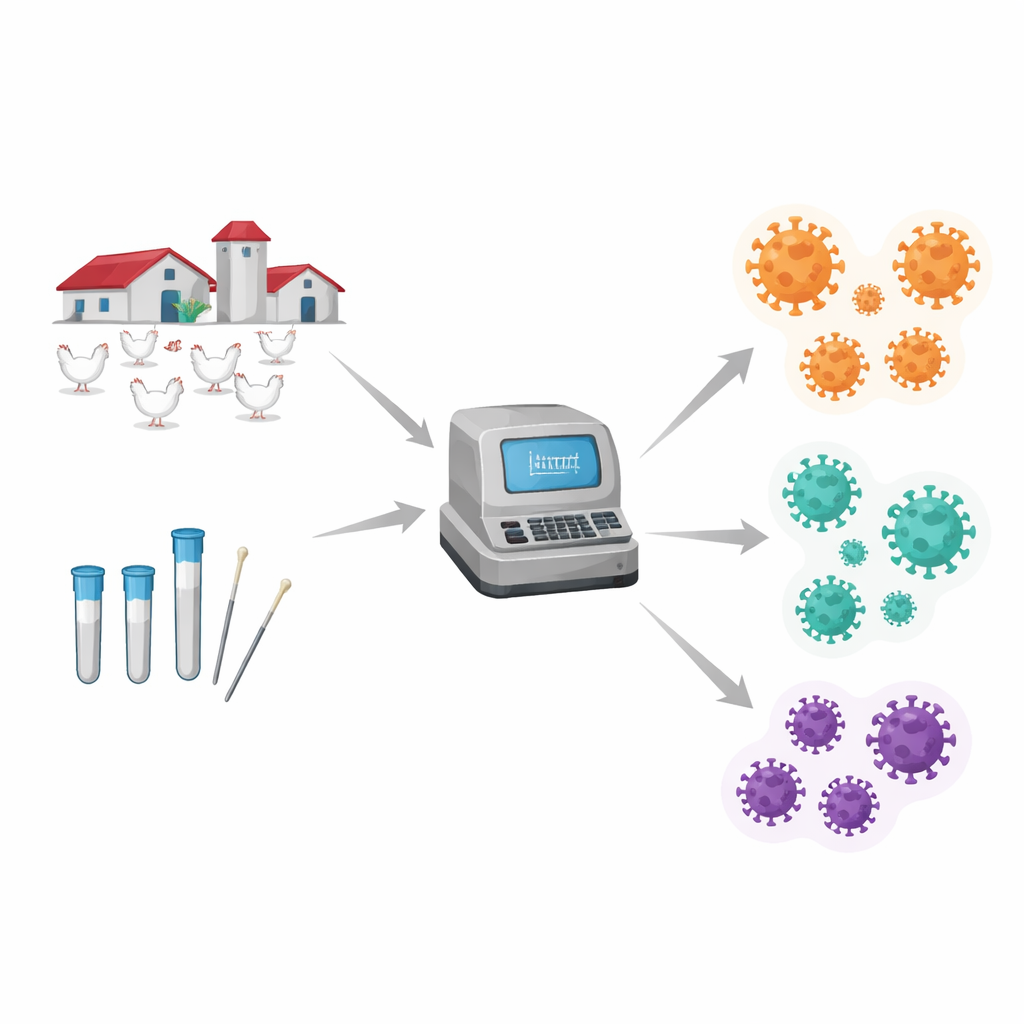
The team collected 60 samples from Egyptian poultry flocks showing signs of infectious bronchitis and screened them, along with four commonly used vaccines, for the virus. Twenty-two samples tested positive and were run through the HRM protocol, targeting a 435-base-pair fragment that spans the end of the N gene and the 3′ tail. The resulting melt curves naturally grouped the viruses into three main clusters matching the major vaccine lineages used in Egypt: Massachusetts (Ma5), strain 4/91 (also called Variant I), and Variant II. When the researchers sequenced the full S1 gene for selected isolates, the groupings closely matched the HRM results. They also discovered a small deletion—about 15 genetic “letters”—at the junction between two genes in the 4/91 and Variant II strains that helps explain their distinct melt patterns.
How This Tool Can Help Farmers and Vets
Because the HRM test runs in a single closed tube and analyzes only a short viral fragment, it can deliver answers in less than five hours—far quicker and cheaper than full gene sequencing, which can take days. The method was able to distinguish vaccine strains from related field strains and to flag mismatches where a virus looked vaccine-like in one region but clearly different in the highly variable S1 gene. The authors conclude that HRM is best used as a rapid screening tool to sort viruses into major families and track which vaccine lineages dominate in the field, while full sequencing remains important for fine-scale tracking and for resolving unusual cases. For poultry producers, this combined strategy promises faster outbreak investigation, better vaccine choices, and ultimately more secure supplies of chicken meat and eggs.
Citation: Ali, A., Prince, A., Aljuaydi, S.H. et al. Development of an HRM-qRT-PCR platform for fast and cost-effective genotyping of infectious bronchitis virus in Egypt. Sci Rep 16, 12053 (2026). https://doi.org/10.1038/s41598-026-45311-9
Keywords: infectious bronchitis virus, poultry vaccines, high-resolution melting, viral genotyping, Egypt poultry health