Clear Sky Science · en
Quantifying functional vision in a mouse model of oculocutaneous albinism type 1
Why this study matters for everyday vision
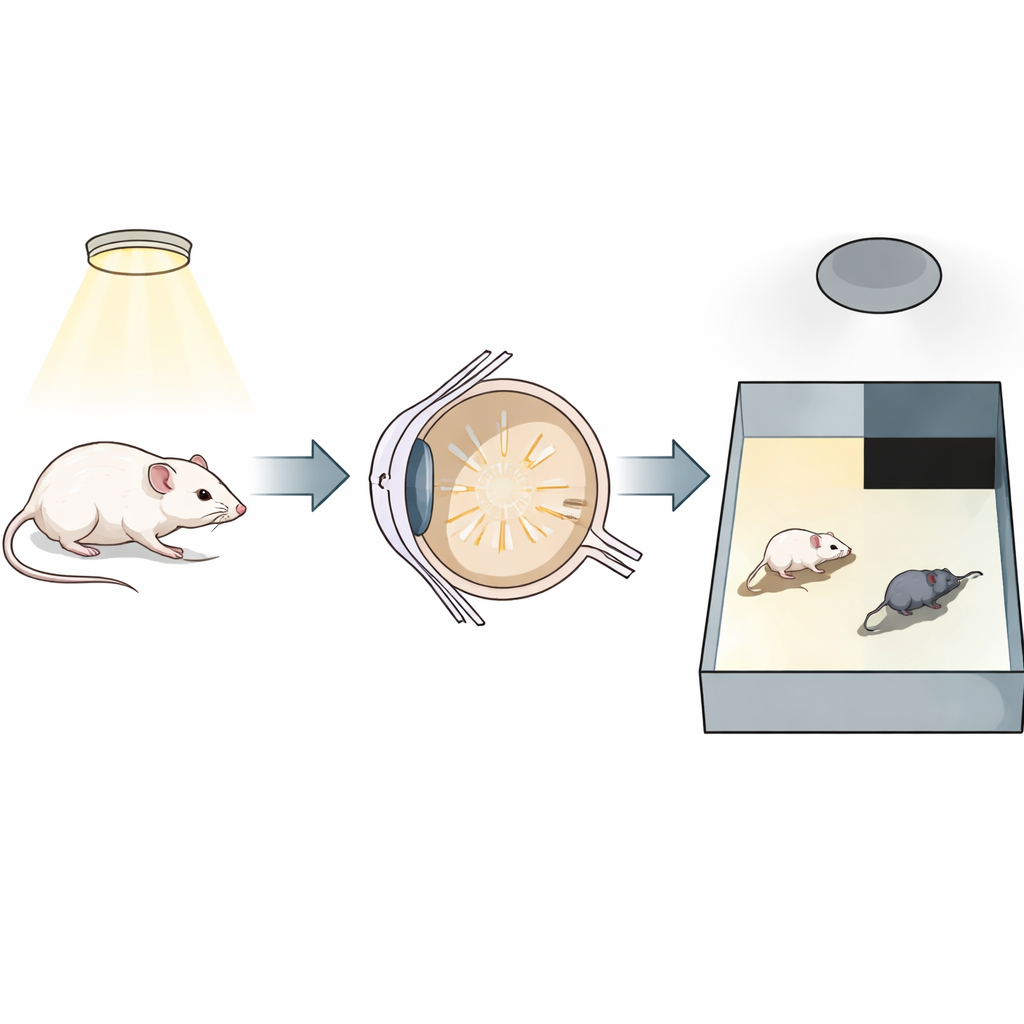
People with albinism often struggle with bright light, blurry sight, and trouble making out details, yet it is hard to measure exactly how these problems affect daily life. This study uses mice that carry the same kind of gene change seen in a common form of albinism, called OCA1, to ask a simple question: how well do they actually see in real-world situations? By turning vision into measurable behaviors—like avoiding bright spaces, noticing new objects, or reacting to a looming shadow—the work lays the groundwork for testing future treatments aimed at restoring functional sight, not just changing how the eye looks.
Albinism, pigment, and the challenge of seeing clearly
Oculocutaneous albinism type 1 (OCA1) is caused by changes in a gene needed to make melanin, the pigment that colors our skin, hair, and eyes. In the eye, melanin does more than set eye color—it helps guide normal development of the retina and keeps stray light from bouncing around inside the eye. Without enough pigment, people with OCA1 often have underdeveloped central vision, miswired visual pathways, extreme light sensitivity, and shaky eye movements. The mouse model used here lacks a working version of the same pigment-making enzyme, so its eyes are pale and its retina is structurally altered in ways that resemble human OCA1. This makes these mice a powerful stand-in for understanding how albinism changes vision and for checking whether new therapies actually make a practical difference.
Testing light avoidance in bright and gentle conditions
The researchers first looked at how OCA1 mice handle bright light by placing them in a box split into a well-lit side and a dark shelter. Both normal and OCA1 mice explored freely when the light was off or set to a comfortable indoor level. But under intense brightness, OCA1 mice spent far less time in the lit side than their normal counterparts, even though they crossed between the two sides just as often. This pattern suggests that the drive to explore was intact, but strong light became so uncomfortable that the pale-eyed mice chose to retreat sooner. The findings mirror what many people with albinism describe: normal behavior in moderate light, but strong avoidance once brightness crosses a personal threshold.
How well do mice notice something new?
Next, the team asked whether albinism affects the ability to notice and investigate new objects when light is not painfully bright. Mice naturally spend more time sniffing and examining something unfamiliar than something they already know. In a moderate-light arena containing a familiar shelter and a new object, normal mice repeatedly approached and investigated the new item, circling it and spending a notable share of the test engaged with it. In contrast, OCA1 mice behaved much more like a separate strain that is effectively blind due to severe retinal degeneration. Both the OCA1 and blind mice spent little time with the new object, visited it less often, and favored the familiar shelter or corners instead. This suggests that, even when light is comfortable, OCA1 mice struggle to see or recognize new shapes in their surroundings.
Reactions to looming shadows and fine visual detail
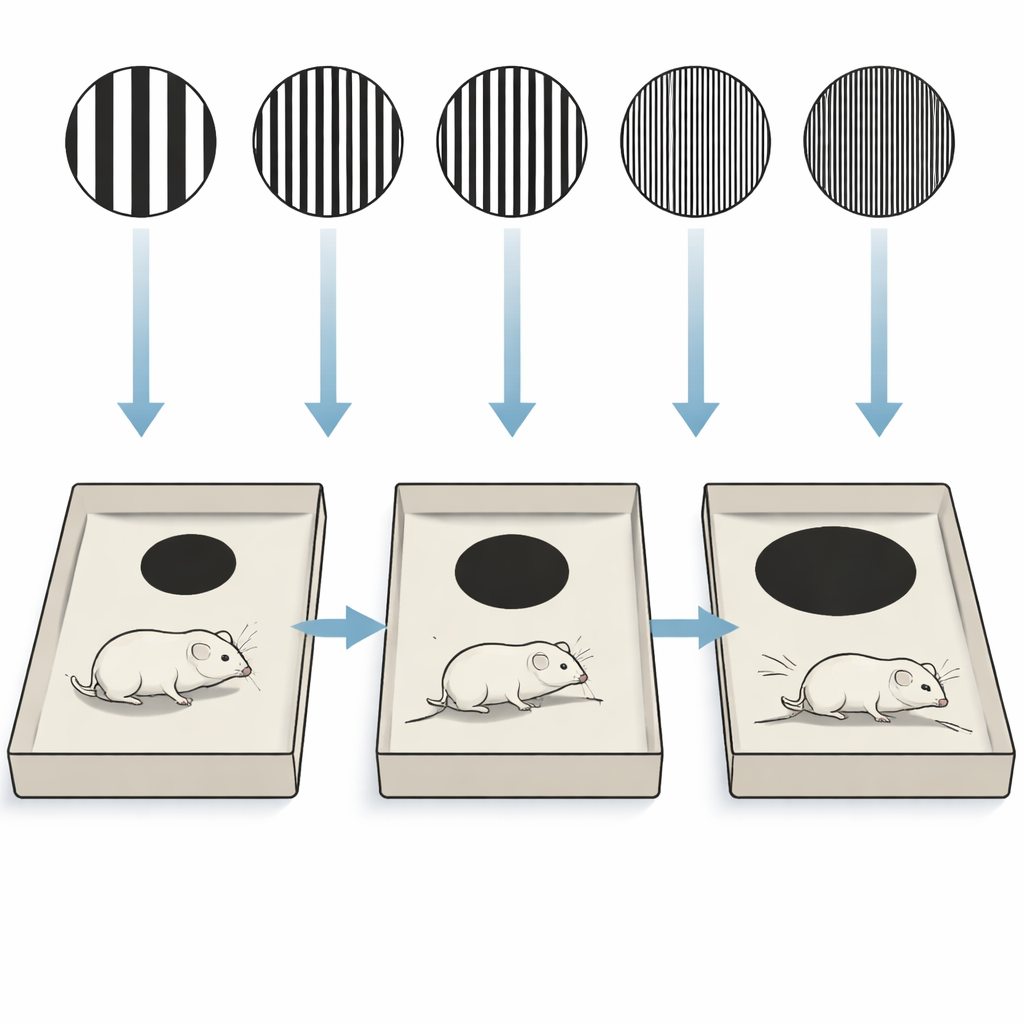
To probe how well OCA1 mice detect motion and detail, the researchers used an overhead "looming" stimulus: a dark disk that rapidly grows in size above the animal, mimicking an approaching threat. They overlaid this disk with stripe patterns ranging from coarse to very fine and recorded whether mice froze in place or fled, and how quickly they reacted. Normal mice showed the strongest responses at intermediate stripe sizes, a hallmark of healthy spatial vision, and reacted quickly with either freezing or flight. OCA1 mice displayed far fewer responses overall and reacted more slowly, particularly for certain stripe sizes. When they did respond, they were more likely to flee than freeze, hinting that altered visual processing in albinism not only reduces sensitivity to detail but may also change how the brain chooses defensive strategies.
What these findings mean for future treatments
Taken together, the study shows that mice with OCA1 do not just have pale eyes—they have specific, measurable problems with light tolerance, object recognition, and fine spatial vision that echo real-world challenges faced by people with albinism. Because these deficits are captured with straightforward behavioral tests, they can now serve as practical readouts for future gene- or drug-based therapies. If a new treatment helps OCA1 mice spend more time in bright spaces, notice new objects, or react more reliably to looming threats, it would signal a meaningful gain in functional vision. In this way, the work provides a crucial bridge between lab-based eye measurements and the everyday visual tasks that matter most.
Citation: Kriebel, W.G., Larimer-Picciani, A.M., Nukala, M. et al. Quantifying functional vision in a mouse model of oculocutaneous albinism type 1. Sci Rep 16, 14563 (2026). https://doi.org/10.1038/s41598-026-45301-x
Keywords: oculocutaneous albinism, functional vision, mouse model, visual behavior, retinal development