Clear Sky Science · en
Predictive modeling of influenza strain drugs using temperature-based topological indices and regression analysis via multi-criteria decision making techniques
Why ranking flu drugs with math matters
Every winter, doctors reach for a familiar toolbox of medicines to treat influenza and other viral infections. But which drugs are likely to be most effective, and how can we quickly compare promising new compounds without running expensive, time‑consuming lab tests for each one? This study shows how ideas from mathematics and statistics can help prioritize flu drugs on a computer screen first, so that only the most promising candidates move on to detailed experiments.
Turning molecules into networks
The researchers begin by treating each drug molecule as a kind of network: atoms become points and chemical bonds become lines between them. This framework, called graph theory, allows computers to analyze structure in a precise, repeatable way. On top of this, they use a special family of measurements known as temperature‑based indices. These indices capture how “connected” each atom is relative to the whole molecule, in a way that reflects stability and how the molecule might behave under different thermal conditions. By computing these indices for 20 influenza‑related drugs—ranging from classic flu antivirals like Oseltamivir to repurposed agents such as Ritonavir and Azithromycin—the team creates a compact numerical fingerprint for each compound. 
Predicting key physical traits from structure
Next, the study asks whether these structural fingerprints can stand in for labor‑intensive measurements. The authors focus on five basic physical properties that strongly influence how a drug behaves in the body and in manufacturing: boiling point, flash point (how easily a substance ignites), molar refractivity, polarizability, and molar volume. Using regression analysis—fitting mathematical curves to data—they relate each temperature‑based index to these properties. Across the board, simple straight‑line relationships are not enough. Instead, gently curved, cubic equations capture the trends much better, often explaining over 95% of the variation for refractivity, polarizability, and volume, and around 70% for boiling and flash points. This means that, once the indices are known, the model can give reasonably accurate first estimates of these important traits without doing new experiments for every drug.
From predicted properties to ranked drug candidates
Knowing approximate physical properties is useful, but drug developers ultimately need to choose among alternatives. To move from prediction to choice, the authors apply two decision‑support methods widely used in engineering and economics: the Weighted Sum Model and the Weighted Product Model. Both methods treat each index as a separate “criterion” and then combine them into a single overall score for each drug, assuming that higher index values are generally favorable. In essence, they simulate a panel of judges that scores every compound on several structural dimensions at once and then averages those judgments in a systematic way.
What the models say about specific drugs
When the dust settles, a consistent pattern emerges. Azithromycin, better known as a common antibiotic, rises to the top of both ranking schemes, with Ritonavir and Indinavir close behind. These compounds have particularly high temperature‑based indices and predicted values for properties linked to molecular size and stability, such as molar refractivity and volume. At the other end of the scale, drugs like Favipiravir and Triazavirin tend to have lower structural scores and predicted property values, placing them near the bottom of the rankings. The study also compares actual and predicted measurements—for example, boiling point or molar volume—to check the realism of the models, finding that the cubic equations track the general trends well, even if they struggle with the largest, most complex molecules. 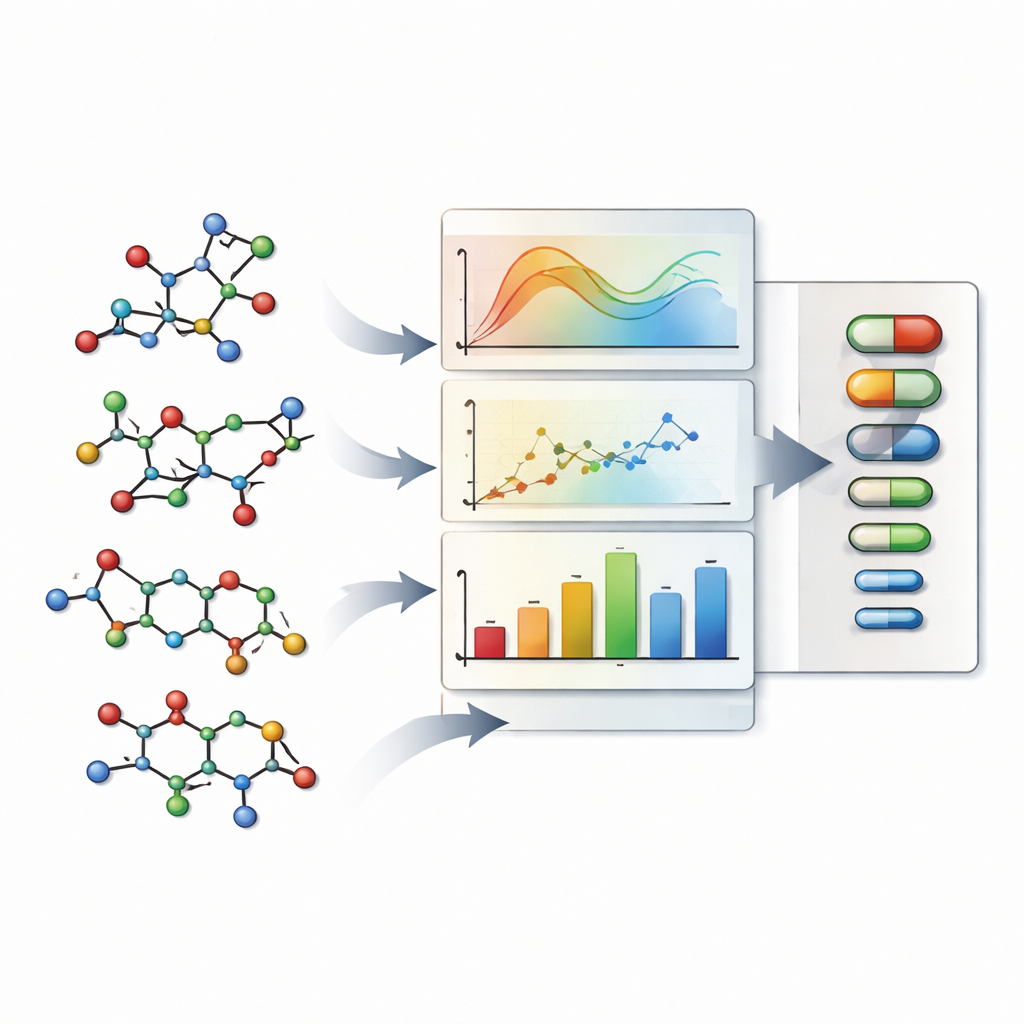
What this means for future flu treatments
To a lay reader, the message is that we can use mathematical descriptions of shape and connectivity to narrow down which flu drugs deserve the most attention before stepping into the lab. This does not prove that Azithromycin or Ritonavir are the “best” clinical options against influenza—real‑world effectiveness depends on many biological factors not captured here. But it does show that temperature‑based indices, combined with curve‑fitting and multi‑criteria ranking, form a fast, inexpensive filter for prioritizing antiviral candidates. As new compounds are designed or repurposed, similar tools could guide researchers toward the most promising options more quickly, helping to keep pace with ever‑changing flu strains.
Citation: Hayat, H., Ahmad, S., Siddiqui, M.K. et al. Predictive modeling of influenza strain drugs using temperature-based topological indices and regression analysis via multi-criteria decision making techniques. Sci Rep 16, 14035 (2026). https://doi.org/10.1038/s41598-026-45284-9
Keywords: influenza drugs, computational drug ranking, graph theory in chemistry, QSPR modeling, multi-criteria decision making