Clear Sky Science · en
Performance evaluation and codal assessment of double-skinned solid-core CFST columns with varying steel configurations
Stronger building columns for safer cities
Modern cities rely on tall buildings, bridges, and towers that must safely carry enormous vertical loads and withstand earthquakes or impacts. Engineers are constantly searching for column designs that are not only stronger, but also more ductile—that is, able to bend and deform without suddenly collapsing. This study looks at a new type of composite column made from steel tubes filled with concrete, arranged in a double-layered “skin” around a solid concrete core. By comparing several shapes and configurations, the researchers show how small changes in geometry can lead to major gains in strength, stability, and resilience.
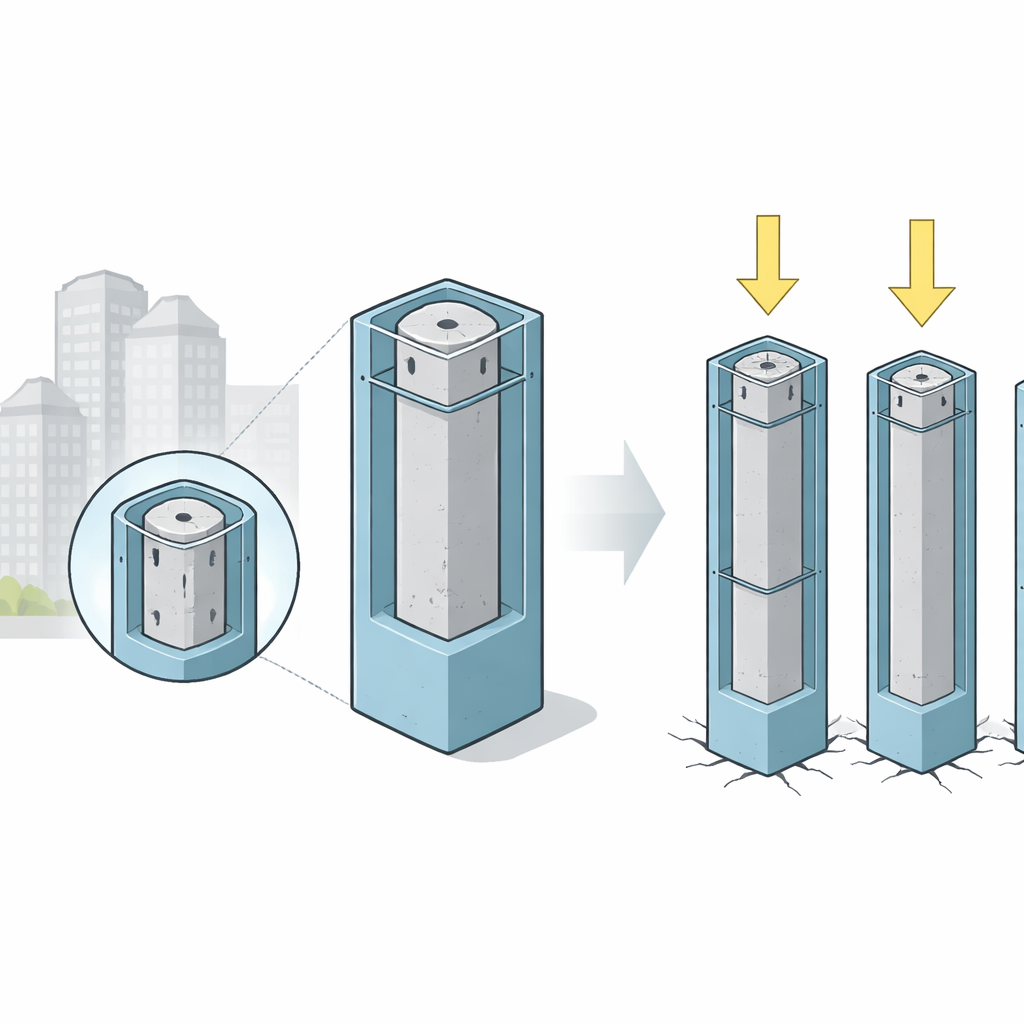
What these new composite columns look like
The columns studied here belong to a family called concrete-filled steel tubes, where a hollow steel tube is packed solid with concrete so that both materials work together. The team focused on a newer variant: double-skinned, solid-core columns. In these, there is an outer steel tube and a second inner steel tube, with all the space between and inside filled with concrete—no empty voids. The tubes can be square or circular, and combining them in different ways (square–square, circular–circular, or mixed) changes how the column behaves under load. Each test column was short and squat, about 41 centimeters tall, a scale that highlights how the cross-section and material arrangement control the way forces move through the column.
How the experiments were carried out
Eight different column specimens were built using standard concrete and thin-walled steel tubes. Some had only steel tubes with no concrete, some had a single concrete-filled tube, and others used the new double-skin, solid-core layout with an inner and outer tube. After casting and curing, each specimen was placed in a large testing machine and squeezed axially—straight down the length—until its capacity was reached and its shape changed significantly. During loading, the researchers measured how much the columns shortened, how stiff they were at the start, and how much extra deformation they could tolerate after reaching their peak strength. They also carefully recorded how and where the steel buckled and how the concrete crushed.
Why circular outer tubes win the strength contest
The results showed a clear pattern: circular columns were generally stronger and more ductile than square ones. A circular steel tube spreads stress evenly around its perimeter, which helps confine the concrete inside and delays local buckling of the steel. For example, a hollow circular tube carried far more load than a hollow square tube, and a concrete-filled circular tube notably outperformed a concrete-filled square tube. The advantage became even more pronounced in the double-skin columns. Configurations with circular outer tubes, even when they used less steel, carried higher loads and deformed more gracefully than those with square outer tubes. Their failure involved relatively uniform radial expansion and gradual crushing of the core, rather than sharp kinks, “elephant foot” bulges, or sudden local buckling.
What double skins and solid cores add
Adding a second inner steel tube and a solid concrete core significantly boosted performance over single-skin columns. The best double-skinned specimens were about 56 percent stronger than their single-skin counterparts made with similar materials. The inner tube helps restrain the concrete and supports the outer tube from within, while the solid concrete core avoids weak zones and ensures that load is transferred smoothly through the entire section. In some cases, double-skinned circular configurations achieved nearly twice the strength predicted by common design rules, showing that current building codes are conservative for these advanced layouts. To explore this more systematically, the authors trained a simple artificial neural network using geometry and material data to predict column strength, and it matched test results very closely, hinting at a useful design tool once more data are available.
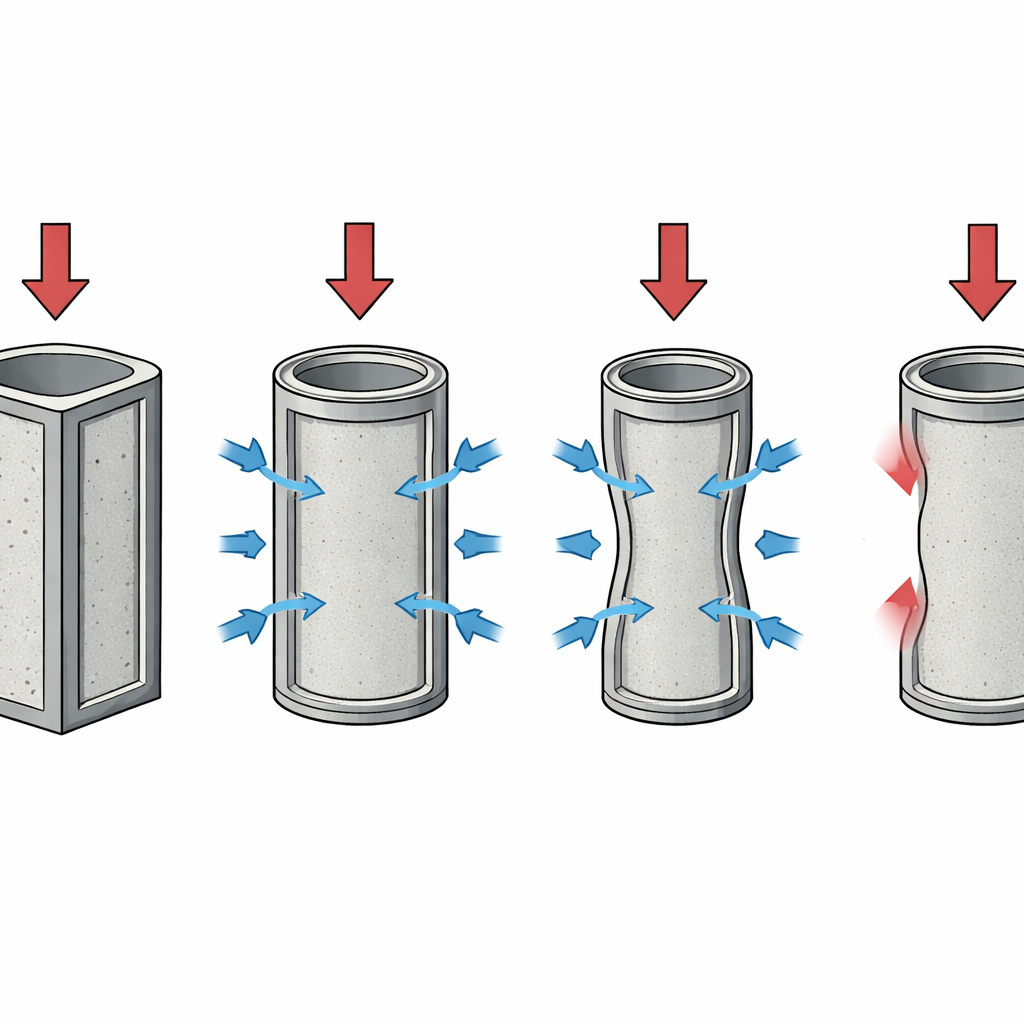
What this means for future buildings
For a non-specialist, the main message is straightforward: by carefully choosing the shape and layering of steel tubes and concrete, engineers can create columns that are much stronger and more forgiving than traditional designs. Solid-core double-skinned columns with circular outer tubes in particular combine high strength, stiffness, and ductility, making them attractive for high-rise buildings, seismic regions, and structures that must absorb impact without catastrophic failure. Although current design codes underestimate their capacity, and more testing is needed, this work shows a clear path toward slimmer, safer, and more efficient structural supports in tomorrow’s built environment.
Citation: Neelamegam, P., Kanchidurai, S., Ganga, V. et al. Performance evaluation and codal assessment of double-skinned solid-core CFST columns with varying steel configurations. Sci Rep 16, 14477 (2026). https://doi.org/10.1038/s41598-026-45278-7
Keywords: concrete-filled steel tubes, double-skin columns, structural strength, seismic design, building materials