Clear Sky Science · en
Machine learning approach for adult age estimation using dental characteristics on panoramic radiographs
Why your teeth can hint at your age
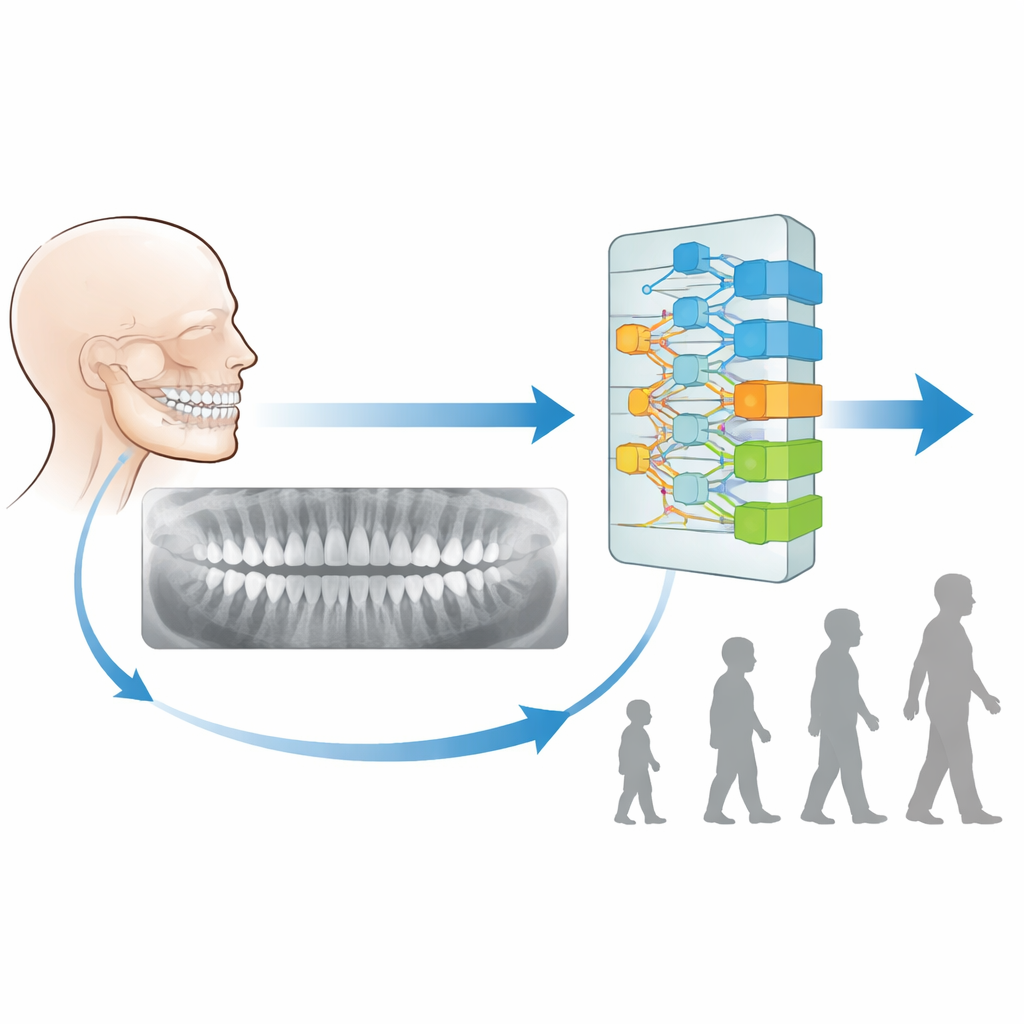
As we go through life, our teeth quietly record our personal history of meals, mishaps, and dental visits. This study asks how much that record can reveal about a person’s age in adulthood, using modern computer techniques to read subtle patterns in routine dental X ray images.
Teeth as lifelong storytellers
In children and teenagers, age can be estimated fairly well by looking at how teeth grow and form. For adults, however, that growth is complete, so experts must turn to changes that build up over time, such as worn surfaces, fillings, crowns, implants, and missing teeth. These clues are useful in areas like forensics, where investigators may need to narrow down who a person could be, and in anthropology, where scientists study past populations. Traditional approaches usually add up the total number of certain dental treatments or conditions and plug those counts into a simple formula, but this can throw away a lot of detail about exactly which teeth are affected and how.
Turning a mouthful of details into usable data
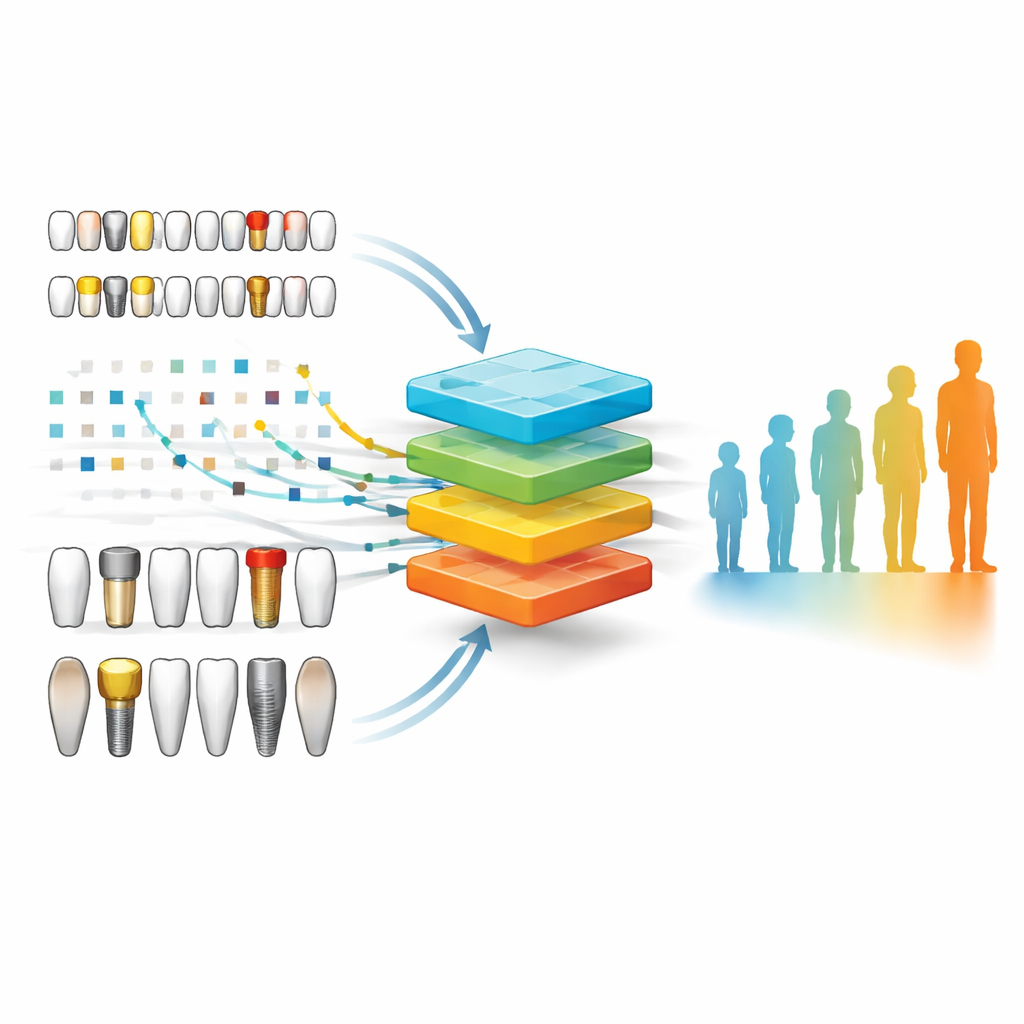
The researchers worked with 2,415 panoramic dental radiographs from adults aged 20 to 89 years. On each image, trained observers labeled every tooth with one of nine easy to recognize categories, such as sound, missing, filled, crowned, or implanted. If a tooth showed two different features at once, like a root canal under a crown, both were recorded together. Instead of collapsing all this information into a few totals, the team created a structured digital map for every mouth that kept track of what was happening at each position in the jaw. This map served as the input to both traditional statistical formulas and a suite of machine learning models.
Teaching computers to read dental patterns
To judge how well different methods could estimate age, the team compared standard linear regression with six machine learning approaches, including random forests and gradient boosting. They used a careful testing strategy in which models were repeatedly trained and tested on different subsets of the data, so that every prediction was made on images the model had not seen before. Across the full group of men and women, the best traditional formula missed by about 12 years on average, while the best machine learning model reduced that error to about 11 years and explained a bit more of the variation in age.
What the models learned from our teeth
The researchers also opened the “black box” of their best models to see which dental features mattered most. They found that having many sound, untouched teeth tended to push predicted ages downward, while a higher number of missing teeth and crowns nudged estimates upward. Back teeth generally carried more age information than front teeth, likely because they are used more heavily for chewing and are more often restored or removed. Even so, the models tended to overestimate the ages of younger adults and underestimate those of older adults, showing that the relationship between dental history and age remains imperfect.
How this could be used in real life
For now, these computer based age estimates are not precise enough to stand alone, especially when the goal is to pinpoint an individual’s age. They are better viewed as one more piece of evidence that can support other methods, such as examining bones or additional dental measures. The work shows that keeping detailed, tooth by tooth information improves how much can be learned from a simple X ray, and that machine learning can make modest gains over older formulas. With larger and more varied datasets, and by combining image features with clinical records, future versions of this approach may become more reliable aids in forensic and clinical decision making.
Citation: Lee, D., Oh, S., Hwang, S. et al. Machine learning approach for adult age estimation using dental characteristics on panoramic radiographs. Sci Rep 16, 14401 (2026). https://doi.org/10.1038/s41598-026-45271-0
Keywords: dental age estimation, panoramic radiograph, machine learning, forensic dentistry, adult teeth