Clear Sky Science · en
Integrative study of the rare Incarvillea potaninii (Bignoniaceae) in Mongolia: conservation, comparative plastome, distribution modelling, phylogeny, and taxonomic insights
A small flower with a big story
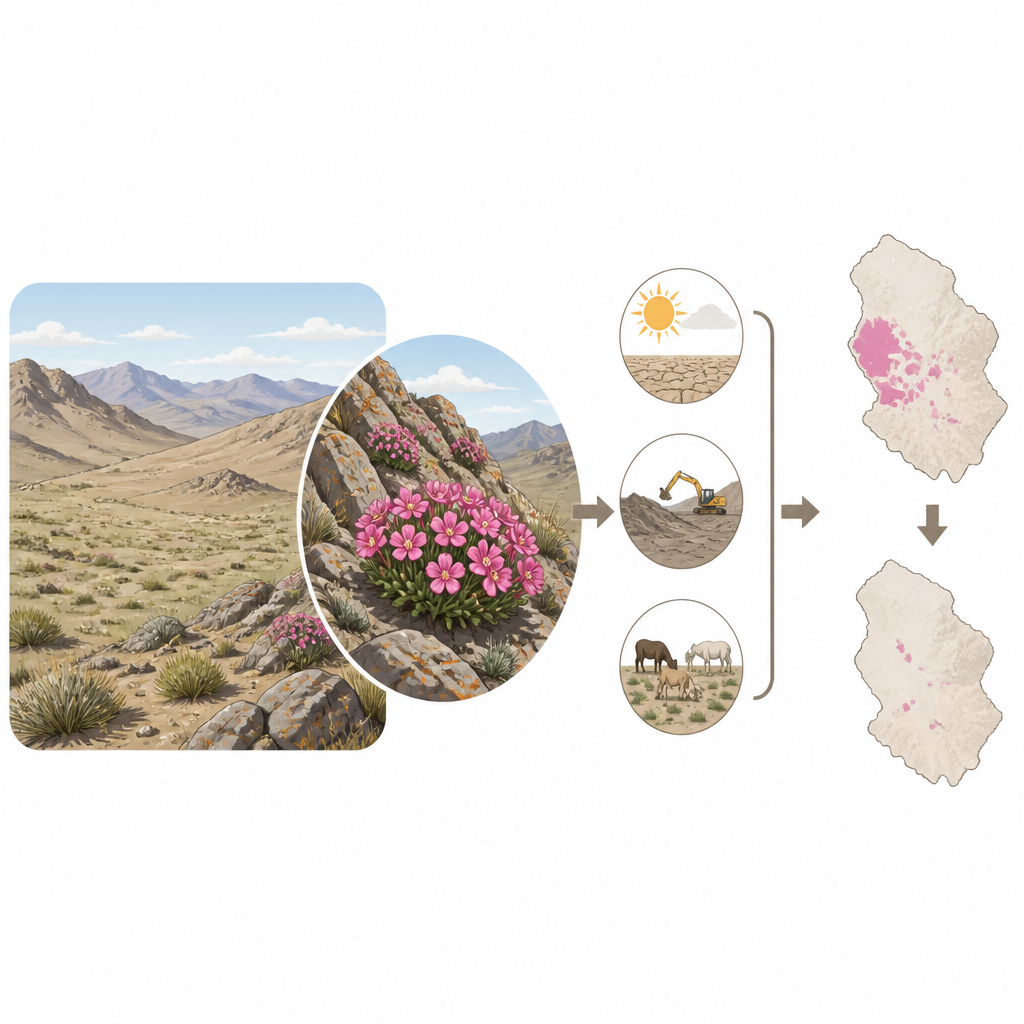
High in the rocky hills of Mongolia’s southern Gobi, a little pink flower grows in scattered pockets of harsh land. This study follows that plant, Incarvillea potaninii, to understand where it lives today, how climate and soil shape its future, and what its DNA can tell us about the history of its plant family. For readers, it offers a glimpse of how modern genetics and computer models combine to protect a rare species found nowhere else on Earth.
Where this rare plant calls home
Incarvillea potaninii is part of a small group of flowering plants spread from Central Asia to the Himalayas. Once thought to grow in both Mongolia and northern China, the authors carefully checked field records and old museum specimens and found that confirmed wild plants now occur only in Mongolia. The species lives in fragile desert and mountain habitats, often along dry streambeds and stony valleys. Because its range is so narrow and its sites are easily disturbed by grazing, mining, and climate change, the team reassessed its global conservation status and found that it fits into the “vulnerable” category, meaning it faces a high risk of disappearing in the wild.
Reading the plant’s green blueprint
To see how this species fits into the tree of life, the researchers decoded its chloroplast genome, the circular DNA inside the plant’s green leaf cells. They found a compact genetic blueprint with 111 unique genes and several missing or altered genes compared to typical flowering plants. When they compared this blueprint with those of twelve close relatives, they saw large flips and shifts in the order of genes and strong changes in certain repeated regions. These changes help explain how the group has evolved over time and suggest that pieces of DNA have moved around in different ways in different species, even when the plants still look quite similar.
Family ties across Asian mountains
Using dozens of shared genes from the chloroplast, the team built a family tree for thirteen Incarvillea species. The analysis shows that Incarvillea potaninii is most closely related to a Chinese species, Incarvillea sinensis, and also linked to another Central Asian species, Incarvillea semiretschenskia. Together, these ties support the idea that members of the group spread directly between Central Asia and East Asia across mountain corridors, rather than only through the high ranges of southwestern China. At the same time, the odd shifts and expansions in the chloroplast DNA do not neatly match the branching of the family tree, hinting that the structure of the genome has its own, partly independent history.
Mapping present and future safe havens
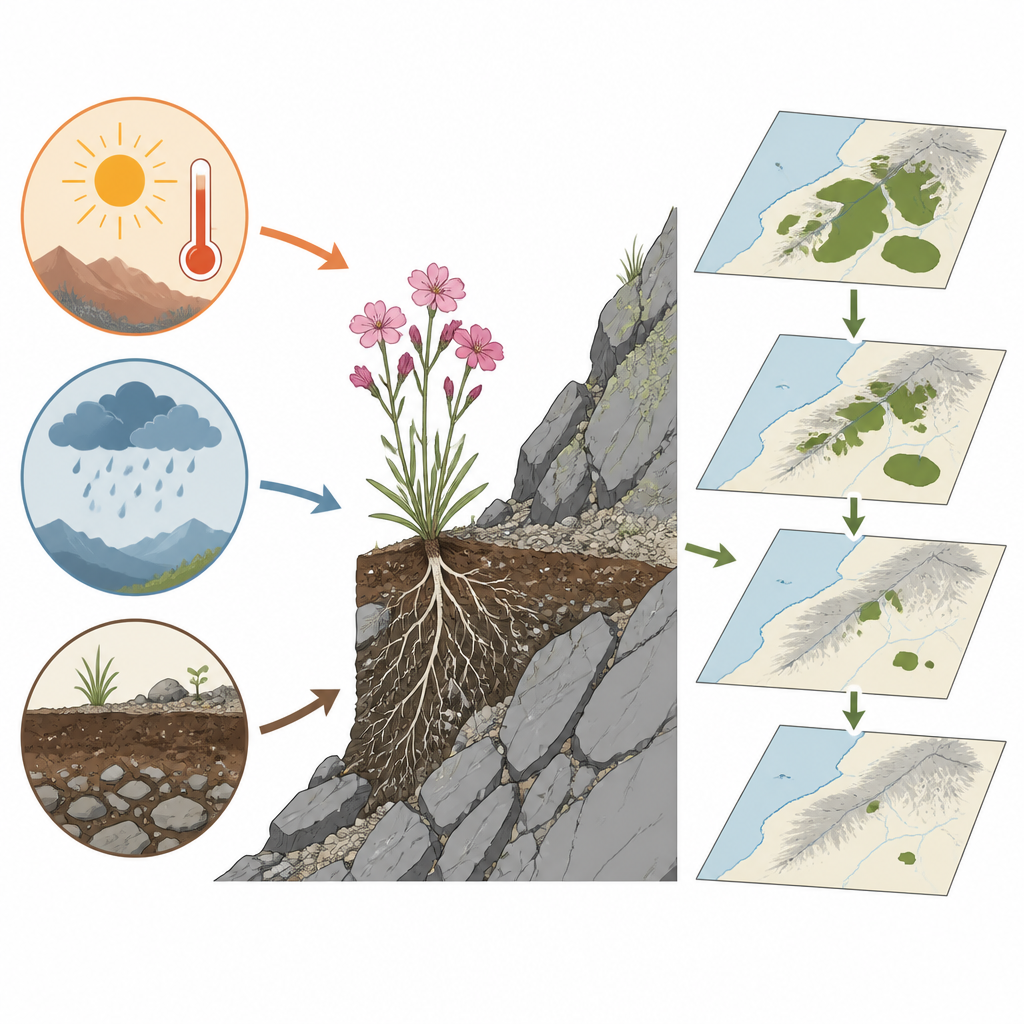
To understand how much room is left for this plant, the authors turned to a computer tool that predicts suitable habitat from known sightings and environmental data. They combined field observations, online records, climate, soil, and habitat maps to estimate where the plant could live now and under future climate conditions. Today, roughly 19,600 square kilometers in southern Mongolia provide suitable conditions, with the very best patches clustered in a few mountain ranges. The model shows that three main factors strongly shape its range: how much temperatures swing over the year, how dry the driest months are, and how acidic or alkaline the soil is.
What climate change may bring
When the team looked ahead to the middle and late twenty‑first century under different warming scenarios, the total suitable area for the plant changed only modestly, but the most ideal patches shrank sharply in some futures. Under a lower‑emissions pathway, the very best habitat could drop by more than half by 2070, especially in key strongholds in the southern Gobi. Nearly half of today’s suitable range overlaps with protected areas, yet the most favorable sites are still underrepresented, leaving conservation gaps in several mountain districts. The authors suggest a mix of better on‑site protection and off‑site seed or plant collections to guard against local losses.
Why this matters for a single pink flower
By tying together fieldwork, genetics, computer modeling, and classic plant description, this study shows how a little‑known flower can illuminate both Earth’s changing climate and the deep history of a plant group. Incarvillea potaninii turns out to be a unique branch of its family, confined to a small corner of Mongolia and finely tuned to local temperature, rainfall, and soil. The work provides a clearer genetic identity for the species, maps where it is most likely to survive in coming decades, and points to the places where careful protection could make the difference between persistence and quiet disappearance.
Citation: Baasanmunkh, S., Tsegmed, Z., Nyamgerel, N. et al. Integrative study of the rare Incarvillea potaninii (Bignoniaceae) in Mongolia: conservation, comparative plastome, distribution modelling, phylogeny, and taxonomic insights. Sci Rep 16, 14814 (2026). https://doi.org/10.1038/s41598-026-45263-0
Keywords: Incarvillea potaninii, Mongolia flora, chloroplast genome, species distribution model, plant conservation