Clear Sky Science · en
Polyhydroxybutyrate / carbonized waste rubber biocomposite films
Turning Old Tires into New Materials
Every year, mountains of worn-out car tires pile up, stubbornly resisting decay and posing a long-term burden for landfills and the environment. At the same time, society is searching for greener plastics that can break down naturally instead of lingering for centuries. This study brings these two challenges together by asking a simple question: can the carbon-rich remains of old tires be blended with a biodegradable plastic to create new, useful materials? By combining recycled tire waste with a plant-friendly plastic called PHB, the researchers explore a way to turn a disposal problem into a valuable resource for sustainable products.
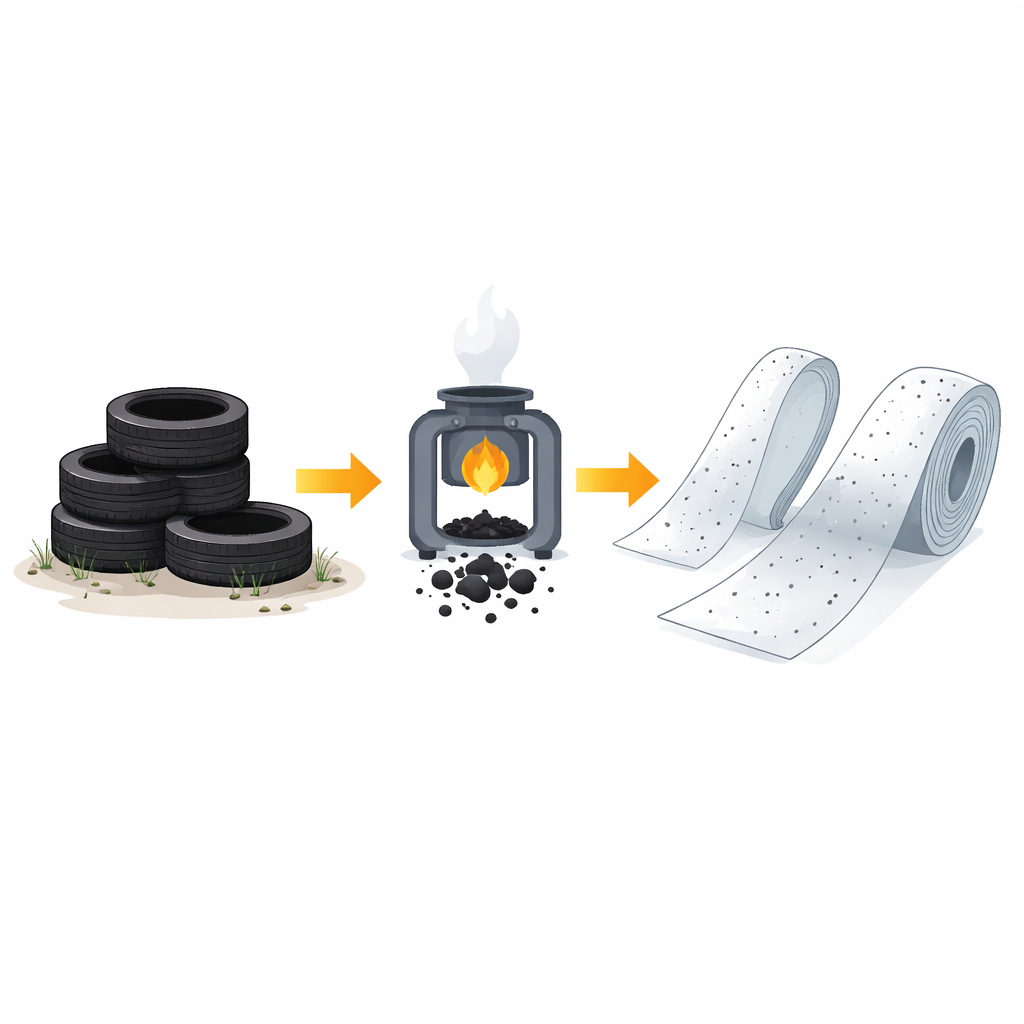
From Tire Trash to Useful Carbon
The researchers start with waste rubber from used tires and subject it to high-temperature treatment, a process known as pyrolysis, which leaves behind a carbon-rich solid. This material, called carbonized waste rubber (CWR), behaves somewhat like a finely divided charcoal. Instead of letting this substance go unused, the team blends it in tiny amounts—between 0.5% and 2% by weight—into PHB, a biodegradable plastic made by certain bacteria. Using a solvent casting method, they dissolve PHB, mix in the carbon particles, and then evaporate the liquid to form thin, flexible composite films that resemble plastic wrap, but with a dark speckled appearance from the embedded carbon.
Testing Heat Resistance and Stability
To find out how these new films behave under heat, the team measures how their weight and energy uptake change as temperature rises. They observe that all samples break down in three main steps as they are heated. The main plastic portion decomposes around 290 degrees Celsius, a hallmark of PHB itself, while the carbon from the tires breaks down at slightly higher temperatures. Importantly, the added carbon does not significantly shift the temperatures at which the plastic melts or begins to degrade, meaning the processing window of PHB is preserved. However, the amount of non-burnable residue, or ash, increases clearly with more carbonized rubber, signaling that the waste tire material remains as a stable backbone when the plastic burns away.
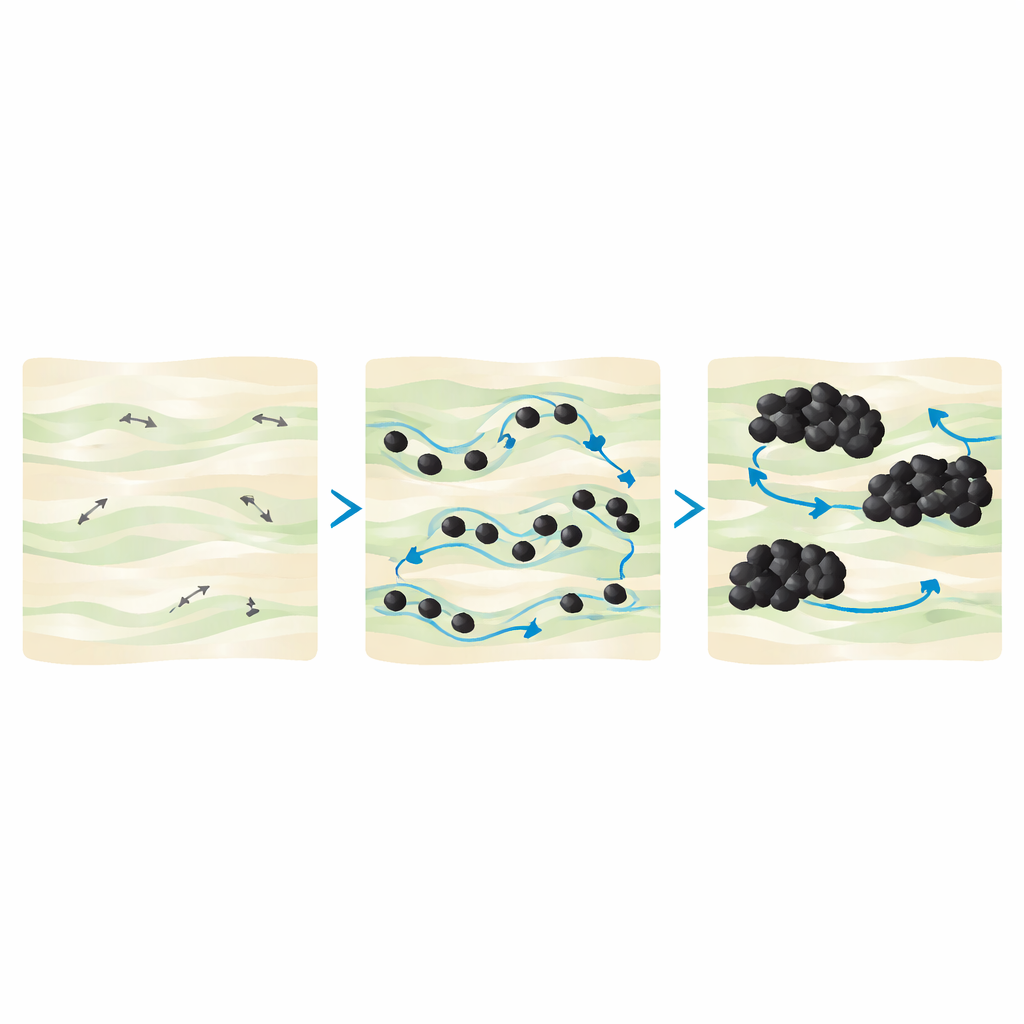
Adding Conductivity Without Changing the Chemistry
The team also examines how well the films conduct electricity, an important feature for applications like antistatic packaging or simple electronic components. Pure PHB behaves almost like an electrical insulator, but when carbon from tires is added, its conductivity rises into the range typical of semiconducting materials. The best performance appears at about 1% carbonized rubber, where the particles are dispersed well enough to form continuous pathways for electrical charges. At higher levels, the particles start to clump together, disrupting these pathways and slightly lowering conductivity again. Meanwhile, chemical analysis using infrared light shows only small shifts in characteristic signals of PHB, suggesting that the rubber-derived carbon sits within the plastic rather than reacting strongly with it.
Inside the Film: Pores and Well-Mixed Particles
Microscope images of the film cross-sections reveal a porous internal landscape, shaped by how the films are cast from solution. As the solvent evaporates slowly, tiny voids form throughout the material. Within this sponge-like structure, the carbonized rubber particles appear to be spread reasonably evenly, indicating good mixing between the plastic and the recycled filler. This pore structure can influence how the material behaves mechanically and thermally, but in this case it also shows that a simple, low-energy fabrication method can produce relatively uniform, functional films from a blend of biodegradable plastic and tire-derived carbon.
What This Means for Greener Products
In everyday terms, this work shows that a stubborn kind of waste—old tires—can be transformed into a helpful ingredient for greener plastics. By sprinkling in very small amounts of carbonized tire rubber, the researchers preserve the basic behavior of a biodegradable plastic while boosting its electrical conductivity and leaving its melting and breakdown points largely unchanged. The result is a new class of thin films that could be used in packaging and other products where both environmental friendliness and added functionality are desired. Instead of piling up in landfills, worn tires could find a second life as part of smarter, more sustainable materials.
Citation: Şen, F., Zor, M., Candan, Z. et al. Polyhydroxybutyrate / carbonized waste rubber biocomposite films. Sci Rep 16, 9703 (2026). https://doi.org/10.1038/s41598-026-45256-z
Keywords: biodegradable plastics, waste tire recycling, biocomposites, sustainable materials, electrically conductive films