Clear Sky Science · en
Correlation analysis between the collapsibility of loess and physicomechanical indices in Longdong region and prediction of the collapsibility coefficient based on machine learning
Why sinking ground matters for daily life
In many parts of northern China, towns, roads, and canals are built on a wind-blown soil called loess. This soil can suddenly compact when it gets wet, causing the ground to sink and damage buildings and infrastructure. The study summarized here looks at loess in the Longdong region and shows how simple measurements and modern machine learning can quickly flag where the ground is likely to stay firm and where it may collapse.
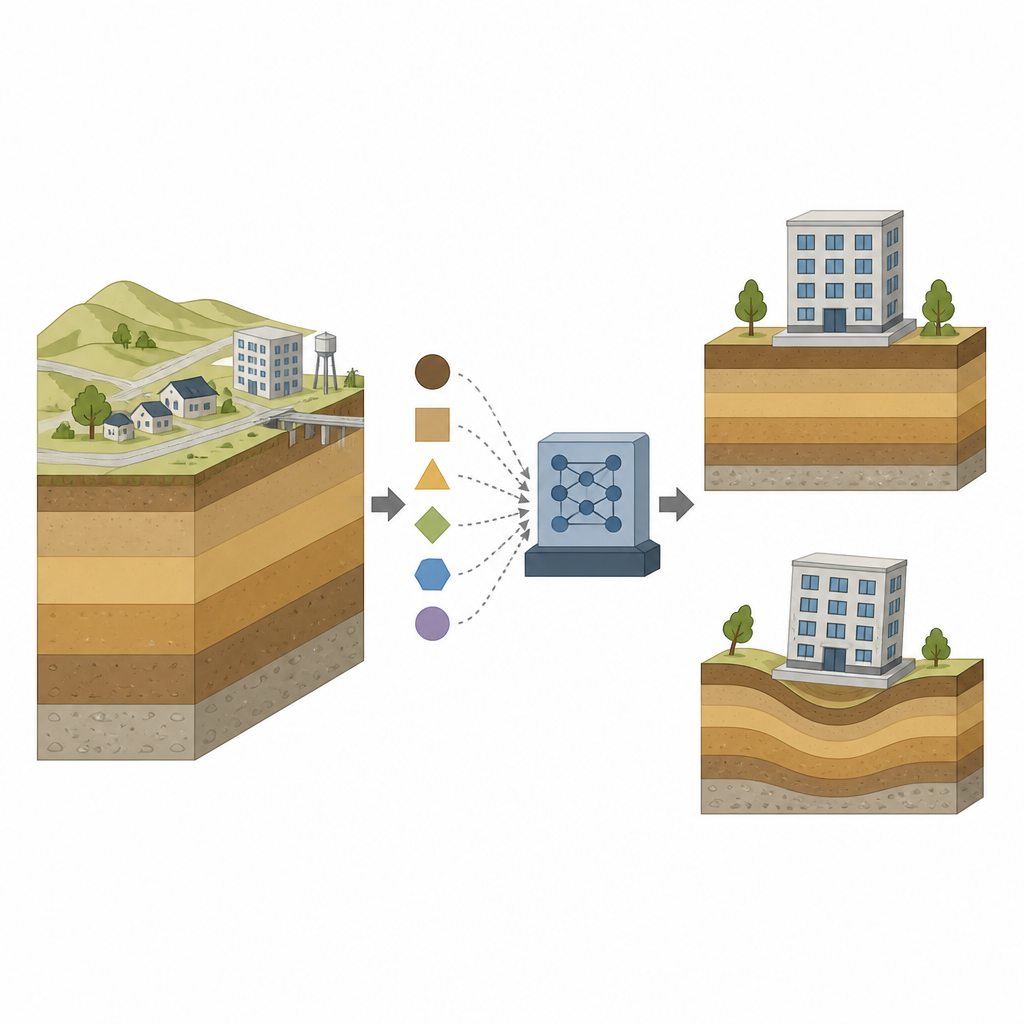
Fragile soil beneath growing cities
The Longdong region sits in the heart of the Loess Plateau, where loess layers can be tens of meters thick. As new projects such as water diversion works, railways, and housing expand across this landscape, engineers must understand how likely the soil is to settle when wetted. Traditional tests for collapsibility require careful laboratory work on many samples and take time. The authors collected 259 real-world test records from construction sites around Qingyang City, each including the measured collapse of the soil along with basic physical properties such as depth, density, pore space, water content, and how easily the soil compresses.
Simple soil clues that signal trouble
Using statistical analysis, the researchers examined how the measured collapse of the loess relates to each soil property. They found that the amount of empty space in the soil, described by a “void ratio,” has the strongest link with how much the soil will sink. Depth below the surface also matters: shallow layers under lighter pressure are looser and more prone to collapse, while deeper layers are naturally more compact. Water saturation and how easily the soil compresses play secondary roles. From thousands of data points, they identified practical thresholds. In this region, loess with relatively few pores (void ratio below 0.960) and buried deeper than 16 meters almost never shows harmful collapse in tests.
A quick rule for safe ground checks
Building on these findings, the team proposed a rapid screening rule for field engineers. If a soil layer meets both conditions—low void ratio and sufficient depth—it can be treated as non-collapsible with high confidence, greatly reducing the need for detailed collapse tests at those spots. When they checked this rule against the original dataset and an independent set of 62 new samples from nearby sites, it correctly identified non-collapsible soil in about 98 percent of cases. The few misjudged samples had collapse values right at the boundary between “safe” and “unsafe,” reflecting natural variability in loess and test conditions.
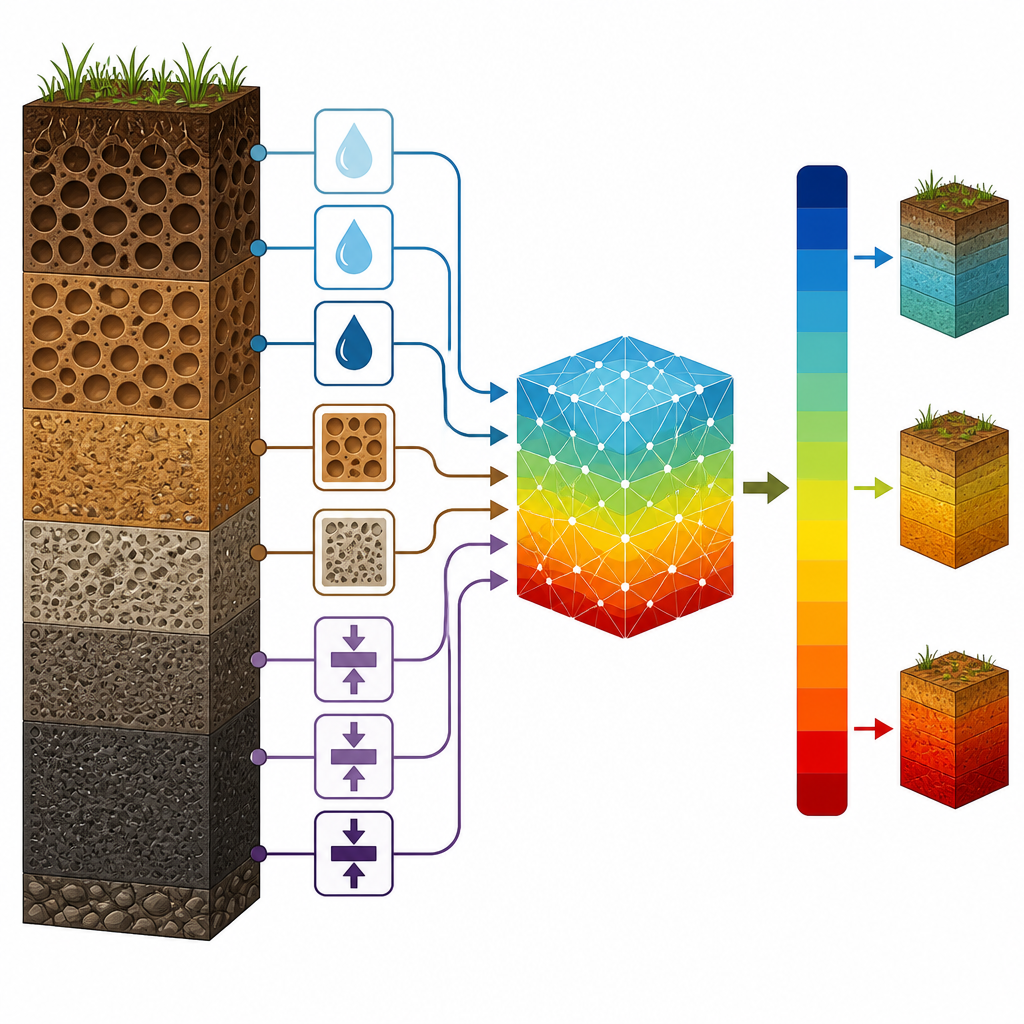
Teaching computers to read the soil
To move beyond simple rules, the researchers also trained computer models to predict the exact collapse value from four key measurements: depth, void ratio, water saturation, and compression behavior. They compared three popular machine learning methods—random forests, extreme gradient boosting, and support vector machines—along with a simpler two-parameter formula. All captured the main trends, but the gradient boosting model stood out for both accuracy and stability, matching measured collapse values very closely for both training and test data and correctly classifying collapsible versus non-collapsible samples more than 92 percent of the time.
Opening the black box of predictions
Because engineers must trust and understand these predictions, the authors applied an explanation tool known as SHAP to see how each input affects the model’s output. The explanations confirmed that void ratio and depth dominate the prediction, with higher void ratios and shallower depths pushing the model toward greater predicted collapse. Water saturation and compression coefficient have subtler effects that vary case by case. The analysis also highlighted a particularly risky combination: layers shallower than about 11 meters with a void ratio above 1.02 are especially likely to collapse when wetted.
What this means for building on loess
In plain terms, this research shows that a handful of straightforward soil measurements can reveal a great deal about how safe it is to build on loess. A simple rule based on depth and pore space can quickly flag layers that are very unlikely to collapse, while a well-tested machine learning model can provide more precise risk estimates when needed. Together, these tools offer engineers in the Longdong region a faster and more transparent way to plan foundations, reduce costly surprises, and design structures that can stand firm on a naturally fragile ground.
Citation: Liu, D., Wang, K., Bian, Y. et al. Correlation analysis between the collapsibility of loess and physicomechanical indices in Longdong region and prediction of the collapsibility coefficient based on machine learning. Sci Rep 16, 15939 (2026). https://doi.org/10.1038/s41598-026-45254-1
Keywords: loess collapsibility, soil mechanics, machine learning, foundation engineering, Longdong region