Clear Sky Science · en
Contribution of non-linear internal waves to marine net primary production has been underestimated
Hidden Waves That Feed the Sea
Far below the ocean’s surface, invisible waves ripple through layers of water, quietly feeding microscopic plants that support marine food webs and help draw carbon dioxide out of the air. This study shows that these underwater waves, called non-linear internal waves, boost ocean plant growth much more than scientists had realized, meaning current satellite-based estimates of ocean productivity in parts of the South China Sea are significantly too low.
Why Underwater Plant Growth Matters
Marine plants, mostly tiny drifting organisms known as phytoplankton, carry out photosynthesis much like forests on land. Their net primary production is a major driver of life in the sea and an important part of Earth’s carbon cycle, helping to regulate climate by absorbing carbon dioxide. Because ships can only sample a small fraction of the ocean, scientists usually estimate this production from space by measuring the green pigment chlorophyll at the surface and plugging it into models. Those models, however, assume that what we see at the surface reflects how much plant material is present throughout the sunlit layer of the ocean.
Invisible Waves With Big Effects
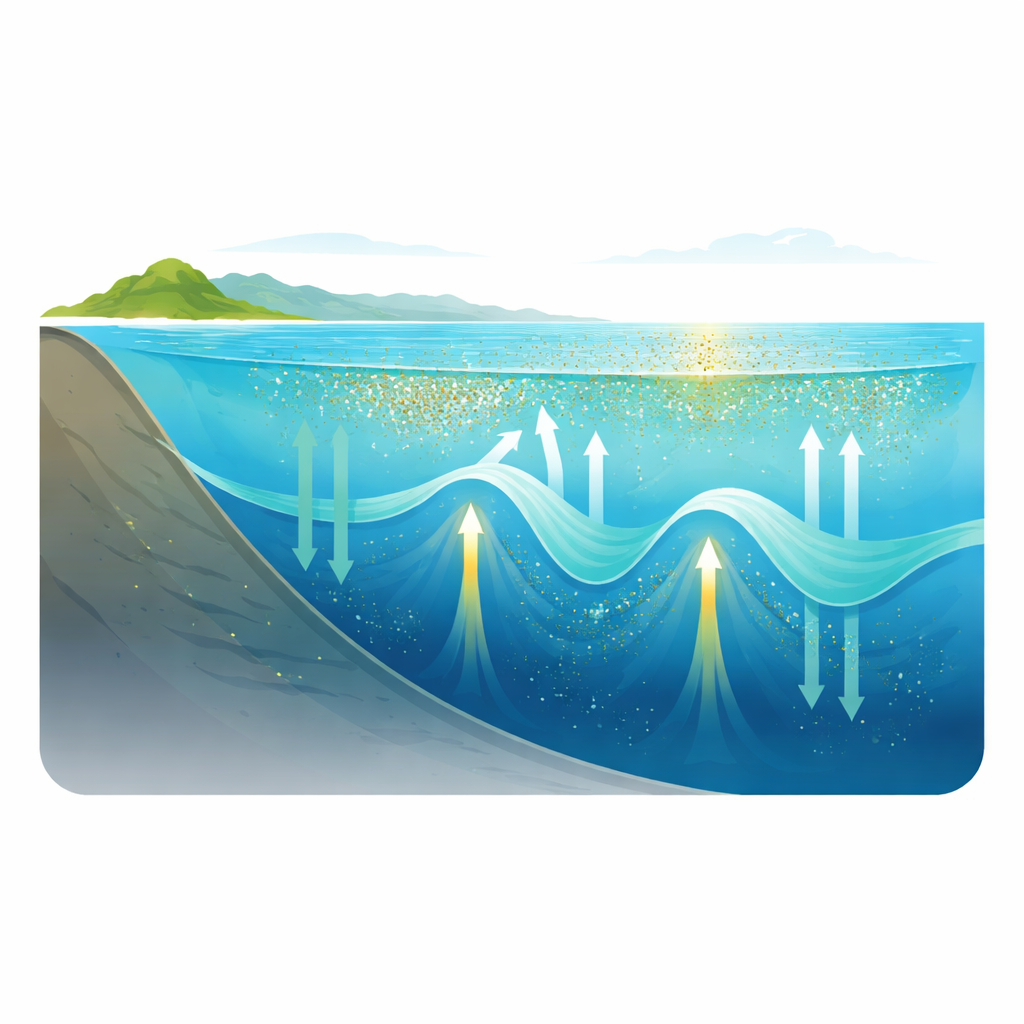
In the northern South China Sea, powerful internal waves regularly travel along boundaries between lighter warm water and heavier cold water, especially near features such as the Dongsha Atoll. These waves do not show up as dramatic breakers, but they can shift entire layers of water up and down by tens of meters and stir the water column. The researchers compared this active region to a nearby deep-ocean station where internal waves are weak. At the surface, both places looked similar and rather low in chlorophyll. Deeper down, however, the internal-wave region held a much thicker, richer layer of phytoplankton, even though satellite images alone would not reveal this difference.
How Mixing Builds a Subsurface Plant Layer
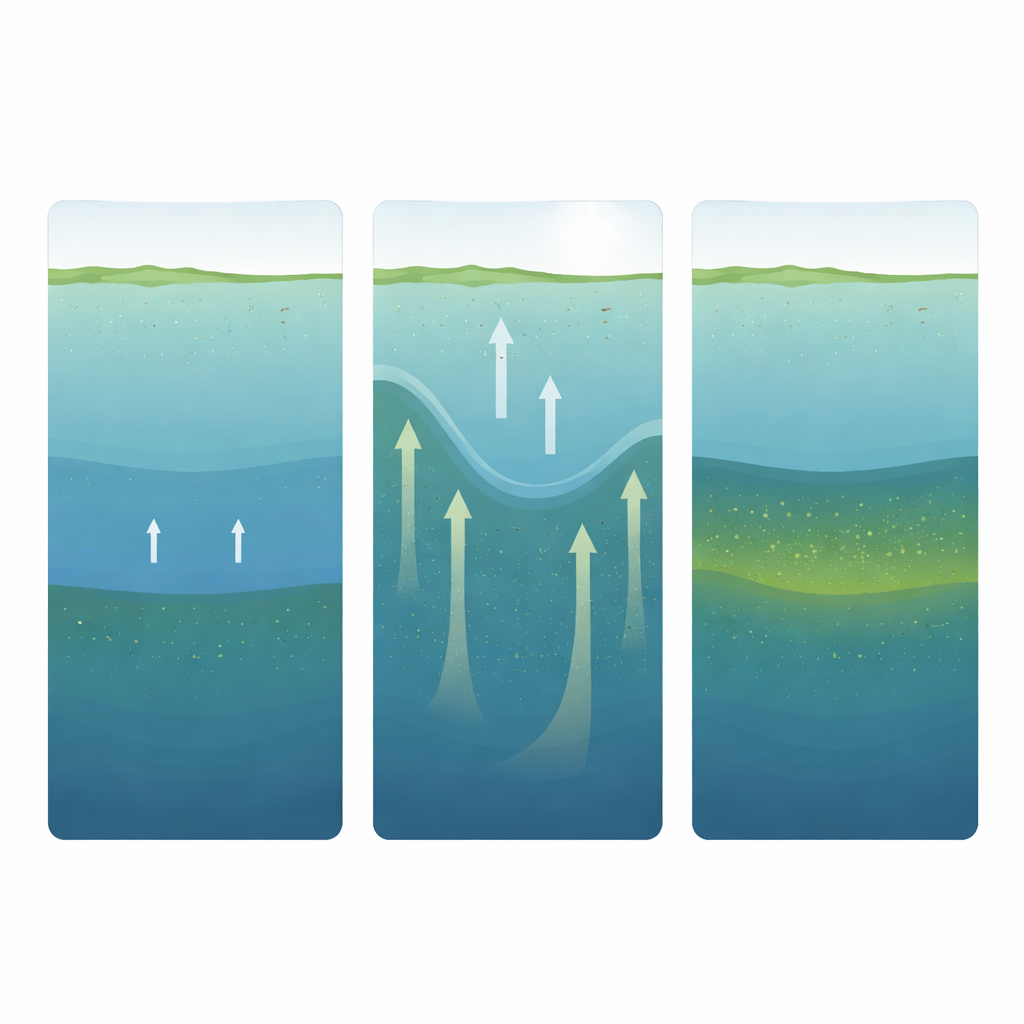
Inside wave-dominated waters, the strongest concentrations of chlorophyll occurred well below the surface, around and beneath the base of the mixed upper layer. Measurements of turbulence showed that internal waves greatly increased vertical mixing, drawing nutrient-rich water upward from depth into the sunlit zone where phytoplankton can grow. The result was a more pronounced “subsurface maximum” in chlorophyll: in the internal-wave region, the total amount of chlorophyll integrated through the lit layer of water was about 45 percent higher than at the quieter reference station, even when the measured surface chlorophyll was the same or lower. In effect, the ocean was hiding a substantial amount of extra plant biomass beneath an apparently poor surface.
Why Satellite Models Miss the Extra Growth
Standard satellite-based models, such as the widely used Vertically Generalized Production Model, were built on typical relationships between surface chlorophyll and the total chlorophyll in the lit layer. This study found that those relationships do not hold in areas dominated by internal waves: the same surface reading corresponds to much more chlorophyll overall. When the authors adjusted the model to account for their field measurements, they found that earlier work had significantly underestimated net primary production in the internal-wave region. Instead of a 15 to 37 percent boost, the waves appear to raise production by roughly 89 percent during the warm season.
Revising the Ocean’s Carbon Budget
When the corrected numbers are scaled up to the broader region, internal waves add at least 3.57 trillion grams of carbon per year in new plant growth in the South China Sea, about 2 percent of the entire basin’s so-called new production. This is comparable to or larger than the annual impact of tropical cyclones in a much bigger slice of the western North Pacific. Because internal waves are common in many shelf seas worldwide and may intensify as the ocean stratifies under climate warming, their contribution to ocean productivity and carbon uptake is likely much greater than currently included in global estimates.
Takeaway for Non-Specialists
The work reveals that some of the ocean’s most important plant growth happens out of sight, fueled by underwater waves that stir up nutrients without leaving obvious traces at the surface. By relying solely on surface color, existing satellite models have been missing nearly half of this extra production in certain wave-rich areas. Recognizing and better accounting for these hidden contributions will be crucial for more accurate assessments of marine ecosystems and their role in moderating Earth’s climate.
Citation: Pan, X., Ho, TY., Wong, G.T.F. et al. Contribution of non-linear internal waves to marine net primary production has been underestimated. Sci Rep 16, 14497 (2026). https://doi.org/10.1038/s41598-026-45238-1
Keywords: internal waves, ocean productivity, South China Sea, phytoplankton, carbon cycle