Clear Sky Science · en
Ultrastructural and histochemical insights into neotenic and metamorphic axolotl lungs with clues to pulmonary regeneration
Why a salamander lung matters to us
Axolotls are unusual salamanders that can regrow lost body parts, and their powers of repair fascinate scientists hoping to improve healing in humans. This study asks a simple question with big implications: how do axolotl lungs change when these animals shift from life in water to life on land, and what does that reveal about the kind of lung tissue that can bounce back after injury?
Two life stages, two lung designs
Axolotls normally stay in a youth-like form, breathing mostly through gills while also using their lungs. With added thyroid hormone, they can be pushed into a land-adapted form that relies more on air breathing. The researchers compared lungs from three “water‑living” animals and three hormone‑treated “land‑ready” animals. Under the microscope, both groups had lungs built around a central air space divided by many folds, unlike the tree‑like airways of mammals. But there were clear differences in the thickness and makeup of the tiny walls that separate air from blood.
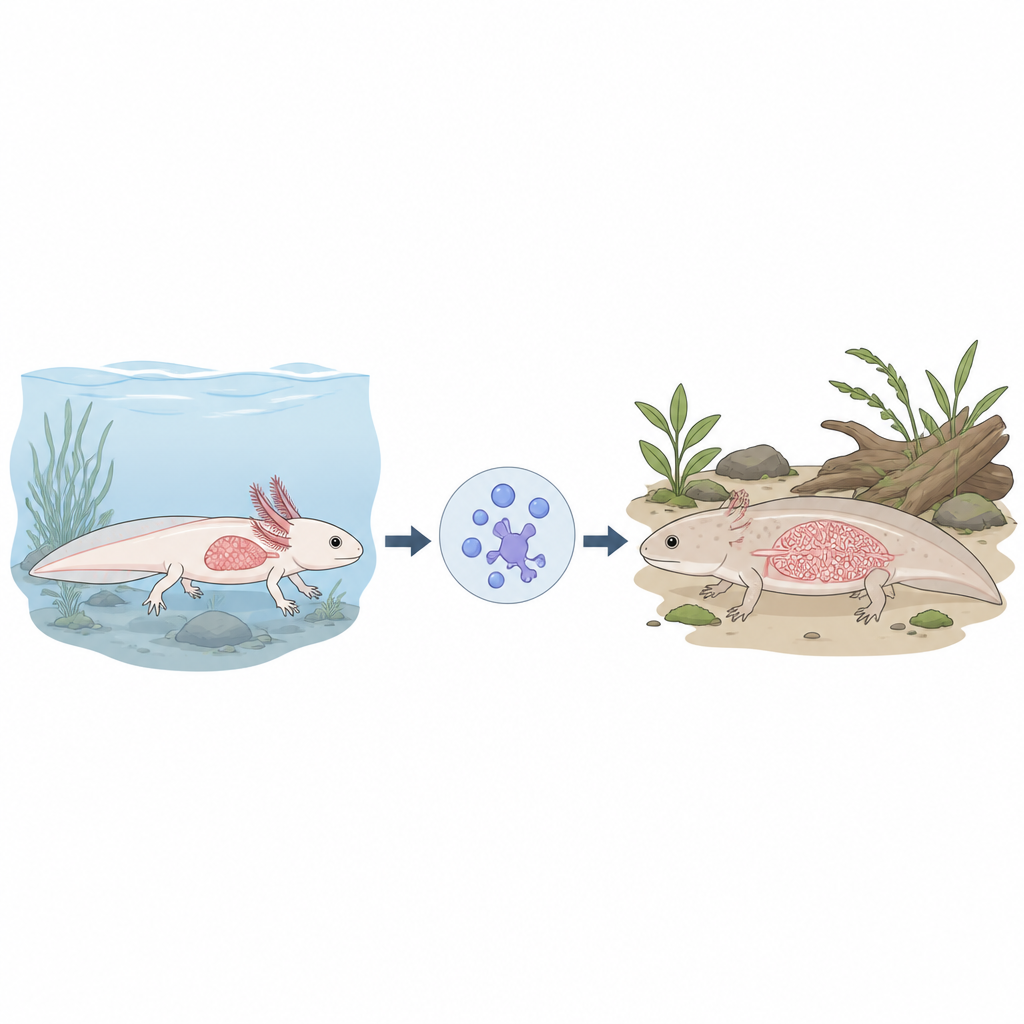
From thick, stiff walls to flexible air pockets
In the water‑living axolotls, the walls around the air spaces were thick and the open spaces themselves were narrow, with heavy deposits of collagen, a structural protein that adds stiffness. After metamorphosis, those walls thinned and the air spaces widened, while the supporting tissue showed more elastic fibers, which can stretch and recoil. This shift from collagen‑rich to more elastic support suggests that the lung becomes better suited to the repeated expansion and contraction needed for breathing air on land.
Special lung cells reshuffle their jobs
The team also focused on the cells lining the air spaces. In mammals, there are two main types of such cells, but in axolotls these features are blended in a more flexible way. Using powerful electron microscopes, the authors found cells with tiny surface projections and round nuclei that contained lamellar bodies, packet‑like structures that store surfactant, a substance that reduces surface tension inside the lungs. In water‑living axolotls, even some ciliated cells in the small airways carried these surfactant packets. After metamorphosis, however, the ciliated cells no longer held lamellar bodies, while nearby lung surface cells showed more mature surfactant structures and a more refined barrier between air and blood, more reminiscent of mammalian lungs.
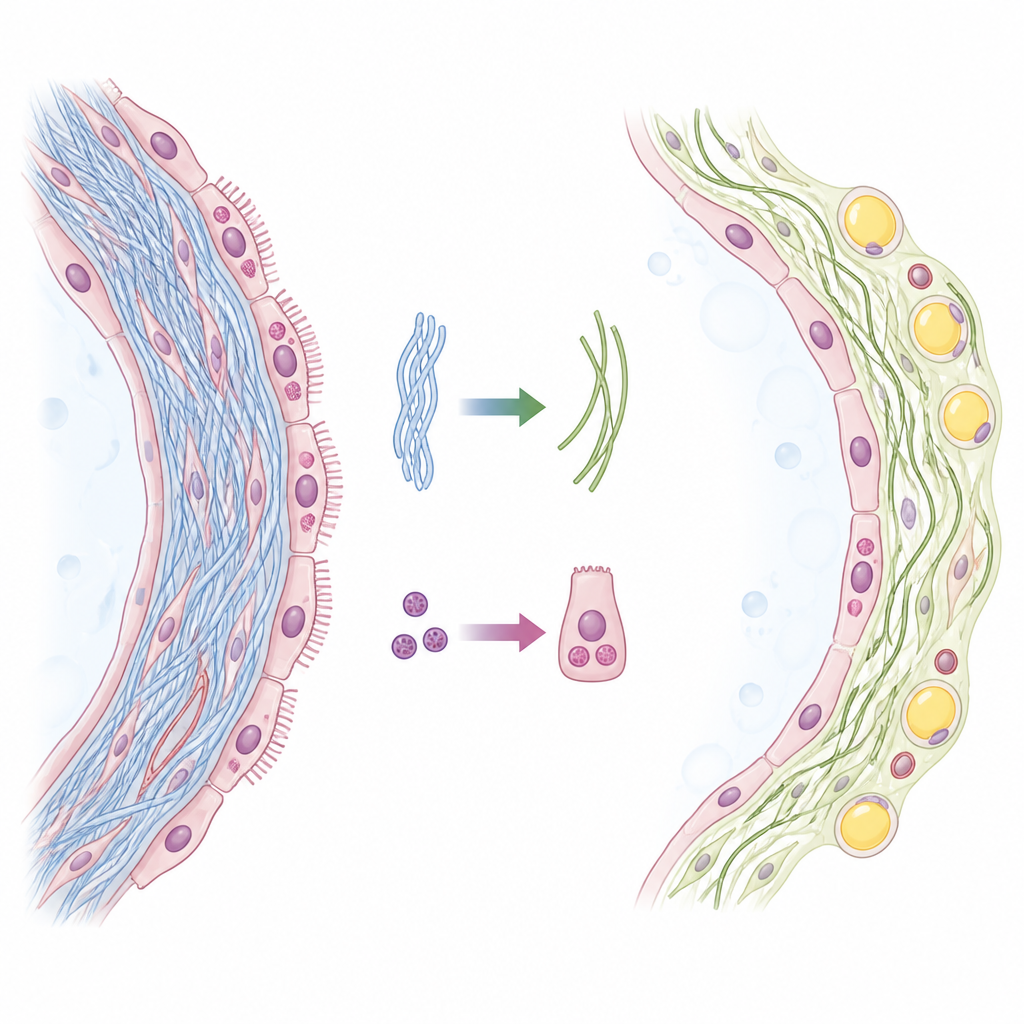
Support cells that may help repair
Within the tissue between air spaces, the scientists identified interstitial lipofibroblast‑like cells in both life stages. These cells stored fat droplets and sat close to the surfactant‑producing cells. In other animals, similar cells are thought to supply raw materials for surfactant and even act as stem‑like cells during lung growth and repair. The fact that such cells persist in both water‑living and land‑ready axolotls raises the possibility that they contribute to the animal’s remarkable ability to regenerate lung tissue after injury.
Signals of maturing and remodeling tissue
To track how lung surface cells mature, the team stained tissue for a structural protein called cytokeratin 7, which appears as certain stem cells turn into fully formed lining cells. This marker was barely seen in the water‑living lungs but appeared at low levels in the land‑ready lungs, hinting that metamorphosis nudges these cells toward a more specialized state. Together with the shift in connective tissue and the reorganization of surfactant‑producing cells, this pattern paints a picture of a lung that can reshape itself in response to hormone signals.
What this means for future lung repair research
By charting how axolotl lungs remodel when the animal moves from water toward land, this study outlines a lung design that remains adaptable yet functional. Thick, collagen‑heavy walls give way to thinner, stretchable tissue, cell types reshuffle their roles in handling surfactant, and support cells with repair potential remain in place. Although axolotl lungs do not perfectly match human lungs, understanding how they stay so flexible and repair‑ready could guide future efforts to encourage better healing in damaged human lungs.
Citation: Güneş, A., Gürgen, D.G., Kaplan, A.A. et al. Ultrastructural and histochemical insights into neotenic and metamorphic axolotl lungs with clues to pulmonary regeneration. Sci Rep 16, 15077 (2026). https://doi.org/10.1038/s41598-026-45215-8
Keywords: axolotl, lung regeneration, metamorphosis, surfactant, elastic fibres