Clear Sky Science · en
Reinforcement learning based resource allocation scheme for vehicular communication in 5G networks for smart cities
Why smart traffic needs smart power
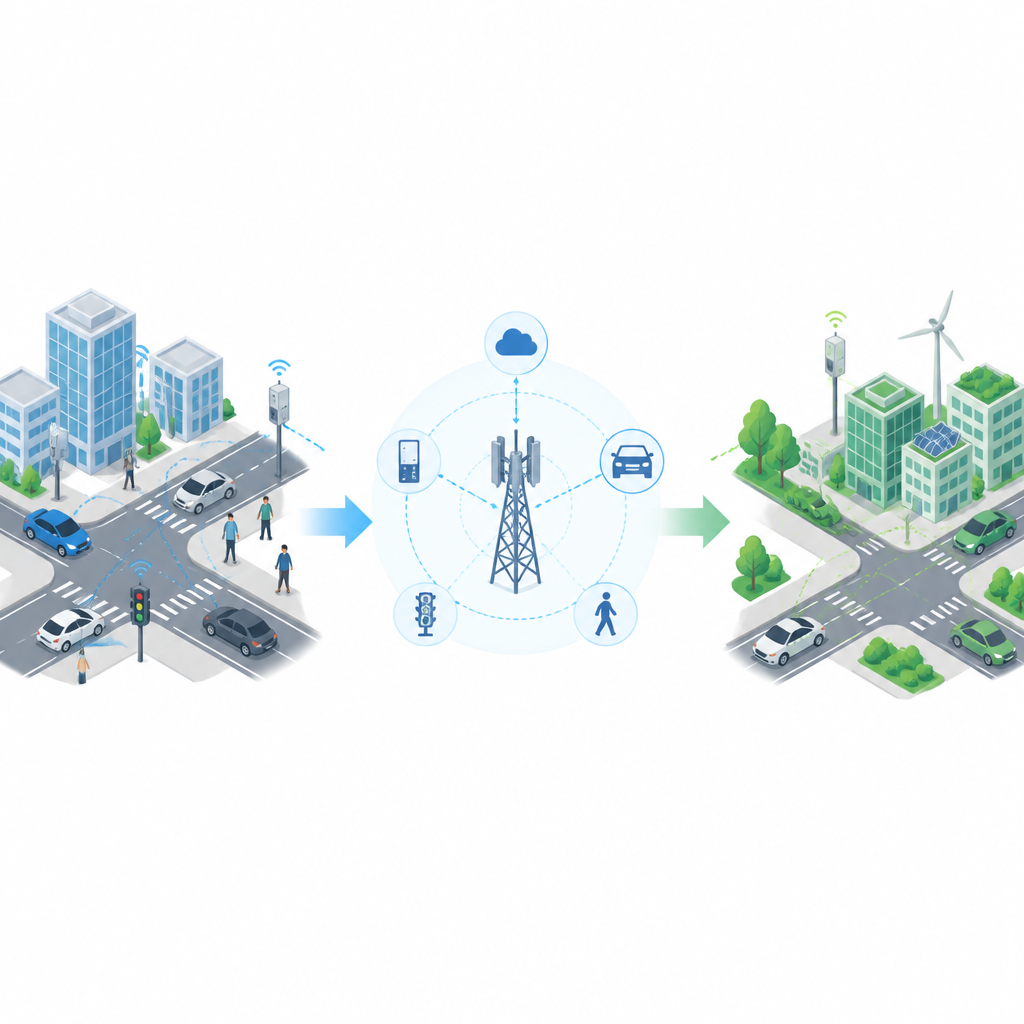
As cities fill with connected cars, phones, and roadside sensors, all this wireless chatter quietly burns a lot of electricity. The networks that let vehicles talk to each other and to traffic lights must be fast and reliable, but also gentle on energy use if we want cleaner, greener transport. This study explores how a simple kind of learning software can help cars automatically choose just the right amount of radio power, cutting waste while keeping critical safety messages flowing.
Cars that learn how loudly to “talk”
The work focuses on Vehicle to Everything links, where cars share information with other cars, people, roadside units, and the wider network over 5G. In busy streets, signals bounce off buildings, vehicles move quickly, and the quality of the wireless link changes from moment to moment. Traditionally, power levels are set using fixed rules or centralized planners that struggle to keep up with this constant motion. Here, each vehicle instead runs a small learning agent that observes its surroundings, chooses a power level for its radio, and then learns from the results.
How learning steers power use
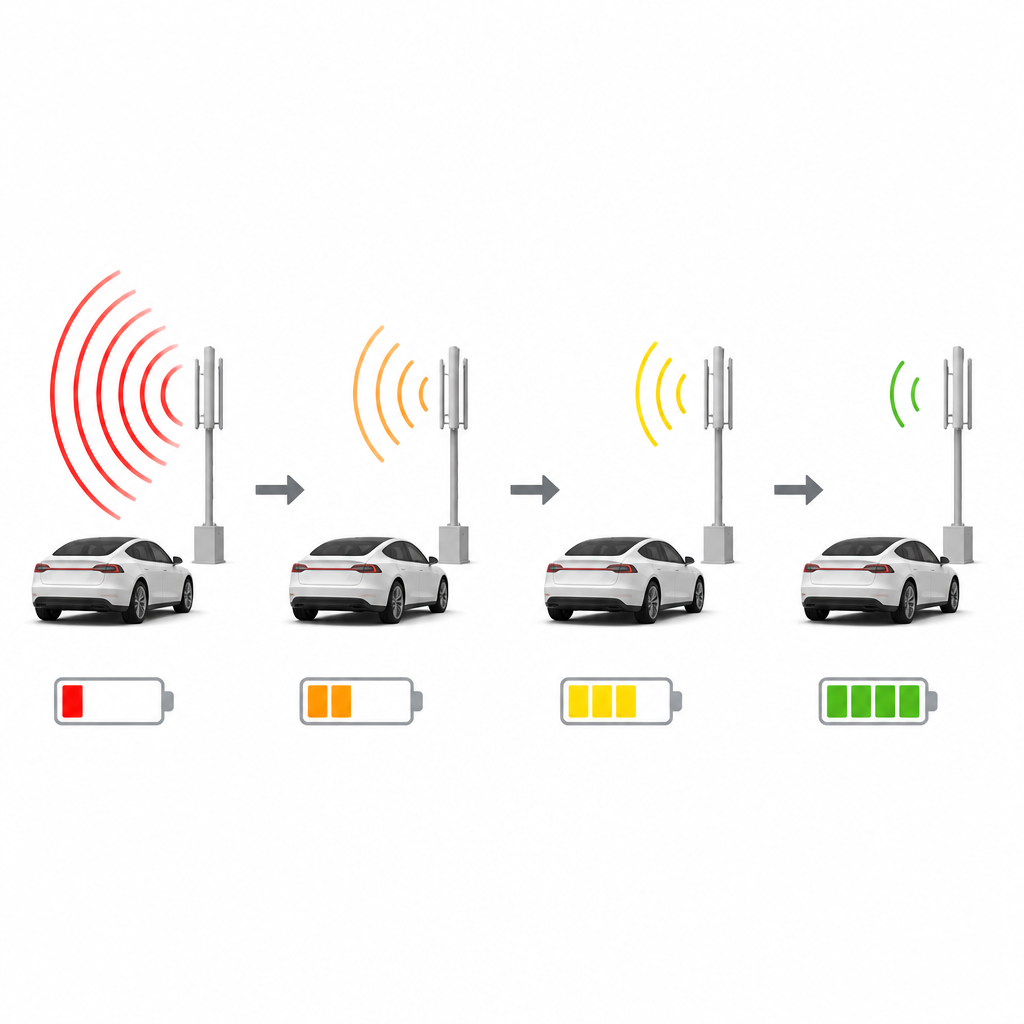
The authors build on a method called Q learning, chosen because it is lightweight enough to run on electronics inside a car. The agent watches simple measurements such as how strong its signal is compared to interference, how far it is from the receiver, and how crowded the road is. For each situation, it tries different power settings and receives a numerical reward that balances two goals: send data quickly and clearly, but use as little power as possible. Over many trials the agent fills a small table that links each situation to a good choice of power, gradually converging toward a policy that works well without needing a large processor or detailed network model.
Working in messy real city conditions
To test the idea, the researchers simulate a busy urban intersection with vehicles, pedestrians, roadside units, and 5G base stations. The model includes real world effects such as signal loss with distance, reflections from buildings, and the Doppler shifts created by moving cars. The learning agent starts out exploring almost at random, so its energy efficiency and data quality jump up and down from one training run to the next. With experience, however, its behavior settles: it tends to choose moderate power levels that keep the signal strong enough for safety messages but avoid blasting the airwaves. The simulations show that energy efficiency peaks at certain distances and signal quality levels, and then drops off when links become too long and would require wastefully high power.
Simple software for robust, local control
A key strength of the approach is that each vehicle learns on its own, using only local information. If a roadside unit fails or coverage temporarily weakens, the car notices that its link quality has fallen and experiments with alternative power choices to recover performance. Because the learning table is small, the method is practical for embedded hardware and can react quickly to changing traffic and channel conditions. The study also examines how imperfect measurements of the radio channel still average out over time, allowing the agent to find stable, sensible strategies without a perfect view of the network.
What this means for future streets
For everyday road users, the message is that the same intelligence making cars safer can also help them be kinder to the power grid. By letting each vehicle learn how loudly to speak over the air, this work shows a path to wireless systems that waste less energy while still delivering the fast, reliable links needed for collision warnings and other time critical services. The authors suggest that future extensions with multiple cooperating vehicles and shared learning could further improve how the radio spectrum is used in crowded city streets.
Citation: Brindha, S., Nasreen, P.P.S., Sagar, P. et al. Reinforcement learning based resource allocation scheme for vehicular communication in 5G networks for smart cities. Sci Rep 16, 15807 (2026). https://doi.org/10.1038/s41598-026-45209-6
Keywords: 5G V2X, smart cities, reinforcement learning, energy efficiency, vehicular communication