Clear Sky Science · en
Mechanism and control strategies for asymmetric floor heave in extra-thick coal seam roadways under high stress
Why the mine floor sometimes suddenly rises
Deep underground, coal mines rely on long tunnels to move people, air, and coal. In some of China’s extra‑thick coal seams, the rock floor of these tunnels can suddenly swell upward by half a meter, squeezing equipment and endangering workers. This study looks at why this uneven “floor lift” happens under very high stress, and how to stop it, using a real working face in the Caojiatan Coal Mine as a full‑scale natural laboratory.
What happens beneath a thick coal seam
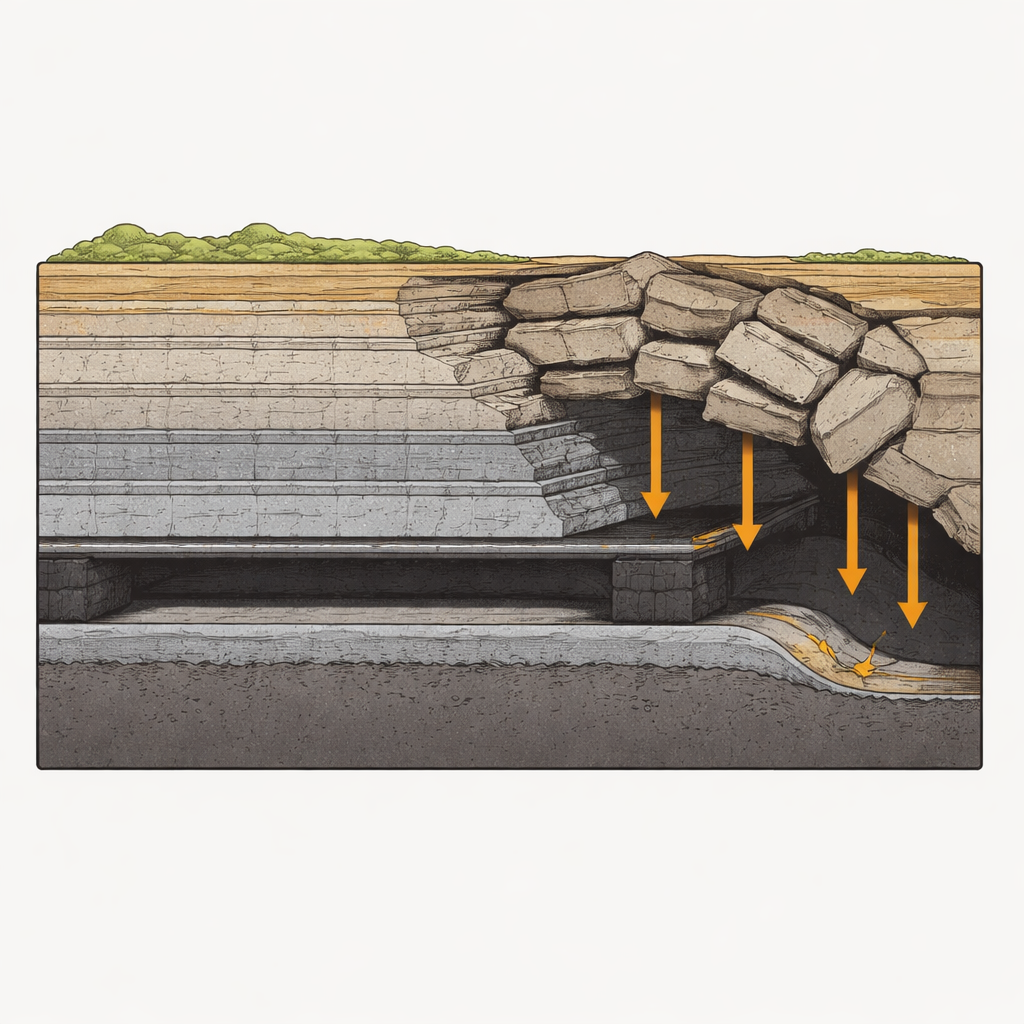
In the mine studied, the coal bed is more than ten meters thick and lies several hundred meters below ground. When such a large slice of coal is removed, it leaves a broad empty zone, or goaf, above the mined‑out area. The thin rocks just above the coal collapse, but they do not fully fill this void. Higher, thicker rock layers break into large slabs that bend, rotate, and stack in uneven ways. On the side where a protective block of coal (the pillar) is left to support the roof, these slabs form a stepped, leaning structure. On the opposite side, where solid coal continues, the rock above stays more regular. This uneven roof structure becomes the origin of highly unbalanced forces in and around the tunnel.
Uneven squeezing of the tunnel floor
The authors combined underground measurements, computer simulations, and mechanical modeling to track how the tunnel deforms as mining advances. They found that the floor rises far more than the roof sags, and that this rise is strongly one‑sided: cracks and bulges start on the solid‑coal side and spread toward the pillar side. Instruments placed in the tunnel walls showed that, as the coal face passes, the rock beside the pillar is squeezed much harder than the rock on the solid‑coal side. At about 60 meters behind the face, the stress near the pillar side is more than 20 percent higher. At the same time, the maximum floor heave reaches around 47 centimeters and the highest point shifts noticeably toward the solid‑coal side of the roadway.
How tilted forces reshape the rock
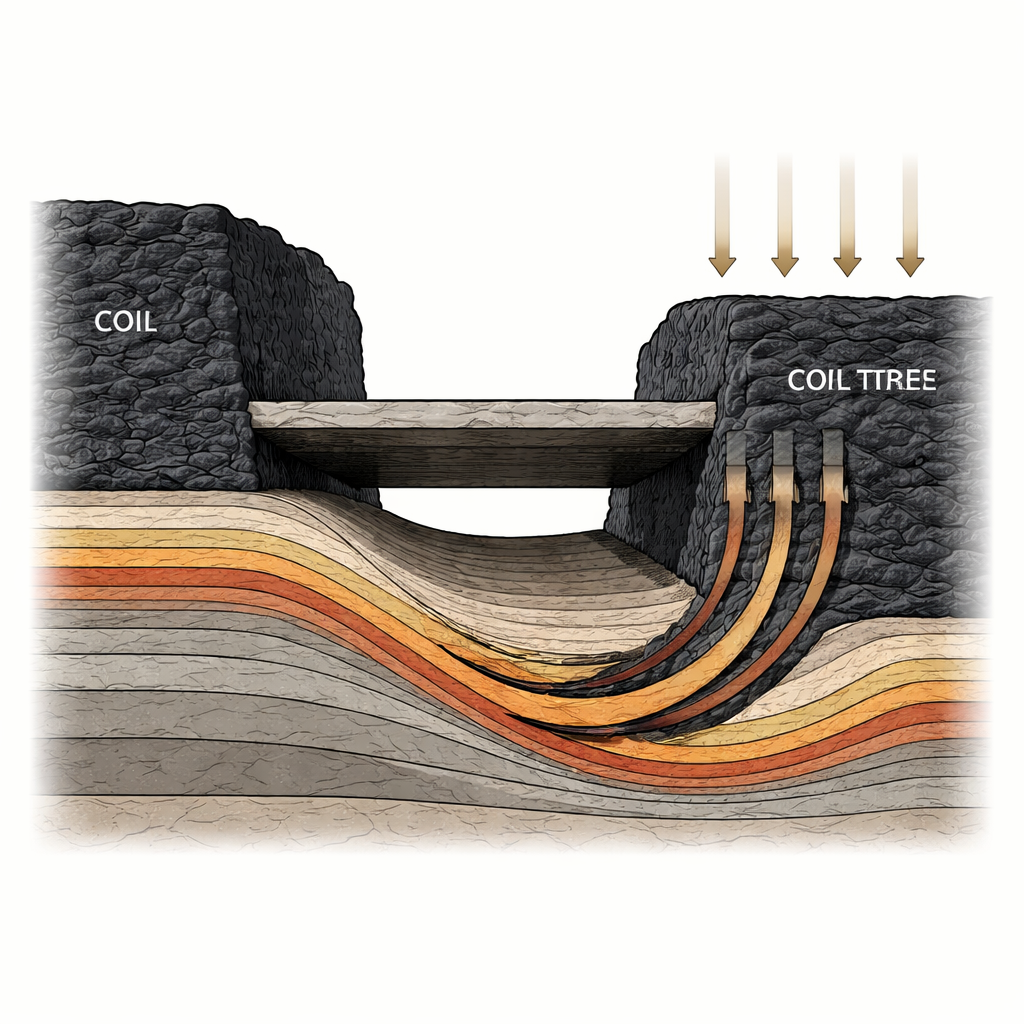
To explain this behavior, the researchers built a mechanical picture of how the broken roof beams press down on the coal and floor. Above the pillar, low‑lying blocks form a stepped beam that pushes strongly downward, while higher blocks act like a hinged arch that transfers even more load onto this stepped structure. This “low‑level stepped plus high‑level hinged” system funnels extra weight into the pillar and then into the floor beneath it. The tunnel center, in contrast, becomes a low‑pressure pocket after excavation. The result is a steep sideways gradient in stress across the floor—like a tilted energy hill with high pressure under the pillar and low pressure under the roadway.
From high pressure to one‑sided floor lift
Under this tilted stress field, the floor rock behaves a bit like a very stiff, slow‑moving paste. Deep beneath the pillar, rock is crushed and sheared along a slanting path that runs diagonally toward the tunnel. Driven by the pressure difference between the high‑stress pillar side and the relieved tunnel center, this damaged rock is gradually squeezed upward into the free space under the roadway. However, the pillar side remains tightly confined by heavy overlying rock, so most of the visible rise appears on the less confined solid‑coal side. The result is a characteristic pattern: subsidence and heavy cracking beside the pillar, and a shifted dome of floor heave toward the opposite wall.
How to keep the floor under control
Based on this understanding, the authors propose a three‑step prevention strategy. First, they recommend cutting and pre‑cracking parts of the roof on the pillar side before they fail on their own, shortening the rock beams and reducing the forces they can transfer. Second, they suggest cutting slots in the floor near the ribs, especially on the pillar side, to interrupt the main stress pathway from the pillar into the tunnel floor. Third, they design stronger, deliberately uneven reinforcement of the floor, using longer and stronger anchors on the solid‑coal side to tie the broken surface layers to deeper, more stable rock. Together, these measures aim to reduce the driving pressure, block its route, and strengthen the floor where it is most prone to rise.
What this means for safer mining
The study shows that extreme, one‑sided floor heave in thick‑seam mines is not just a matter of weak rock, but of how broken roof layers above the pillar focus stress into the floor. By revealing this hidden load path and linking it to real‑world measurements, the work offers mine engineers a clearer recipe for keeping roadways open: treat the roof structure, break the stress chain, and reinforce the floor asymmetrically. Applying this “source‑path‑structure” approach can help mines working extra‑thick seams maintain safer, more stable tunnels under high stress.
Citation: Zhang, J., Sun, J., Wang, B. et al. Mechanism and control strategies for asymmetric floor heave in extra-thick coal seam roadways under high stress. Sci Rep 16, 14515 (2026). https://doi.org/10.1038/s41598-026-45203-y
Keywords: coal mine roadway, floor heave, rock mechanics, ground control, thick coal seam