Clear Sky Science · en
On economic and environmental effects of expanding PV deployment in Poland
Solar power and everyday life in Poland
What happens to jobs, local businesses, and the environment when a country decides to cover roofs and fields with solar panels? This study looks at Poland, a nation long dependent on coal, and asks how a big push for solar power could shape people’s work opportunities, the wider economy, and climate pollution over the next two decades. Its findings speak directly to questions about secure jobs, clean air, and fair treatment of communities during the energy transition.
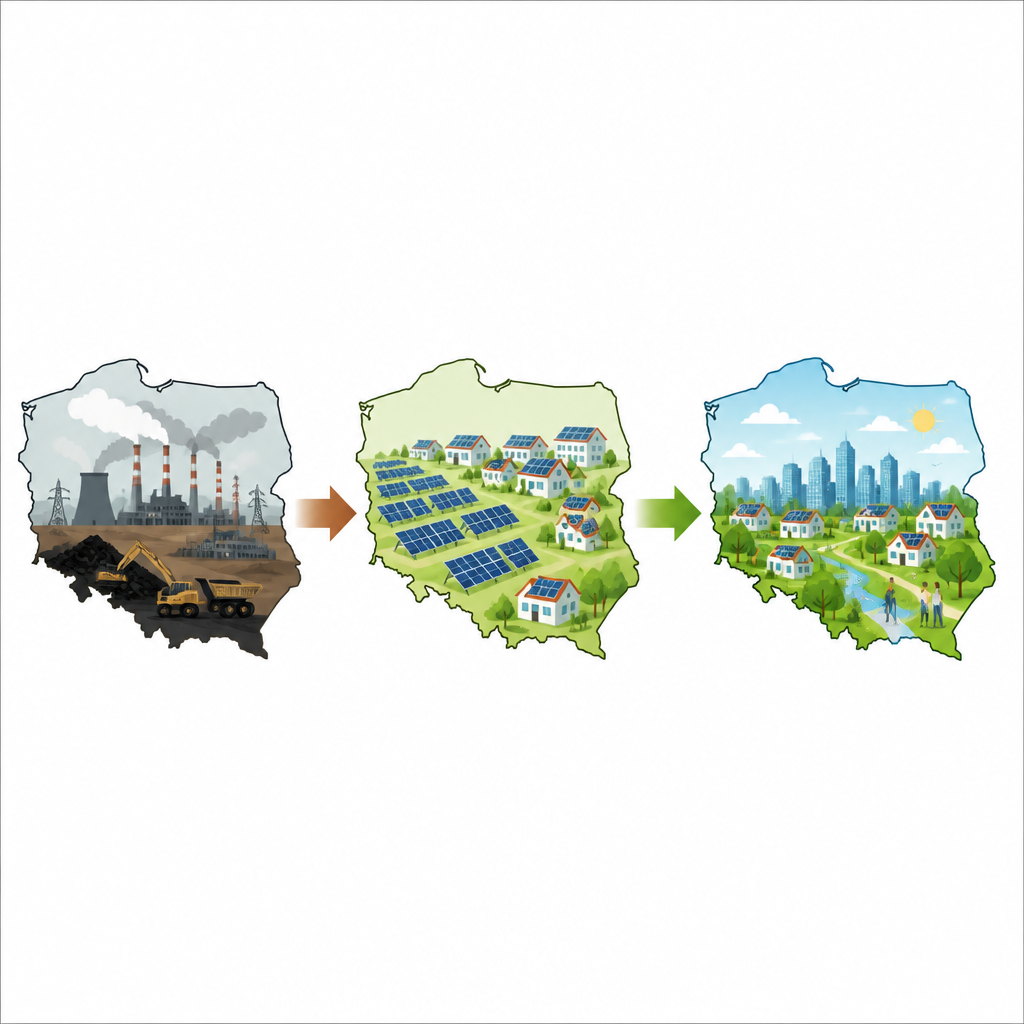
Why solar power matters for Poland
Poland faces a double challenge: it must cut greenhouse gas emissions while keeping energy reliable and affordable in an economy built on hard coal and lignite. Solar power is becoming cheaper and more common, and Poland has already seen fast growth in rooftop and larger solar farms. The authors explain that solar can strengthen energy security by reducing fossil fuel imports, make better use of poor-quality land and building roofs, and create new jobs in manufacturing, installation, and maintenance. Yet until now, no one had systematically measured what a large roll-out of solar panels would mean for Poland’s overall economy and emissions.
Three possible futures for solar growth
The researchers explore three development paths for solar power in Poland up to 2040. The baseline path assumes business as usual, with slow growth held back by weak policy support and grid limits. A second path follows the official Polish Energy Policy to 2040, based on government planning documents. The most ambitious path, called the optimal scenario, reflects what could happen if legal barriers are removed, local energy clusters flourish, and the country fully embraces renewable power. The analysis also separates four types of solar systems, from small household installations under 10 kW to very large solar farms above 950 kW, mirroring how solar is actually being deployed across homes, farms, public buildings, businesses, and industry.
How the study measures jobs, money, and emissions
To link solar investments with wider economic activity, the authors rely on an established input–output approach, which traces how spending in one sector ripples through others. They combine Poland’s latest national statistics with a new dataset from the Energy Transition Observatory, which tracks how much is spent on building and running different sizes of solar systems and how much carbon dioxide is released across their supply chains. From this, they calculate “multipliers” that show how many full-time jobs, how much extra domestic production and value added, and how much carbon pollution arise when one megawatt of solar is installed and then operated year after year.
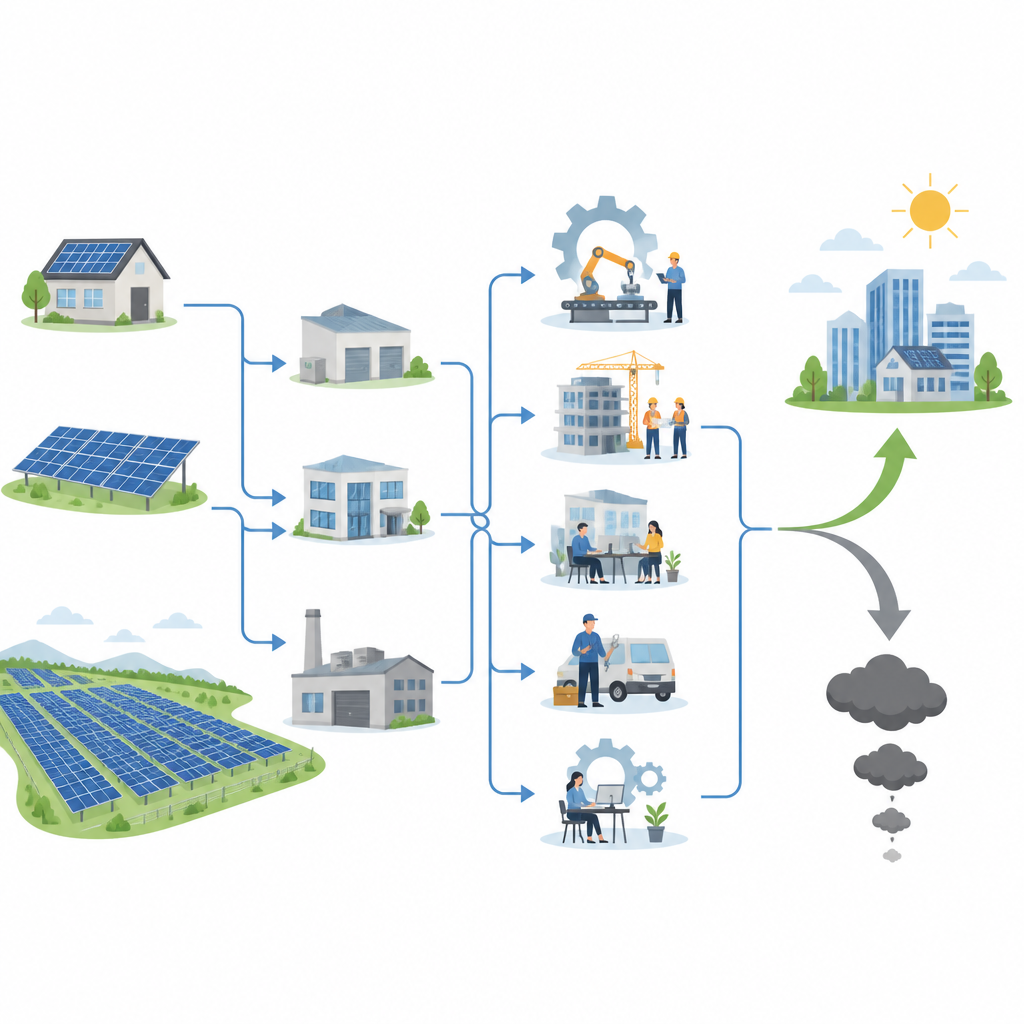
What expanding solar means for jobs and the economy
The results show that solar power can act as a steady source of economic stimulus for at least the next 15 years. Small, scattered rooftop systems are labor intensive and create the most jobs per unit of capacity, while very large farms become more important over time as total installed power rises. When installation and long-term operation are both counted, solar could support roughly 20,000 full-time jobs each year in the baseline path, about 25,000 under current policy plans, and around 35,000 to 40,000 jobs annually in the optimal scenario between 2026 and 2040. These jobs appear not just in energy companies, but also in metal and chemical production, machinery, construction, transport, and repair and maintenance services, spreading benefits across many parts of the economy.
Carbon footprint and cleaner energy
The study also tracks the emissions that occur when solar systems are built and maintained, including the electricity, diesel, and other energy used in their supply chains. Although installing large amounts of new capacity creates an initial “carbon debt,” the authors estimate relatively low emissions per kilowatt of capacity and per kilowatt-hour of future electricity generated, especially for medium and larger installations. Over time, as solar power displaces coal-based electricity, the net effect is a substantial cut in climate pollution and improvements in air quality, provided that the more ambitious solar scenarios are pursued.
What this means for a fair transition
For a general reader, the key message is that expanding solar power in Poland is not only about clean electricity; it is also about stable employment and a smoother transition away from coal. The analysis suggests that, with supportive policies, solar could absorb a significant share of workers leaving the coal sector while keeping overall job numbers in the power system roughly stable. By quantifying both economic gains and carbon impacts across different scenarios and system sizes, the paper offers practical evidence to guide national energy and climate plans and to design policies that make the shift to renewables fairer for workers and communities.
Citation: Lach, Ł., Kopeć, S., Zyśk, J. et al. On economic and environmental effects of expanding PV deployment in Poland. Sci Rep 16, 15122 (2026). https://doi.org/10.1038/s41598-026-45196-8
Keywords: solar energy, Poland, energy transition, employment, carbon footprint