Clear Sky Science · en
Evaluation and analysis of brittleness and acoustic emission characteristics of tight sandstone under the influence of acid-treatment
Why weakening rock can boost gas production
Deep underground, natural gas is often trapped in extremely tight sandstone—rock so stiff and sealed that it resists cracking even when engineers pump in high-pressure fluids. To make these reservoirs flow, operators commonly bathe the rock near a well with acid before hydraulic fracturing. This treatment eats away at minerals and weakens the rock, lowering the pressure needed to crack it. But if the rock becomes too soft, it may deform instead of snapping, and the fracture network needed for long-term gas production will be poor. This study asks a practical question with big economic stakes: how long should sandstone be exposed to acid to reduce fracture pressure without destroying its ability to break in a clean, brittle way?
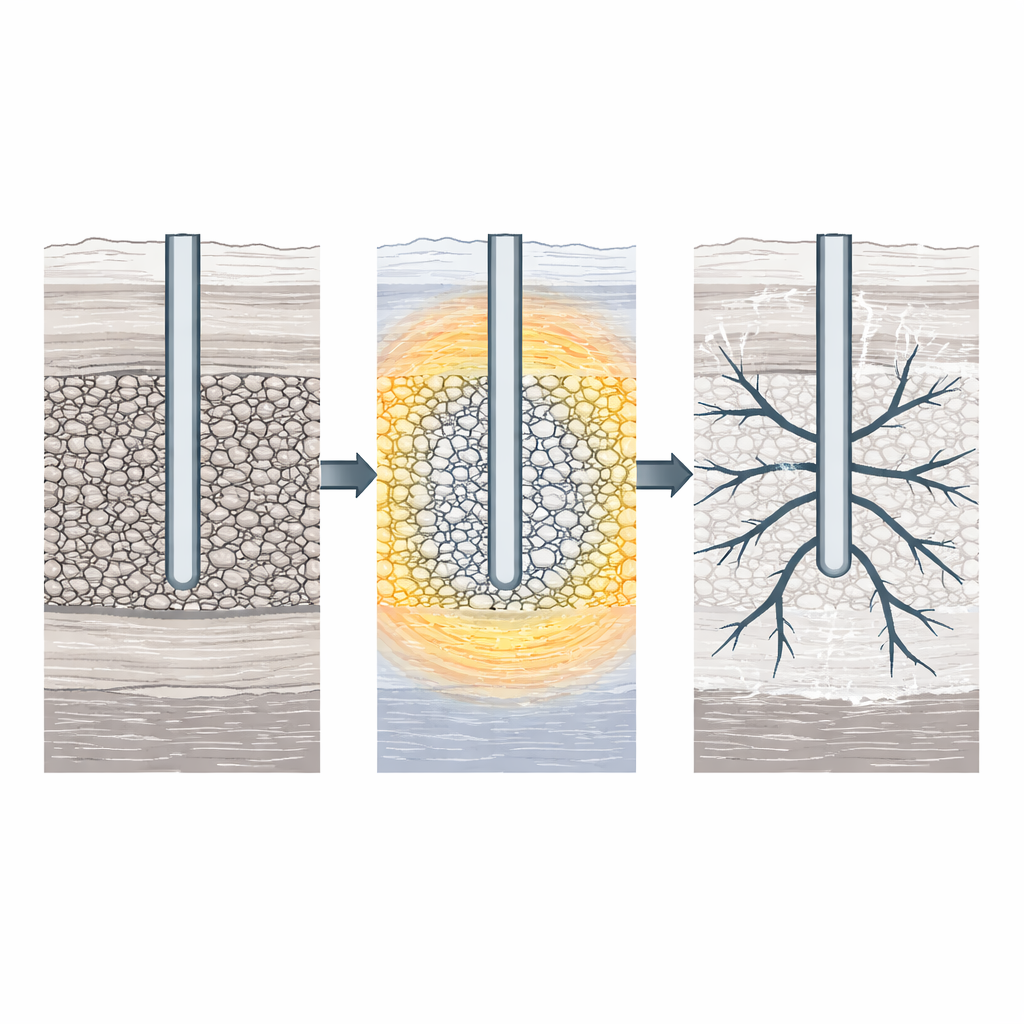
How acid reshapes underground rock
The researchers worked with tight sandstone from a Chinese gas reservoir, composed mainly of hard quartz and feldspar grains held together by mineral “glue” and a small amount of clay. They immersed cylindrical rock samples in a mixture of hydrochloric and hydrofluoric acids for times ranging from one hour to seven days, then squeezed them in a press until they failed. X-ray diffraction tests showed that acid partially dissolved the main framework minerals and their cement, subtly changing the rock fabric. Early on, the reaction was vigorous: the samples lost mass quickly and the acid’s acidity dropped, then both trends gradually leveled off. Over longer times, more mineral was removed, porosity increased, and fine particles detached from the grain skeleton.
From stiff to fragile to too soft
Mechanical tests revealed that the rock did not simply get weaker in a straight line. Uniaxial compressive strength—how much squeezing the samples could bear—decreased step by step as acid time increased. The stiffness (elastic modulus) fell slowly at first, then plunged after roughly a day of treatment, while a parameter that reflects how rock bulges sideways under load (Poisson’s ratio) declined almost linearly after six hours. Most intriguingly, a new brittleness index that focuses on the stress and strain between the first growth of internal cracks and ultimate failure rose to a clear peak after about 12 to 24 hours of acid exposure and then dropped. In other words, there is a window where the sandstone becomes easier to fracture yet still fails in a sudden, energetic way rather than squashing and smearing.
Listening to rock break
To “hear” how the rock failed, the team monitored tiny sound pulses—acoustic emissions—that occur when microcracks form and grow. In untreated samples, bursts of signals appeared early as pores compacted, then surged near final failure. After short acid treatments, fewer intense events occurred at the beginning, probably because dissolved cement reduced friction between grains. When exposure reached roughly 12–24 hours, high-energy acoustic events became more common during the elastic loading stage, consistent with many sharp microcracks forming and linking just before the rock snapped. With very long treatments (beyond about two days), acoustic activity shifted toward the early stages of loading and failure was more gradual, suggesting a transition from brittle cracking to grain sliding, pore collapse, and overall more ductile behavior.
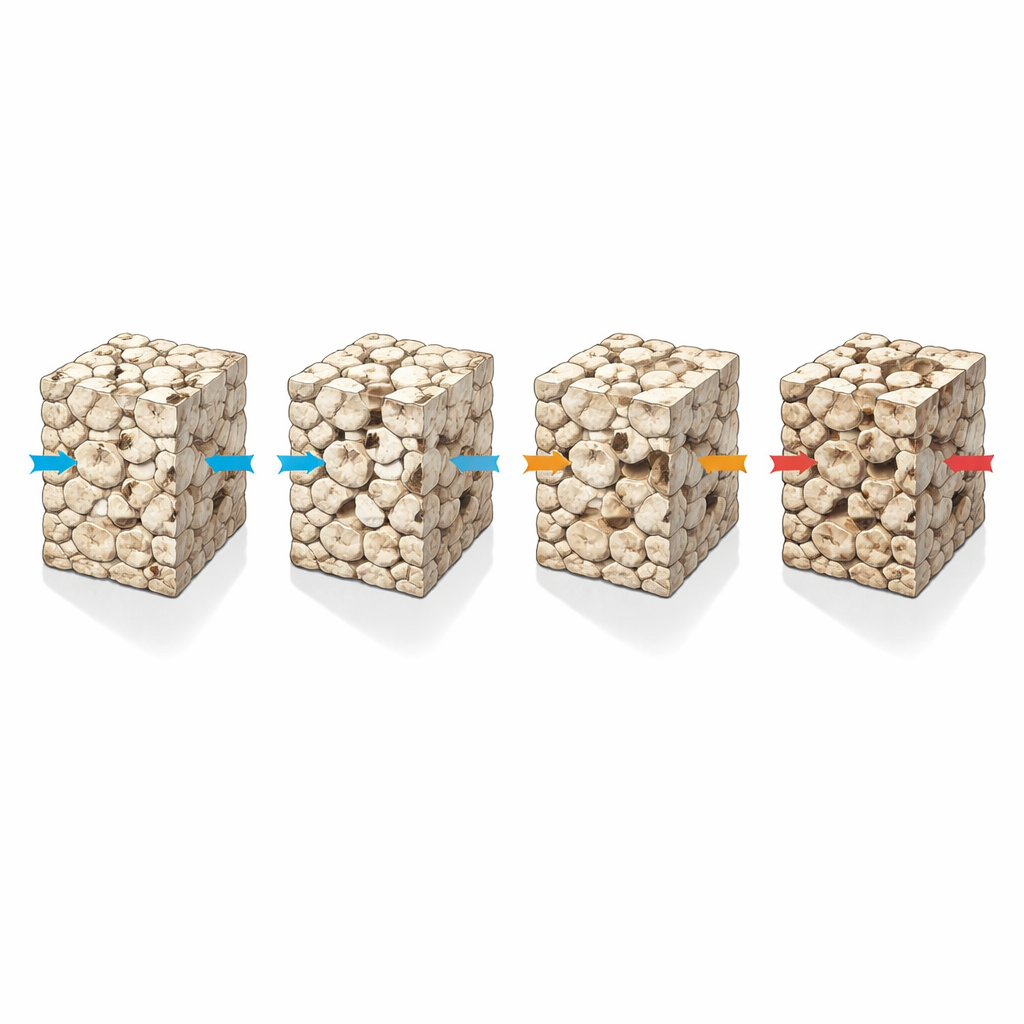
Energy stored, energy spent
The authors also tracked how much mechanical work done by the press was stored inside the rock as recoverable elastic energy and how much was dissipated as irreversible damage and friction. For lightly treated or untreated sandstone, early loading mainly went into closing pores and defects, so dissipated energy dominated. But after extended acid exposure, the altered rock stored proportionally more elastic energy right up to failure—until internal damage became so severe that sudden collapses and plateaus appeared in the stress–strain curves. Across all samples, the total strain energy required to break the rock first decreased and then increased with treatment time, reaching a minimum around the same 12–24-hour window where brittleness was highest. This energy-based view reinforces the idea that moderate acidization promotes an efficient, snap-like failure, while over-acidization encourages more sluggish, energy-dissipating deformation.
Finding the sweet spot for safer, smarter fracturing
By combining mineral analysis, mechanical measurements, strain-based crack detection, and acoustic “listening,” the study concludes that tight sandstone has an optimal acid treatment duration—around half a day to a full day—where it is both easier to fracture and remains sharply brittle. Shorter treatments may leave fracture pressures too high, while longer soaks erode the grain framework and promote soft, compactive failure that hampers the growth of long, connected fractures. The new brittleness index, which focuses on the crucial interval from crack initiation to peak stress, offers engineers a practical tool for tuning acid pre-treatment schedules so that deep, tight reservoirs can be fractured at lower pressures without sacrificing the complex crack networks needed for sustained gas production.
Citation: Geng, W., Guo, S., Huang, G. et al. Evaluation and analysis of brittleness and acoustic emission characteristics of tight sandstone under the influence of acid-treatment. Sci Rep 16, 11693 (2026). https://doi.org/10.1038/s41598-026-45184-y
Keywords: tight sandstone, acid treatment, rock brittleness, hydraulic fracturing, acoustic emission