Clear Sky Science · en
Fluorescent emission profiles reveal interspecific differences in three Danube River Basin sturgeon species
Glowing Fish in a Changing River
Sturgeons are living fossils: ancient, armor-plated fish that once thrived in great rivers like the Danube but are now among the most endangered animals on Earth. This study reveals an unexpected twist in their story: under blue or ultraviolet light, these river giants quietly glow in shades of green and red. By treating this glow as a kind of optical fingerprint, the researchers explore whether invisible light patterns on sturgeons could become a gentle, non-invasive way to tell species apart, monitor their health, and support conservation and farming.
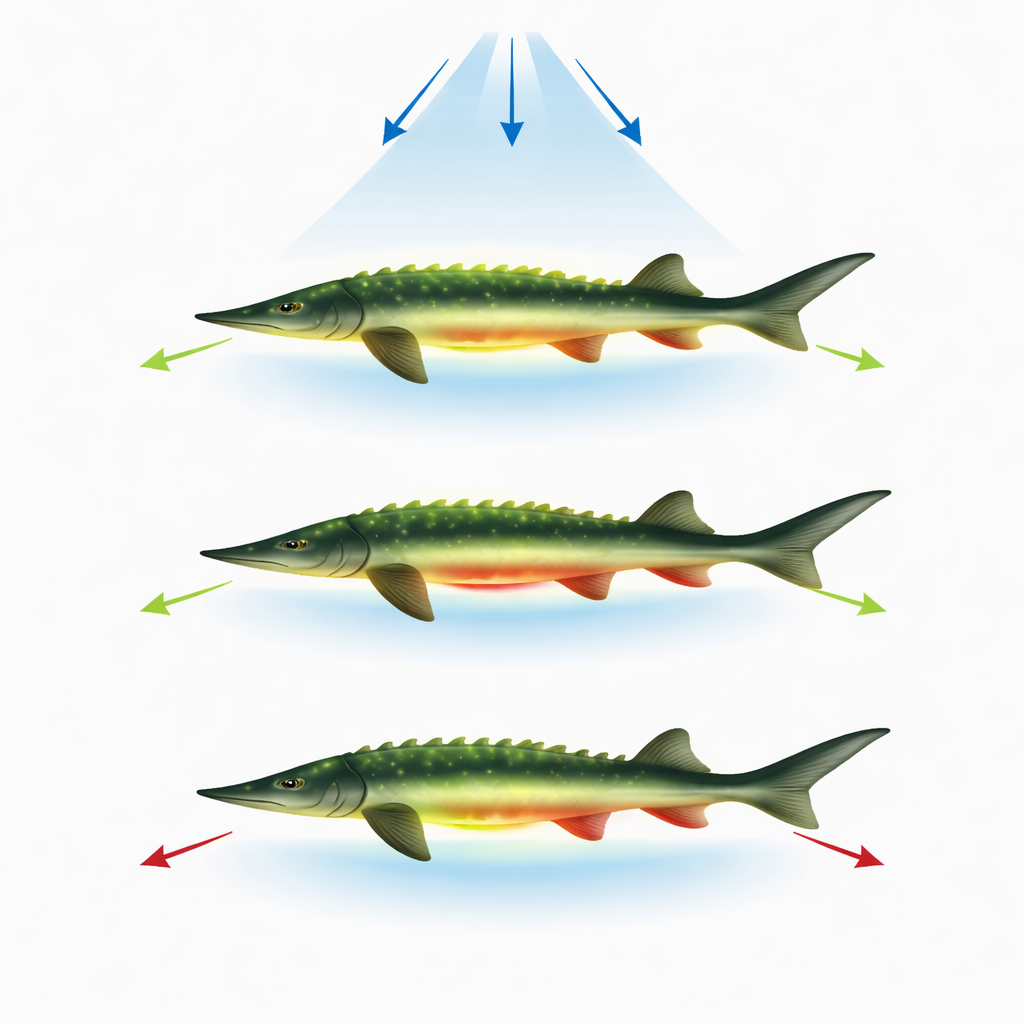
Hidden Colors Under Special Light
Many tropical reef fishes are known to biofluoresce: they absorb blue light and re-emit it at longer, often greener or redder, wavelengths. Until now, no one had shown that sturgeons do this too, even though they share some of the same pigment chemistry as other glowing fish. The team focused on three closely related species from the Danube River Basin that are important for both conservation and aquaculture: Russian sturgeon, sterlet, and stellate sturgeon. These fish are hard to tell apart by eye, especially as juveniles or when hybrids are present, and standard genetic tests are slow, invasive, and impractical for rapid screening of large numbers of animals.
How the Glow Was Measured
To uncover these hidden colors, the researchers used two complementary approaches. First, they photographed juvenile sturgeons under normal white light and then under intense blue or ultraviolet light, with filters that blocked reflected blue so only re-emitted light was captured. The photos showed clear green glows along the snout, body armor plates, fins, and belly, with each species showing a slightly different pattern. Second, they turned to hyperspectral imaging, a technique that records how much light is reflected or emitted at hundreds of finely spaced wavelengths per pixel. By scanning each anesthetized fish under blue light, segmenting out the background, and averaging across thousands of pixels, they produced a detailed “spectral curve” describing how strongly each species glowed across the visible range.
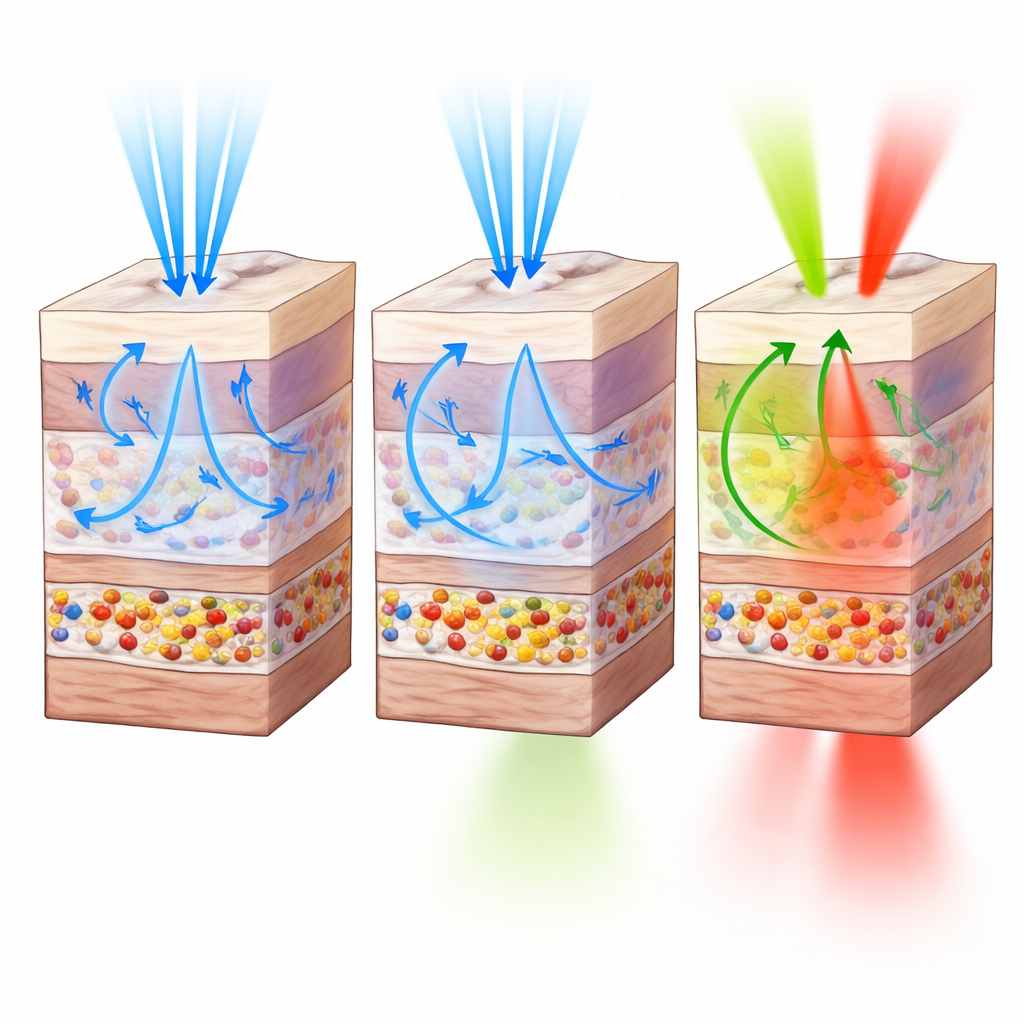
Different Species, Different Light Signatures
All three species showed a common structure: a strong peak where the blue excitation light was reflected, a distinct green emission around 550 nanometers, and a secondary, weaker red emission extending into the far red. But the balance between reflected blue and emitted green and red light differed among species. Stellate sturgeon reflected more of the incoming blue light and produced comparatively weaker fluorescence. Sterlet did the opposite, reflecting less blue but glowing more strongly. Russian sturgeon sat between these extremes but showed especially robust emission in the shorter green range. When the team used a statistical method called principal component analysis to condense these patterns, individuals grouped cleanly by species, confirming that each type of sturgeon has a repeatable, species-specific fluorescent profile.
What Might Be Shaping the Glow
The glow was not uniform across the body. It clustered along bony scutes, the rostrum, and ventral regions, echoing the sturgeon’s unusual skin: thick, collagen-rich tissue reinforced with hard armor plates and specialized sensory structures. Such complex layers can bend and scatter light, keeping it near pigments longer and boosting local fluorescence. The authors suggest that structural differences in skin layers, the arrangement of reflective cells, and pigments related to bile breakdown may all contribute to how and where each species glows. They also note intriguing hints that sex or physiological state might influence fluorescence, although this study was not designed to test those ideas and did not treat glow intensity as a direct stress indicator.
New Light for Conservation and Farming
For a layperson, the key takeaway is simple: sturgeons carry hidden, species-specific patterns of glow that can be seen and measured without harming the fish. This study delivers the first proof that such biofluorescence exists in these ancient river dwellers and that it varies in a structured, meaningful way between species. If future work links these patterns reliably to identity, sex, or health, farmers and conservationists could use cameras and specialized lighting—as opposed to needles and tissue samples—to track which species and lineages they are raising, spot unwanted hybrids, and possibly flag early signs of trouble. In other words, the quiet glow of sturgeons could become a powerful, gentle tool to help bring them back from the brink.
Citation: Juhasz-Dora, T., Ljubobratovic, U., Kovacs, G. et al. Fluorescent emission profiles reveal interspecific differences in three Danube River Basin sturgeon species. Sci Rep 16, 12713 (2026). https://doi.org/10.1038/s41598-026-45170-4
Keywords: sturgeon biofluorescence, hyperspectral imaging, Danube River conservation, fish aquaculture, non-invasive monitoring